Through my eyes

living my life without regrets

Thursday, January 21, 2016

Igoumenitsa, - Ηγουμενίτσα - GR / Brindisi, (I)

Igoumenitsa,  -  Ηγουμενίτσα  -  GR  / Brindisi, IT

Riding in Greece is a breeze if you take the highway, yes it’s a toll road, but worth it. The ride today was wonderful, despite some rather dense fog when we left Vergina. We rode past high, tree covered mountains. I never thought Greece would be covered with forest. The local roads would have become a bit more involved. I am glad we chose the highway to make better time.

Our goal for the day is the coastal town of Igoumenitsa. It is a small ferry town linking to other towns in Greece or in Italy. We want to go to Brindisi, Italy. Our plan is to visit Pompeii, then shoot north towards Germany. It beats going along the eastern side of the Adriatic Sea, with too many potential border crossings along the way. But first we need to get tickets for the ferry. I looked on line but found it too convoluted, too confusing to book the tickets via computer.

So we decided to just go to the harbor and book our tickets in person. We booked a hotel via Bookings.com and we arrived ‘early’ in Igoumenitsa. Our room was being worked on but yes, it was ready. From the hotel we could walk to the counters of the ferry companies to see who had the best rates, or the best times, etc. Or so I thought. All of the buildings and the port building itself are brand new, look modern and there are lots of options to book a ferry. When we walked over on this Thursday most of the ‘offices’ were closed. We asked who sells tickets to Italy, to Brindisi and were lead to just one ticket office. There is no real option to buy from selected companies. We were faced with the one choice and we bought the tickets. The price was 74 Euros for each of us. The ship would leave at 1 AM, next day. Yes, you read right, 1 AM (just after Midnight).  Immediately I thought why did I book a hotel room? There is absolutely nothing to do at the port. It’s a big parking lot with offices around a central space. So now it is something like 1 PM and in 12 hours we are on the ferry ship. What do we do here?

So am I glad I have a room to go to? Sleeping is a bit out of the question, the day is way too bright. We go back to the hotel and we are the only guests. We read some. We look out the window from our 3rd floor room and there is nothing to look at. I try to nap, no good. We walk to find a place to have some food, there is just one place open and we eat ‘something’. We go back to the hotel and just wait. We close the window shutters, set the alarm for Midnight and try to sleep. Impossible, I worry too much I will not hear the alarm and I toss and turn. Ah, after a while we open the window again, and read some more.
First In Line For The Ferry 
There is no way to book a hotel in Brindisi, Italy right? Well, there is! OK, I tried and found a hotel that suited me; I was pretty sure we would make Brindisi; now that we had our tickets so I went ahead and booked it. Hotel Orientale. We just laid on the bed and read but then, before I knew it, it was 11.30 PM. We had slept somehow and woke up despite all of our planning.

We were asked to be at the ferry by 12.30 AM and we were there at Midnight, almost the first people in line at the pier. We waited, and waited. At 12.40 it started to rain, pouring rain. There was no place to hide; we were standing on a very large parking lot, immediately at the water’s edge without protection of any kind. Luckily our riding gear is waterproof. It poured down on us. Other motorcyclists who showed up were not wearing rain-gear and were soaked to the bones.

We made the mistake of trying to enter the port building to get out of the down pour and almost got locked out from the ferry. We got in to the building OK but to exit, to get back to the bikes, when the rains somewhat abated we had to go through the border crossing again, and we had left our tickets with the parked bikes. A bit of talking, sign language and finally we were back standing in the rain, waiting for the ferry.
Blue Light In The Lounge
Finally, at 1.30 AM the ferry ship becomes visible. Now the hectic loading starts. First everybody gets off the ferry, and then the passengers without vehicles go on first, then the heavy trucks, then us, the motorcycle riders, then all the cars. It is a bit chaotic. Carol and I are given a spot along the walls of the ship to tie down our bikes, it takes time, it takes ingenuity, and the straps to tie the bikes down are not really made for bikes. I improvise, we should be OK.


People Piled Themselves On Anything
Now we need to climb the narrow staircase to the lounge but by the time we get there, most if not all the seats are taken because many other passengers are stretched out across 3 or 4 seats. This is an eight hour ferry trip. Where do we store ourselves? Carol asked a lady from the ship and she finds 3 seats together for us. They are small seats, like airplane seats. The whole room is crowded. There are so many people on this ferry that people crash anyplace and just lay down on the floors and try to get some rest. Blankets appear, kids hug their parents, and couples find each other and cuddle. It is definitely not organized.
They Slept, No Matter Who Watched 
Some Had Their Bedding With Them 
The ferry takes off and we are very lucky. The sea is calm and there are no waves, no storms. I can just imagine how a trip like this could be in a storm. For me it was a bit of a hellish trip. I do not like to travel when ‘humanity’ lets itself go and becomes unorganized. I know a trip like this could be a lot better but we were stuck with the tickets we bought. The next time I have to remember to not get a hotel room beforehand, to not sleep beforehand but to buy a sleeper berth on the ferry for the 8 hour duration. It would be a lot better and a bit more comfortable. Carol and I did the best we could while being caught on this ferry ride but it was not something I like.


Once we landed in Brindisi, we just had to find the hotel, get the bikes put into the garage, find a place to eat and take the rest of the day off. Well it was not that easy finding the hotel, we had to conquer cobblestone streets and back alleys. We asked directions, and turned around on a step hill and rode against a one way street, etc., but…hey, Brindisi is a nice Italian town, the hotel itself was 4 stars and we made it to Italy. We finished moving into the hotel, settling the bikes, eating a salad for lunch and by now it was 1 PM. Nap Time! We woke up at 7 PM and blinked. Some long nap!
Dinner was Pizza and all of a sudden, Brindisi, a town I thought slept like Cinderella was quite awake. Southern Italy is more active at night, it is cooler, and it is the way people have lived here for ages. Every 2nd shop sells ice cream so we had some, too.

Tomorrow we are off to Pompeii; this ferry crossing did screw me up with my sleeping patterns.


Vergina, Greece (GR)

Vergina, Greece (GR)

Picture Postcard Perfect
We are not really visiting Greece, we are now trying to make time to get back to Germany, to get over the Alps before we find ourselves snowed in and unable to cross since we are now into October. On the one hand that is true, on the other hand we do not want to scream down the highways to get to Germany. Yes, we do not dawdle but made up our minds to just stop here and there because we feel like it. Vergina was on our way and we stopped here just to get a quick overview. 

Vergina was the capital of the Macedonian Empire.This was a huge town in its time, with lots of history attached. Today it is a small village. Alexander the Great’s Father (King Phillip ll) was King here and was assassinated here. His tomb is a tourist attraction but you would not know it. This is also the spot where Alexander the Great was crowned King after his father’s assassination. Greece has so many ruins, spots to visit, history galore that this village of Vergina is just one of many spots on the schedule of history hunters; the tomb being just one more tomb for tourists to visit. 

It was not busy when we arrived on this very overcast day. We had ridden along E90 and had to stop for the night, so why not here? The Olympia Guesthouse was perfect for us. The way to find it was by asking locals. Not that easy to find but also not too difficult. Once we left the Highway we came in on very, very local roads. At one point I thought we were wrong, but no, our GPS led us and all worked out just fine. Still, do you trust your GPS explicitly? The reception we received at the Olympia Guesthouse was exceptional. Free cake and coffee, a warm smile, it is the Greek way of greeting guests. Oh, if only we could stay in Greece for awhile, I love it in Greece. Carol and I decided that this might be our goal for next year. 


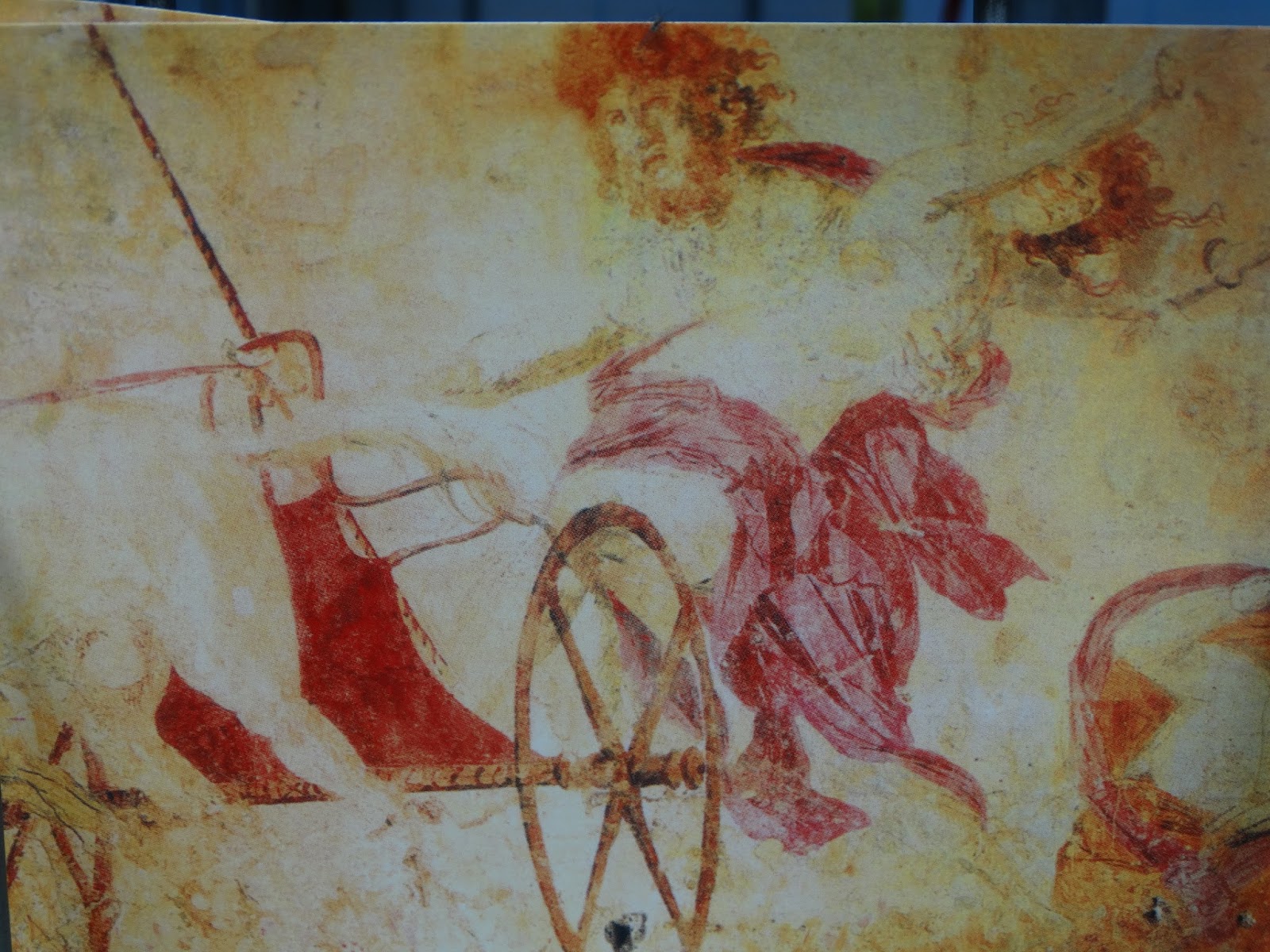
Even Then They Had Great Artists
I Am Glad They Wrote In Latin Script


I learned while visiting the tomb of Phillip ll, that he was murdered because of his ambition to put a statue of himself among the statues of the gods. Someone did not like this at all and killed him, thinking him not to be godlike. He was not; he was a brutal ruler, a killer and an egomaniac. Makes me wonder what his son, Alexander the Great, was really like. Never mind the history stuff people tell me, what was Alex like as a human being? Probably not someone I would have wanted to meet, I guess.
Note The Sun Detail On Top, The Symbol of Macedonia 
The actual metropolis and the Royal Palace are just ruins today. The whole area is not even fully excavated. The locals told me that the ruins were used in years gone by as grazing grounds for sheep and goats but now the Greek Government has fenced the area in. Nobody is allowed to go inside the fenced area to protect it from further decay. Digging within the old ruins is forbidden.  The village is very small, living totally off tourists.

Pretty Urns, Love The Colors


We ate at a very local restaurant but the food was heavenly. I like the Greek kitchen. No matter what I eat, it’s great! Again, we received some small desert for free. How can you beat the  Greeks for hospitality?

Saturday, January 16, 2016

Good Bye, Istanbul, TR

Good Bye, Istanbul….. See You Again Soon!

We are running out of time, it is early October but we have to cross the Alps to get back to Germany. We are aware that we could get snow in the Alps. So even though we did not see everything there is to see in Istanbul, we planned to leave and just ride into Greece. It can be done in just a few hours. From Istanbul to just across the Greek border is a good ride and we are off, after having said good bye to the nice people at the Sultan Hostel. The bikes are OK, all packed but we have to find our way out of this chaos of streets and traffic. Again, I have a general idea of which way we have to ride but when I say traffic, I mean lots and lots of traffic with poor signage to find Greece. We took off through the old part of town, finding some tight roads and narrow alleys. Double parking, carts being pulled, taxis honking, people walking in the street, buses, trolley tracks, you name it, Istanbul has it. I know there is order somewhere but it is hard to find. Our GPS is not made for Turkey; it just gives us the basic, main roads. There is lots of road construction going on and I can only guess which way to go. I get a little lost but somehow we end up on a highway that runs along the edge of the Marmara Sea.  

There is something written on the pavement and it looks like it is for ‘special’ traffic only. I cannot read it, of course, it’s written in Turkish. Carol and I talk about it over the intercom and we decide ‘what the heck, we’ll keep on going’. Lucky us…..we had a good stretch inside busy Istanbul on this road that moved us ‘fast’ out of the heart of the tourist section and yes, we were on the right track to make Greece today. I still have no clue if we were allowed to be on the ‘Kennedy Boulevard’ or not, but we rode it to get out of Istanbul. While it took us 3 hours to get into Istanbul, it only took us 1 hour to get out; much faster than I anticipated. The border crossing into Greece was easy. Carol had a good chat with the Border Guard who told her ‘I love you’ because he was amazed to see a woman riding a bike. Well, maybe it was the woman’s age that got to him (harrumph); he could see Carol’s birth date on her passport. 

As is my habit, once we were in Greece we did not ride that far. I had made no Hotel Reservations, because I learned to not anticipate where or when we will arrive in the new country. Finding a hotel was easy enough. We asked a local man in the next bigger town of Alexandropoulos (Αλεξανδρούπολη) and he told us where we could stay for the night. The city is relatively new; it developed from a fishing village to a modern Greek Port. The hotel was new, the lifestyle was Greek, and we are now into the Greek way of life; quite different from the Turkish way of living.  Already I like Greece, it would even be better if I could read the writing; Yuk, another alphabet.
It truly is all Greek to me!     είναι πραγματικά όλα τα ελληνικά σε μένα!


Palace in Istanbul, TR

Topkapi Palace 
Palace in Istanbul, TR

The whole of Istanbul, especially the spot where the Topkapi Palace now stands is near the waters of the strait of the Bosporus, a very narrow body of water allowing ships to travel from the Mediterranean Sea to the Black Sea. This is the only sea access to Russia. Istanbul spans both sides of this strait, one side being Europe, the other being Asia. This location is a very, very strategic location; it splits the town into two main sections. Controlling the nautical traffic but also the crossing across the Bosporus by land, made, and continues to make, this an ideal spot for controlling traffic. Long before the Ottomans, the Byzantines, the Romans and the Greeks, people knew this was a great location. The Ottoman Sultans knew exactly why they had to be in Istanbul at the exact spot of the Topkapi Palace. This location, this Istanbul, was a Toll Booth. Heavy tolls were issued for any ship to pass through the Bosporus. Heavy tolls were charged to cross the Bosporus on land, too. Nobody could just cross the river via a bridge like Carol and I did. Only in the last century was it possible to build a bridge spanning Europe and Asia. You can see on the map how important a location Istanbul really is.


Even the Greeks established a town in this spot and some evidence suggests that the exact spot where today’s Topkapi Palace stands was the exact spot the Greeks had their town. We had to make a choice what to see first, or what was the most desirable item on the list to visit. When we finally came to the last day in Istanbul and wanted to visit this Topkapi Palace, we found it to be closed for the day. At first I was upset at not being able to see the Topkapi Palace, the seat of the Sultans of the Ottoman, but then…. It is a great excuse to return to Istanbul again. I mean, how can we not see this Palace with the harem and all?


Grand Bazzar. Istanbul, TR

Grand Bazaar, Istanbul, TR 

Is this an ancient mall?  Yes and No! It is a shopping spot alright but it ties in with the social structure of the Middle East; with an ancient way of living, with how things were and are done for the benefit of all. 

Just after the Ottomans took over Istanbul from Constantinople, the Sultan had a Cloth Market built, run by guilds. It opened up in 1461 and is today’s Grand Bazaar. It was a covered, indoor place that was open all day, but at night was watched by guards. The Sultan guaranteed the safety of the stock within the building. In all the years this market, even as extended as it is today, has had very, very few thefts. There has been damage from earthquakes and fires, but that is a different calamity. That is over 550 years of selling items.
Map of the Grand Bazaar
The bazaar attracts so many customers, has so many shops, that it is not just a tourist attraction (90 million plus visitors annually) but it seems to be the heartbeat of the city. The whole area in and around the Grand Bazaar is teaming with activity. Sure the old building is rather quaint and outdated in many ways but it is Istanbul, it is Turkey, it is the Turkish lifestyle you see when you visit. There are no bathrooms, so plan ahead. This is not a place with lots of eateries either. There are some, but they serve the most basic foods and there are few areas to sit down. The concept of eating while shopping was foreign to the Ottomans; that is a new Western Idea. No, you do not have the usual stores you see throughout Istanbul. This is not an electronic articles wholesale place. A lot of items you see you might never need, but they are for sale here. Not really toys, not really lamps, not really jewelry like Tiffany but a lot of jewelry. Yes, you can buy carpets. Yes, you can buy clothing. Yes, you can buy spices and leather.  You ask about the style of the clothing? Well, this is Turkey! It is a different taste level, a different way of looking at what you might need. You can buy a lot here, they have thousands of shops and each is packed with merchandise.  Yes, you should bargain, we did. We bought tea; Alma Chai (Apple Tea) and it is very, very tasty and good. But it takes a bit of time to bargain and conclude the sale. It was not prepacked, it had to be weighed and then packed in a baggie. It’s the old way of shopping. You might get to know the stall owner; he then takes care of you. It is more personal than shopping at a mall; it is different than shopping on 5th Ave. in NYC.

The above short video shows the highlights of Istanbul including the Grand Bazaar (about 1/3 of the way in) and the Blue Mosque (almost at the end).

Carol and I are jaded. We do not need a thing. Everything we look at that has tangible value in our eyes is just ‘stuff’. We are the worst shoppers you can imagine. But we bought something (Alma Chai), like I said before. It takes time to find, it takes lots of smiles, lots of talking to salesmen. You can get bargains if you know how to shop. For shopaholics it is a wonderful place to find a lot if items. Carol and I just wandered around, watching others. That was fun for us, too.

It is a must see place no matter what you might think. It is a place that belongs on each bucket list, no matter your age or outlook on life. The Grand Bazaar is a must see.


Tuesday, January 12, 2016

Whirling Dervishes, Istanbul, TR

Whirling Dervishes

Large Mural of Folk Dancing
Carol read about the Whirling Dervishes and wanted to see how they could be just spinning in place, not getting dizzy and not falling over. It is amazing to think about. To spin for hours, holding one’s body in a strict position seems impossible to do. We wanted to learn and to witness this feat in more detail.

The Dervishes have ceremonies one can visit and watch, but it is not an entertainment, nor a lightly taken side show. Applause is not permitted, nor are pictures. The men who dance and swirl for hours on end, use the swirling to get into a trance-like condition to pray. To be in contact with another reality, to drug themselves with dizziness to feel ‘different’. To understand all of the implications of the spinning and swirling is difficult to grasp. It is mind control, it is a different dimension. The Persian Mystic Rumi wrote about it extensively.

We visited the “Sema Istanbul Dervishes” in the Hodjapasha section in Istanbul; a section just before leaving Europe and going into Asia.   (www.hodjapasha.com)   This area today is a cultural pocket set up for the arts, deep within a back ally. It was a surreal experience to have visited this service.

The Spinning Dervishes are a mythical order of Sufi Islam, a small hybrid of Islam but so important that the whole order was incorporated into the Unique “Masterpieces of Oral and Intangible Heritage of Humanity” listed by UNESCO.  We witnessed a ‘SEMA’, a ritual, a spiritual journey. In the Universe, everything, from atoms to the solar system and to the blood which circulates in the body, revolves.
Sema - This One Was For Entertainment So Pictures Allowed

No Matter the Color - Also For Entertainment
Sema is a ritual, a spiritual journey which the soul makes to God as it becomes mature and attains unity. After this journey, it returns to its life to serve humankind again.
This spinning, swirling dance, is a prayer; once entered it can (will) bring the Dervish closer to the mysticism of the love for the Divine in ourselves in every minute of our lives. There is much symbolism along the way. There are many stops on this journey, seeking guidance from all around the universe and even from death.

According to the founder, Mevlana, (Rumi) in the early 13th Century: “When you enter the Sema you will leave both worlds; the world of the Sema is outside both worlds.” It takes study, it takes dedication, and it takes understanding to fulfill this ritual, this journey.

Carol and I were sitting, mouth agape, trying hard to understand and follow each person during their prayer service. Each body position, each clothing part, each step had its meaning and we were clueless yet knew that we were seeing something few will see in their lifetime. We were witnessing the spirit of humankind shown to us in a dance form that far exceeds what we ordinarily do in our daily lives.

At the end when the music stopped, the praying men left, the colored lights went out, we walked back to the trolley, unable to really speak to each other. It was a very personal, deeply rooted experience that each of you, reading this, should experience at least once in your life time.
Not Christian or Jew or Muslim, not Hindu, Buddhist, Sufi, or Zen. Not any religion
or cultural system. I am not from the East or the West, not out of the ocean or up
from the ground, not natural or ethereal, not composed of elements at all. I do not exist,
am not an entity in this world or the next, did not descend from Adam or Eve or any
origin story. My place is placeless, a trace of the traceless. Neither body nor soul.
I belong to the beloved, have seen the two worlds as one and that one call to and know,
first, last, outer, inner, only that breath breathing human being.
Mevlana Rumi (1207 - 1273)


Basilica Cistern, Istanbul, TR

Basilica Cistern, Istanbul, TR, - Dervishes -


The city, Istanbul, is very old. For centuries people lived in close proximity to the sea but there was always a need for drinking water. So how did the Ottomans handle the lack of fresh drinking water? There are not enough rivers or lakes to supply the need for water by millions. Carol and I found out about the ancient methods, still used today. There are many reservoirs strategically placed below ground throughout Istanbul.

The old water reservoir we visited, the Basilica Cistern, was built as early as the 6th century when Istanbul was still named Constantinople.  The spot where the water is stored today was a Cathedral in the 6th Century and when this Cathedral burned down it was converted to a Reservoir. The details about just this one water storage place are mind-boggling. I have the feeling that Istanbul, like Rome, Athens or Damascus, has many layers below ground that are hardly visible. 
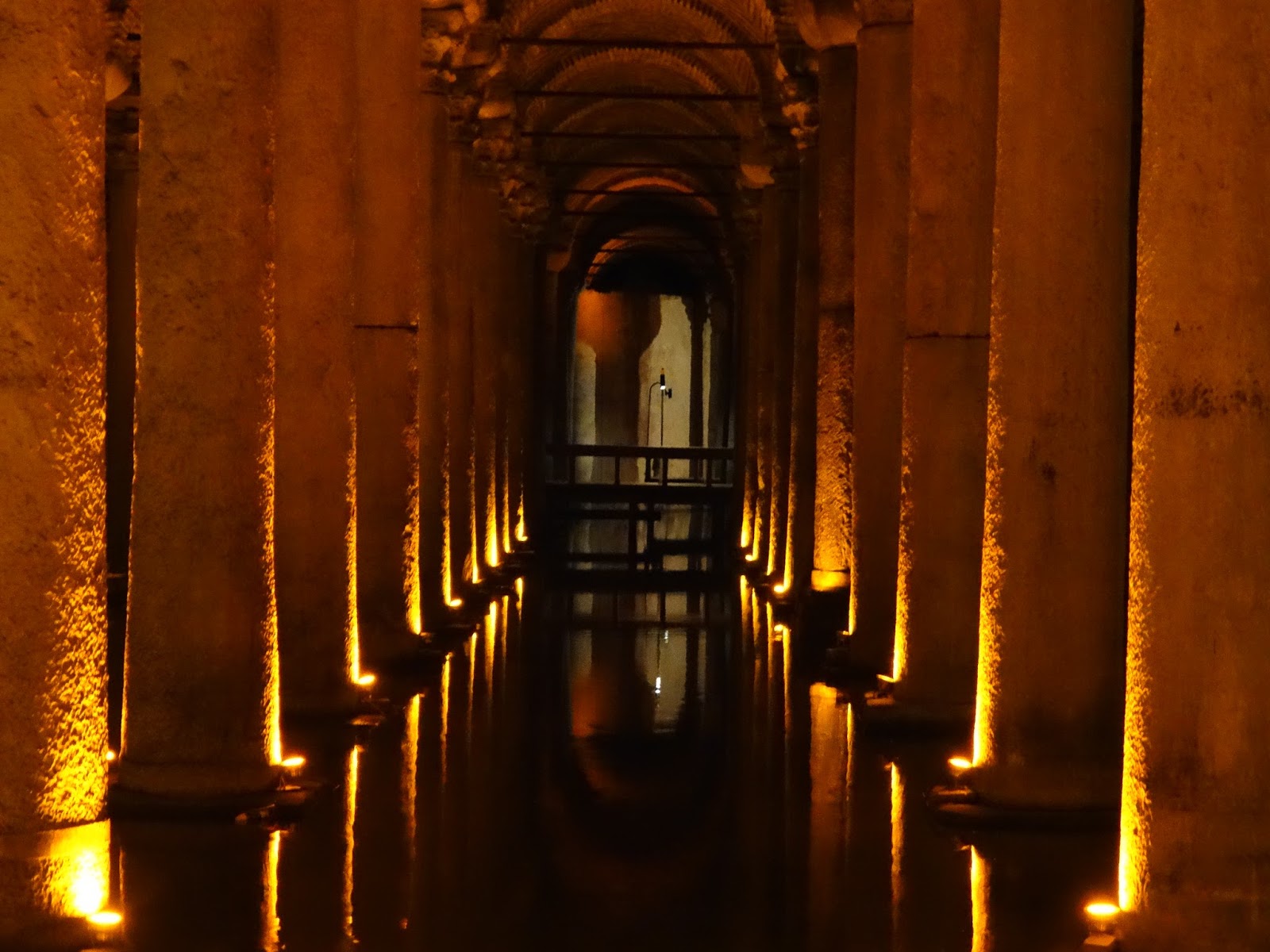
The Cistern Is Huge And The Lights Make It Look Romantic 

The Basilica Cistern From The Outside
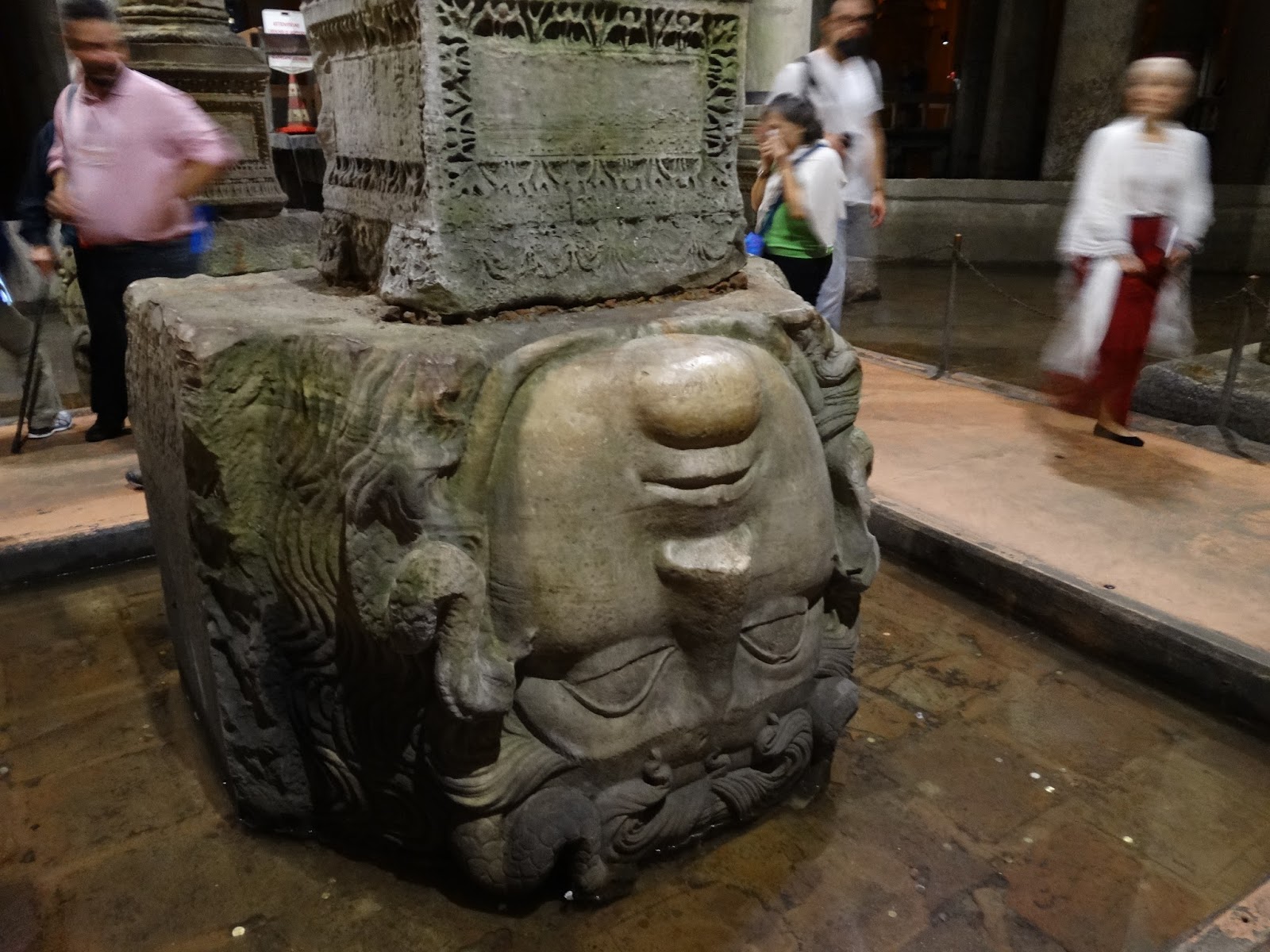
I was told that 7000 slaves were used to build this huge holding tank. To find columns, to find any other building material, the ruins of the burned down Cathedral were looted and anything the people could find to make building easier was used to build the water reservoir. While we visited we saw a mix of these columns within this cistern. One of those columns had an upside down carved head of Medusa as a base. Another column had another Medusa head placed sideways. Some columns had ornate decorations of the Evil Eye (supposed to ward off evil Spirits). The whole installation was huge. Capable of holding 2.8 million square feet of water, this Cistern sure helped with the water usage. Most of the water stored was rain water.

Today, instead of relying on just rain water Istanbul recycles water very carefully. This ancient installation just serves to show how it used to be so some water is kept in the old Basilica Cistern. Today’s water comes from deep wells far away and is being pumped into Istanbul. But rain water and recycled water are the main sources for Istanbul’s water.
The Fish Are Blind 
Fish swim and spawn in those waters.

 Many of those fish have lived inside the holding tank for so long they can no longer see. They have lived and bred inside the cistern for generation after generation, living always in the dark. Those fish cannot live any place else now, they must stay in the cistern. It is a strange ‘evolution’.
here
You Must Turn Your Hand 360 Degrees To Get Good Luck


Visiting this old Cistern, built so long ago by slaves, left me in awe of the energy that was expended to make Istanbul the stronghold it is. This cistern is extremely large, even a bit eerie. I imagined the light failing while being deep inside it. A touch spooky! (I always have a working flashlight on me). Yea! 

The seeing eye column is said to bring good luck "IF" you can turn your hand a full 360 degrees around the 'eyeball'.

Carol could do it, too !
Good Job, Carol !
Move Away A Bit And It Gets Darker And Darker 

Dark In Some Spots, EERIE !!!!
Medusa's Head On Its Side As The Base For One Of The Columns
Upside Down Medusa Head Is The Base Of Another Column
Elegant Marble Columns With Decorations Were Used Inside The Cistern


Istanbul's Blue Mosque, TR

Istanbul’s  Blue Mosque, TR


Bike covers and cats don’t go together. When we checked on our bikes in the morning we found that now Carol’s bike cover was ripped to shreds by a cat too. I guess some cats used her covered bike as a spot to be out of the weather but then, when the winds flop the fabric, their claws swat at the ‘moving’ fabric and the damage adds up to rips after rips. OK, it depends on the cat, but most stray cats are ‘mousers’ and they have done a job on both of our covers now. What is the best way to cover the bikes then? The nylon covers we have will not work, that is for sure! We found our bike covers damaged before we started the day. Not a good way to start the day.

Minaret - A Finger Pointing To Allah??

At Dusk All The Lights Go On 

The 'Blue' Tiles Inside The Mosque 
Our plan today is a visit to Istanbul’s famous Blue Mosque. Actually there is not much ‘blue’ to the Mosque and no Turk ever called it the Blue Mosque. It’s just a Western name given because there is a lot of ‘blue’ in the 21,000 tiles used throughout the buildings. As a Westerner the Islam religion is a mystery, not understood by me. Oh, I understand the concept of Allah, of the Prophet, praying 5 times a day, having a belief system that contains 5 major points like:  Allah is the only God; Muhammad is the Prophet, praying 5 times a day, giving alms to the poor and going once in your life to Mecca (haj). I am sure there are other things that define Islam. I am sure there are many subtleties, too. That is why there are Sunnis, Shia and other smaller, mythical groups of Islam, each having a different outlook. We hear about the extremism almost daily, is this extremism here in Turkey, too?  Can I see something in their house of prayer, their mosque that is an indicator?  I will go and take a look, see what there is to see without being judgmental, I hope. No, I have no interest in turning into a Muslim. I explain why at the end of this blog.

Everybody in Turkey knows it as the Sultan Ahmed Mosque because it was built in just 7 1/2 years (1609-1617) by Sultan Ahmed I. It is yet another amazing building, not far from the Hagia Sophia and not far from the Royal Topkapi Palace. The young Sultan was just 19 years old when he gave the order to start building and he himself worked as a laborer for a while.

The main design follows the ideas of the Great Turkish Architect Sinan, but in charge and adding to the details was Sinan's  pupil, the Architect Mehmed Aga. Not only is this building complex a mosque but in accordance with Turkish tradition, it is a ‘kulliye ’, an extended mosque that includes a hospital, a madrasah (school), a bazaar (market), an imaret (soup kitchen) and a tomb for the members of the royal family. Other buildings like the ‘time house’ where astronomers predicted and calculated the times for prayer and other Islamic events were added, too.

As always when one enters a mosque, shoes come off, feet, hands and face need to be clean and the body and hair (for women) should be covered to a strict ‘decency’ level. The attire requirements are different for males and females. Carol knew about this and brought her own scarf to cover her hair, and had dressed conservatively. Many people in the long line who wanted to get in to see the mosque, needed to ‘rent’ dresses or hair covering. I have no objections at all to doing as told. It is their house of prayer, it is their belief, and it is their way of doing things. I felt like a guest and behaved accordingly. The long line we stood in moved along slowly but when we entered the mosque proper there was a service going on and I felt like an intruder and did not participate in their service. I just watched discreetly (if that is possible) from afar. I do the same in a Christian church when services are in process. I do not participate, I just sit and try to blend in somewhat. Not knowing what to do at all in an Islamic mosque I did not enter the mosque proper at all, nor did Carol. There were sections that were open for the public but with so many people (tourists?) around it felt a bit awkward, I felt like I was a disturbance, rather than a visitor.
             Praying Is Segregated

Still, I must admit this (blue) Mosque is a rare example of the grandeur of the Islamic world. Nothing was spared to make this a one of a kind building in the honor of Allah. It is a true spiritual representation of Islam.
Quotations in Arabic, taken from the Quran, decorate the top of huge pillars. Arabic ribbon like calligraphy runs along the periphery of the walls.
The Mosque has certain sections and all make total sense. I will list some of the description of these areas. It’s a bit detailed but I found it interesting.

There is the Mihrab, a niche; it looks like a cavity in the wall of the structure. This is the direction towards Mecca, towards the Kabah. This is to be faced when bowing down to pray.


The Minber 
There is the Minber, a pulpit, it looks like a staircase. On top of the staircase is a large platform from which the sermons are delivered every Friday at noon, at the feast of Ramadan and the feast of the Sacrifice. On these occasions every healthy Muslim is encouraged to attend. The Muslim belief actually tells them it is mandatory to attend, women as well as men, but women are given opportunities not to attend. On high holy days, the Sultan Ahmed Mosque holds about 12,000 people inside the main hall and main courtyard. It is a huge space.

Kursi Chair 
There is the Kursi (a chair) from which talks/lectures on religion are given by scholars. The chair at the Blue Mosque is covered in Mother of Pearl. This chair, I was told, is not always occupied, just on very busy days.

There is the Muezzin Mahfili (Muezzin’s Lodge). After the call to prayer from the minaret, the Muezzin comes down the stairs quickly and again, inside the mosque now repeats the call one more time, standing on this raised platform, this lodge. This elevated position within the mosque allows the muezzin to see the Imam and allows his voice to be heard well by all the assembled people. After the ritual prayers are finished the muezzin recites certain words 33 times. They are glorification and praise. To not lose count the Turkish culture uses prayer beads to help them count.  This process is called tasheeh. 
Muezzin Mahfili

There is the Hunkar Mahfili (Royal Lodge), a section within the Mosque that is walled off but one can see inside through ornate, carved screens, where the Royal House used to pray along with the most important ministers. In history Sultans were killed while praying and to make sure this would not happen again, a protected, screened room was installed to give the Sultan and his family some protection. It has its own entrance too.

The Imam I Spoke To 
The whole installation of the Blue Mosque is very active. In order to learn a bit more about the religion, I asked for an audience with an Imam and had a nice chat in English. I do not pretend to know much about Islam and was intrigued. One fine point I had was a question on this point:  when the prophet Muhammad was told to write down what he was told by Allah how could he write it? As a simple shepherd or merchant he was not literate. If someone else wrote for Muhammad, like a scribe, where are those written records today?  Ah, the stories about this are long and nobody really knows, but we had a nice discussion. I left the mosque with a smile on my face; it is a very holy, very nice place. The Imam was helpful and gentle.

I found a brochure that has the meaning of the call for prayer words (the translation in English) and I wanted to write it so I don’t forget: Again, I found it and I just had to remember this:
Here is what is being called out 5 times a day in all of Islam from the minarets:

Allah is greatest. (4x) - (called out 4 times in succession)
I bear witness that there is no god except Allah. (2x)
I bear witness that Muhammad is the Messenger of Allah. (2x)
Come to prayer. (2x)
Come to success. (2x)
Allah is the greatest (2x)
There is no god except Allah
The first call in the morning has an additional line which translates:   Worship is better than sleep.

It was a very good walk through the complex. The Blue Mosque Complex is huge and again, one could spend days learning about all the details. It would help a lot if I knew more about Islam but I have a natural tendency to be against all religions. I do not believe an Imam, a Priest, Minister, Rabbi, Guru et al have any real idea what will happen to us in the afterlife. They just recite what they were told by their teachers and what they read by writers, and they use their own interpretations. Nobody knows! So organized religion is superfluous! Someone said it’s the opium for the masses. I believe in that saying!  I am not an Opium addict.


Tuesday, January 05, 2016

Istanbul, Turkey (TR)

Istanbul, Constantinople, Byzantine et al., TR


The Hagia Sophia Started As a Christian Holy Place
The Christian Church Became a Mosque 
Riding our bikes into Istanbul and finding our hostel was an experience! Before we even entered Istanbul we had to decide in what part of the city we wanted to stay for a few days. Istanbul is HUGE. Most people (Tourists) want to see the Sultanahmet area; the area around the Hagia Sophia and the Blue Mosque. And since we were tourists we were headed to that district, too. Sultanahmet is a large area, a whole district of Istanbul and it takes weeks to walk most of it. We only had a few days in town before we had to head back to Germany. Not that I felt rushed but I know I have to come back to Istanbul to see ‘other’ things. So we did not rush through, we meandered. Our ‘hotel’ was a hostel, the Sultan Hostel.   

This Hostel is centrally located, rated above 8.0 on most websites and a good place to stay when in Istanbul. It is not a posh place, it is a Hostel. We picked it because of its central location and the ease of getting to anything made it a good place to stay. I am sure there are other places, even better places, but we had a spot to park our bikes, received breakfast, had our own room with bath and the room was quiet. What else do we want? The price was OK, too.

The ride into Istanbul was difficult on a motorcycle. Cars veered in front of us to take an exit without signaling, tailgating seems to be a sport, signage is only for the initiated and there are just too many cars on the road, most of them sharing the lane we were in. It was tough on the nerves, clutch hand, brakes and eyes. You have to be totally awake to ride through Istanbul; there is not much room for error. Carol is a good rider, I can tell you that, she was a trooper and we made it to the Hostel alright. It helped a lot that I have been to Istanbul before; I had a pretty good grasp of the city and knew somewhat the direction we had to go. Still, because of road closures for construction, we got lost a few times despite the GPS and my knowledge of having been there, etc. If you go to Istanbul, study, I mean really study the maps. Once checked into the Hostel we never rode the bikes until we left Istanbul. Like NYC, there is no need for personal transport in Istanbul; you walk a lot, take trolleys, and hire taxis.


The sounds of the city are highlighted several times a day by the muezzins calling for prayer. Around the Blue Mosque are many other mosques and the calls are ‘timed’ so that when one call finishes, the other starts. It is quite pleasant to hear the muezzin call, very melodic and a bit romantic even. When it was prayer time, we did not go to the mosques however, we just found a bench or chair or table and sat for 10 minutes, giving the religious people their respect or due. We noticed that most people just kept on going on with their daily lives. Yes, this is an Islamic Country like Italy is a Christian Country but it is very, very secular. Here and there I saw women with a hijab, but most wore western clothing. I only saw one burka in the few days we were in Istanbul.
Hagia Sophia 
Islamic Details Are Amazingly Delicate 
After we had settled into the Sultan Hostel, we walked over to the Hagia Sophia. Entering the museum (formerly a Christian patriarchal Basilica and later an Imperial Mosque) I was overwhelmed by the huge space. What a building! To come to Istanbul and just visit the Hagia Sophia (meaning Holy Wisdom) would be understandable. This is a one of a kind spot on earth. The building is so large, so huge, so spread out that you could study the details for years and probably find yourself not knowing much. There is hidden history around every corner. Humanity has passed through its doors. From the earliest years in 537 AD until today many, many souls have visited this space. Never mind that this ‘Holy Wisdom’ place took almost 1000 years to build. It was and is a ‘holy’ place and a must visit destination.
This Is a Mosaic Made From Very Small Tiles

This Is An Islamic Mosaic With Absolutely Wonderful Detail
The Whole Of This Wall and Door Are Made Of Marble
We spent about 3 hours or more just gawking in awe, straining our necks to look up and about. We could see Christian symbols interspersed with Muslim symbols. I even sat down on one of the few benches along the wall and just watched people. We took too many pictures, but I could not help myself. Carol was in her glory, this is her kind of place, full of history and beautiful mosaics. On an upper level we found the wall-to-wall Marble Gate used by the Synod when entering/leaving their meeting rooms. On the upper level walls were beautiful glittering, gold-tiled mosaics of Biblical scenes or Imperial portraits. There are just too many details to mention, this is a place you have to visit yourself and while here, take your time to see a lot of it.

I could go back to Istanbul just to visit the Hagia Sophia again and maybe I will do that in the future.

For dinner we ate at a ‘rooftop’ restaurant. We climbed rickety stairs, narrow and old to finally land at a terrace with a view of the Blue Mosque. It was twilight. We watched the lights being turned on to highlight the minarets, we heard the muezzin calling the believers to prayers. 

I looked at Carol, smiled and pinched myself. We are in Turkey! We are in ISTANBUL!
   

The Blue Mosque At Sunset From Our Table In A Rooftop Restaurant  

Monday, January 04, 2016

Kirklareli, Turkey (TR)

Kirklareli, Turkey (TR) 


I can read the signage in Turkey; it’s written in Latin Script. Kamal Ataturk was responsible for changing the old script to the modern Latin alphabet. Thank you Kamal!
We finally arrived in Turkey, the modern Turkey; our end goal. This Turkey today was the ‘Ottoman’ Empire; the Empire that lasted for more than 600 years. The Ottoman Empire was not a small blip in history, but a true power in the area. Compare that to the Roman Empire which lasted about 500 years, or the Greek Empire which was split into many smaller parts. All those dominant countries, after a while were no longer Empires but have left us with a great history. Greece, Italy, Turkey, Germany are just that, small countries today. There is no evidence of an Empire any longer but there is something about the people of Greece for example, that makes them different. Think of Italy, they have flair! And when I think of Turkey there is a wild strangeness, a smart calculating idea beyond their daily lives. I like Turkey; I have been to this Country before. And now I am back, getting more ideas of what Turkey was and is like.
The most obvious, immediate change noticeable is that the belief system changes drastically once you cross the border from Bulgaria to Turkey. Most of the people in Turkey are Sunni Muslims. But there are many Shia Muslims, Sufi Muslims or even non-orthodox Muslims, too. Not too many Christians, the Christians have left Turkey for the most part. When I say I notice a change in religion I don’t mean to say all the women wear Burkas or the men dress differently, or there is something written on their faces that would make you see something obvious, yet there is a feeling that this country, Turkey, is different. 
At the end of the Caliphate or the end of the Ottoman Empire, or during WWI, or between the two Wars, during WWII and even today, Turkey is in constant change. The reforms Turkey took upon itself are healthy and still ongoing. Kamal Ataturk, a pro-Western thinker, was most likely the most influential man in recent history. But Turkey always was on the cusp between the great religions, Christianity and Islam. Turkey is the buffer zone between the Near East thinking and the European thinking. Not that either of them are bad, they are just very different from each other.

To visit Turkey is a unique experience, especially visiting Istanbul, our final destination. But, as you might know by now, I take my time getting to my goals. Kirklareli, our first stop in Turkey gives me a bit of breathing room, a stop to take a deep breath before entering the very busy Istanbul proper.
For Carol this is her first time in Turkey and I do not know how she feels as a woman in a Muslim Country. I let her write a report on that if she wants to do it.

 Carol writes:  I had absolutely no qualms about entering Turkey. I know from my reading and from previous travelers to Turkey, that western women have no problems in this very tolerant Country. The only stipulation for women was to have hair, shoulders and knees covered when entering a mosque and everyone had to remove their shoes. My biggest fear had nothing to do with my gender but everything to do with the crazy drivers sharing my lane (in fact there were rarely any lane markings) and the amount of traffic flying past at insane speeds.

Kirklareli is a nice town. We had no Hotel reservations so we had to find a room for the night. With a little back and forth and asking people we did OK. Parking the bikes was easy; the hotel had a large enough parking lot. I did not fear for the bike in Turkey. Just park it, put a cover over it, and that is it. We walked along a busy street just to get a feel for Turkey and to get used to the sounds and ambiance.
 When we were looking for a small nibble, an older man took notice and he asked us, in German, if we wanted help. He was Turkish but he spoke German. Not so unusual in Turkey where many men have spent time in Germany working for some years. He helped us to order a soup and some tea and then left us alone. He was a nice guy, neat and orderly looking. The soup turned out to be head cheese soup but it was delicious. Nothing out of the ordinary happened in Kirklareli, exactly what we were looking for. I felt like a visitor of course, but nobody made a fuss about us.

Carol saw that, even though all the cafés had only men sitting at the table, it was OK, as a western woman to have a coffee too. I am ignorant as to why women are not in the cafés. I remember in Morocco, when Carol had to use the washroom once, it was a real dilemma because there was no facility for women at the café. In Turkey, we did not have that problem. At least I never noticed that Carol had problems, but you can see my point, right?

We spent the night eating dinner at the Hotel, which had a restaurant on the top floor. The food was so-so but all and all Kirklareli was the perfect stopover before we rode into Istanbul. 


Sunday, January 03, 2016

Nesebar, BG - Несебър -

Nesebar, BG  -  Несебър  -  


My Face When I Think Of Nesebar 
It was a bit of a distance from the Rila Monastery all the way to the Black Sea port of Nesebar. We did not ride all of it in one day. We took our time and found a hotel close to Nesebar for just one night and then, the next morning, fresh and not tired we made it into the ancient town of Nesebar. I don’t like riding in the dark, especially in a country I don’t know too well. I will pay gladly for another hotel stop before actually pushing myself to get to the goal town. No matter how close we are, it is safer to wait out the night and then start anew to find the destination the next day.


No Traffic Allowed Into 'Old ' Nesebar 
Our destination in Nesebar was the St. Stefan Hotel. We had a difficult time finding it because the Hotel was in the middle of the Old City and the whole of the Old City was barricaded with only certain residential traffic being allowed in. Guards made sure nobody entered without the right credentials. There were no street signs within old Nesebar. The roads were ancient, rough and narrow. Nesebar has been made into a tourist attraction; a pedestrian area full of ‘old’ stuff. But with a little NYC brashness Carol and I did take our bikes past the ‘guards’ and around the barricades. After some searching on foot, then getting back on our bikes, we found our hotel. We parked on the sidewalk but the hotel clerk said that was OK. So we rolled our guilt feelings of riding into the town on bikes over to the hotel clerk who said we were OK.
Picture Perfect But....
Mostly Ruins 
Actual Living Quarters In Nesebar
Nesebar is a walking town. It is said the town is so old that it defies logic. Settled on an isthmus, it was very early fortified and this small town served the Thracians, Greeks, Persians, Romans and God knows how many other people. After the Ottoman Empire took it over, it declined and was almost forgotten because who would want to live in those ancient ruins? Some typical, for its time, Bulgarian fisherman houses were built and today this old town of Nesebar is a mix of all kinds of architectural oddities. During years past the whole town, was fortified and even today some of the ancient walls have survived. Oh, it is a tourist haven, full of restaurants, shops that sell items nobody really needs and in the summer it must be mayhem. 
Touristy!
I am so glad we came in early October because while still busy, it was bearable to be with so many gawkers and sight seers. I get a bit peeved when locals try to hassle me to buy stuff, when they step in front of me trying to sell their stuff; when restaurants hire ‘yellers’ or ‘sellers’ to entice me to eat in their place instead of at their competition. It was one of those towns. Carol is nicer; she listens then simply says ‘No, thank you!” I have to copy her more, I get mad and just tell them off. Tell them off in not so nice ways.

Not My Kind Of Stuff 
Beaches?
Ah, we say Nesebar, now I know what the town is like but I can tell you it’s not my kind of town. The beaches are dirty, the place is over-run, the water actually stank from I don’t know what.
We saw it, took some pictures and the next day were gone. Turkey was calling us. I don’t understand why people visit the Black Sea, whether it is in Romania or Bulgaria, I did not find the beaches so beautiful.

Rain Boots With the Toe Cut Out?