Through my eyes

living my life without regrets

Thursday, May 25, 2017

To Chennai (Madras)


We had to fly to Mumbai, then change planes and fly to Chennai. Chennai is on the East Coast of India whereas Mumbai is on the west coast. Lots of flying but all went smoothly. Fiona and Gary had it all under control, still I missed Dinesh.
Lakuma, Our New Local Guide

Arriving in Chennai in the middle of the afternoon we checked into our hotel and then immediately started our city tour. Our new guide was Lakuma who has a Doctorate Degree in Tourism with a focus on the history of South India. She wore a pretty sari and was very proud of her Indian heritage. We had some drive-byes of the buildings formerly run by the East India Co; it was somewhat of a blur. Many of the former large British buildings are now Indian Government offices. Unfortunately they look dated and I am not sure how efficient they are for today's economy or politics. Our one main stop, before it closed at 5 pm was St. Mary’s Church, the oldest Anglican Church east of Suez. Built in 1680, it is to my Western mind just an old church, nothing special,
Inside St. Mary's Church
albeit the apparatus to operate the fans to create some kind of air movement during service was ingenious. Several slaves stood outside the Church pulling on ropes attached to pulleys which moved large paddles to “fan” the pious crowd inside.

Two Kids Waiting to Make Their First Communion
At St. Mary's Church
Madras (Chennai) was just a fishing village before the Portuguese, the Dutch, and then later the English came. The big change to the area happened on Dec. 31, 1600. Queen Elizabeth 1st of England granted a royal charter to the famous East India Company (EIC) which grew to do business on a grand scale, unprecedented until that time. The EIC was given a monopoly of trade east of the Cape of Good Hope and West of the Straits of Magellan. This would be all trade in the Pacific between Africa and America. The company made good use of this charter, renewing it again in 1609 with King James 1st. The money made by EIC was astronomical. In 1639 the EIC founded Madras, known today as Chennai when they received permission from the Mogul Leader to trade and establish themselves throughout his kingdom (India). With that agreement, international politics exploded. Self-serving politics entered the trading world and with many ups and downs, wars, pirates, betrayals, expansionism, etc., etc. The company lasted until 1858, when it  was dissolved by order of Great Britain.

The power struggle between the Moguls and the British caused all kinds of wars to start here. Naturally the French, Dutch, Portuguese, etc., were involved or wanted a slice of the total business and to a degree got it, yet the EIC was by far the biggest, most powerful trading company, maybe ever. And all we visited was St. Mary’ Church? Well, Lakuma was not Dinesh. Lakuma however told us the following while riding in the bus:
A Well-Balanced Load

 Madras was the name only the English used, Chennai was the name of the town for ages in the Tamil Nadu language, the Indian language spoken here. Whenever, among Indians, the town was written down in their native script, it was always written as Chennai, never Madras. Madras was only used when speaking or writing in English. The name Madras was taken from the first fishing village that was there when the English came, Madraspatnam. A cotton cloth, produced in this area, was light weight and cool to wear in summer. Originally it was a printed over cloth, workers would wear but the big sales came when plaid woven cotton fabric was used. This plaid fabric was made using vegetable dyes that bled when washed; creating a ‘blurry’ plaid that was the epitome of style at one time. The faults in the yarn, the slubs and nubs the cloth had, the bleeding of the dye colors, all the negatives were advertised as being unique and ‘ the real thing ‘, it was only due to advertising that an inferior product became a fashion statement. Brooks Bros. was the leading fashion house that started this trend.
Flower Seller

There are 29 States within India, 22 speaking their own language, and some even have their own writing system. To be able to speak to each other, Hindi, the native language of Hindustan is used and all numbers are the internationally used numbers. Only in 2010 did the high court of Gujarat rule on making this official. The written system must be the Devanagari script. All official government writings are in English, too.

Chennai population changes over the course of the year. While it is believed that the core population is around 6 million, the seasonal swell of workers and tourists can bring it to 10 million and more.

The main road in Chennai runs from the airport to downtown, 17 km long. The house numbers run consecutively in a clockwise fashion, so the house across the street has a totally different number, not even close to your house number.
Happy Kids

Temperatures can reach 45C in summer and water is very precious. Monsoon rains are needed to refill reservoirs or soak the fields. Chennai has not had monsoon rain for the last 4 ½ years. Cyclones (hurricanes) bring some water but a steady, daily rain (monsoon) is needed desperately.

Chennai’s main industries are: automobiles, leather production, salt, rice sugar and mango production (mango is not a native fruit for Tamil Nadu).

Historically cotton and silk were main products but because of international pressure those commodities have mostly been abandoned in this region.
Kapaleeshwar Temple
Our group visited the Kapaleeshwar Temple, an ancient temple dedicated to Lord Shiva. It is said that Lord Shiva pinched off a head of Lord Brahma to arrest his pride. The crestfallen Lord Brahma came to this spot and did penance. Carol and I took some time off and did not enter the temple. We are getting “templed” out.


Close Up of Some of the Carvings On the Temple


We also drove along the famous Marina Beach (2nd longest public beach on earth – Miami is longest). It is a wide beach, busy with people but the ocean waters are not conducive to swimming, too dangerous with currents and pollution.  At each end of this long, 50 km long, beach are salt works, salt is extracted for use and export. We did not see the salt works.

Phew! It was a long day.  We called it quits for day one, the traveling, the flights and the heat wore us out.


Marina Beach


Asking Directions At the Beach


Monday, May 15, 2017

Udaipur, Day 2


City Palace From the Water
Water, (2 man-made lakes) means boat rides. Come all aboard for a leisurely put-put around Lake Pichola. The City Palace (which we explored yesterday), has steps leading into the Lake, flamboyant
areas for boats to dock, marbled grandeur that today looks forgotten and forlorn. Ah, the good old days of the princely state are gone. I can just imagine the pomp and circumstance surrounding the comings and goings of the Maharana.

Summer Palace In the Middle of the Lake
In the middle of the lake was his Summer Palace, a place to get the cool breezes off the water, to cool down in summer. Lucky us that know A/C, it must have been hot with all the heavy gold clothes that were worn years ago. We just circled around the Summer Palace and saw some of the houses the elite, rich merchants and diplomats built on the shore. It was impressive housing for their time but today some are being rebuilt and others just need more help. One large section on a peninsula is today a hotel complex, rated by Trip-Adviser as one of the best. The Leela Palace Hotel is about US$ 500/night and worth it according to our guide.

Landing on Pleasure Island
Our group disembarked on a smaller island known as the Pleasure Island. In olden days it was just for secluded parties and romantic tête-à-têtes. Today unfortunately, it is used as a concert venue, tourist stops and for large conventions or weddings which ruins the peacefulness here.

Wedding Preparations


Sweeping the Grass In Preparation For the Wedding
Note Another Broom Behind the (R) Hand Bush


Beautiful Blossoms


Our next stop was a long exploring walk through Udaipur’s shopping street. I wanted to find something to take home for the grandchildren but the area was not suitable for that. Even Carol could not find the appropriate cotton top she was looking for. Western and Indian tastes run counter to each other.

Entrance To the Ornamental Gardens
So back we went to explore a garden complex, the Saheliyon Ki Bari (Maiden Garden), an ornamental garden built in 1710 to 1734 by the King. He surprised his queen and her entourage of 48 maidens with this cool spot near one of the lakes as a gift. Here the Harem could take off their facial veils and be just among women and be free from the intrigue of the palace court. No men were allowed.

Rain Without Clouds Fountain


Also At the Entrance To the Gardens


A Favourite, Lily Pond Fountain
  Sectioned off garden areas have names which translate to:
Rain Without Clouds (fountains sprayed water into the air)
Lilly Pond Fountain (numerous water lilies)
Sounds Like in a Rain-forest, etc.
Many Flowers Blooming In These Gardens
Each section had a small Palace and a theme in statues and displays, all had water splashing about that came from the nearby lake and cooled the air. The setup was sophisticated and clever and I am sure the women loved it then more than we can image today.

Another visit to an art shop, this one picked by Dinesh gave me another chance to buy a miniature painting. I could not resist, it will be shipped to the house. Krishna and a lover; a night scene and a bit dark, but we like it.  It is painted on camel bone. Unique, not something you find every day.
Miniature Painting, Krishna With Flute and Lover
 Carol found something in cotton, a robe; hand printed and very well made and a bargain to boot, for me and for Carol. Dinesh knows his spots.

Back at the hotel the wedding preparations for the Indian Wedding were in full swing. Henna hand painting was happening for the women in the wedding party, the women were showing off their colorful saris, men needed help with their dress shirts. It was a bit of a pandemonium but in a good, happy way. Music was barely audible from the dance floor at the far corner of the Palace where our rooms were. The night was soft and mild and clear.
Dinesh and Hans, Hangin' Out In the Shade

The only sour note to all of this was the news that Dinesh could not finish the trip with us. Nobody
told me why but we were just told that Dinesh will stay behind. It was like taking an ice water shower, not pleasant, shocking even. He was a great guide; he has what it takes to make an ordinary trip extra ordinary.

We will miss you Dinesh.


More Pictures of Udaipur


Fateh Garh Palace Hotel


Hotel Was Beautiful But Too Many Stairs


Being Welcomed With Rose Petals


A Rose Water Welcome Drink


Painting On the Wall In the Lobby

Part of the Wedding Party

Also Part of the Wedding Party


Spectacular Views
This Beautiful Woman Was Our Housekeeper


Wedding Preparations


Ganesh


Tile Work


Indoor Fountain

This is a Picture of the Huge City Palace
(With a Bit of Glare On the Glass


A Mirrored Room

Walls and Ceilings Decorated With Many Mini Paintings

Coloured Glass Windows


Sunday, May 14, 2017

Udaipur


Amazing Views From the Hotel
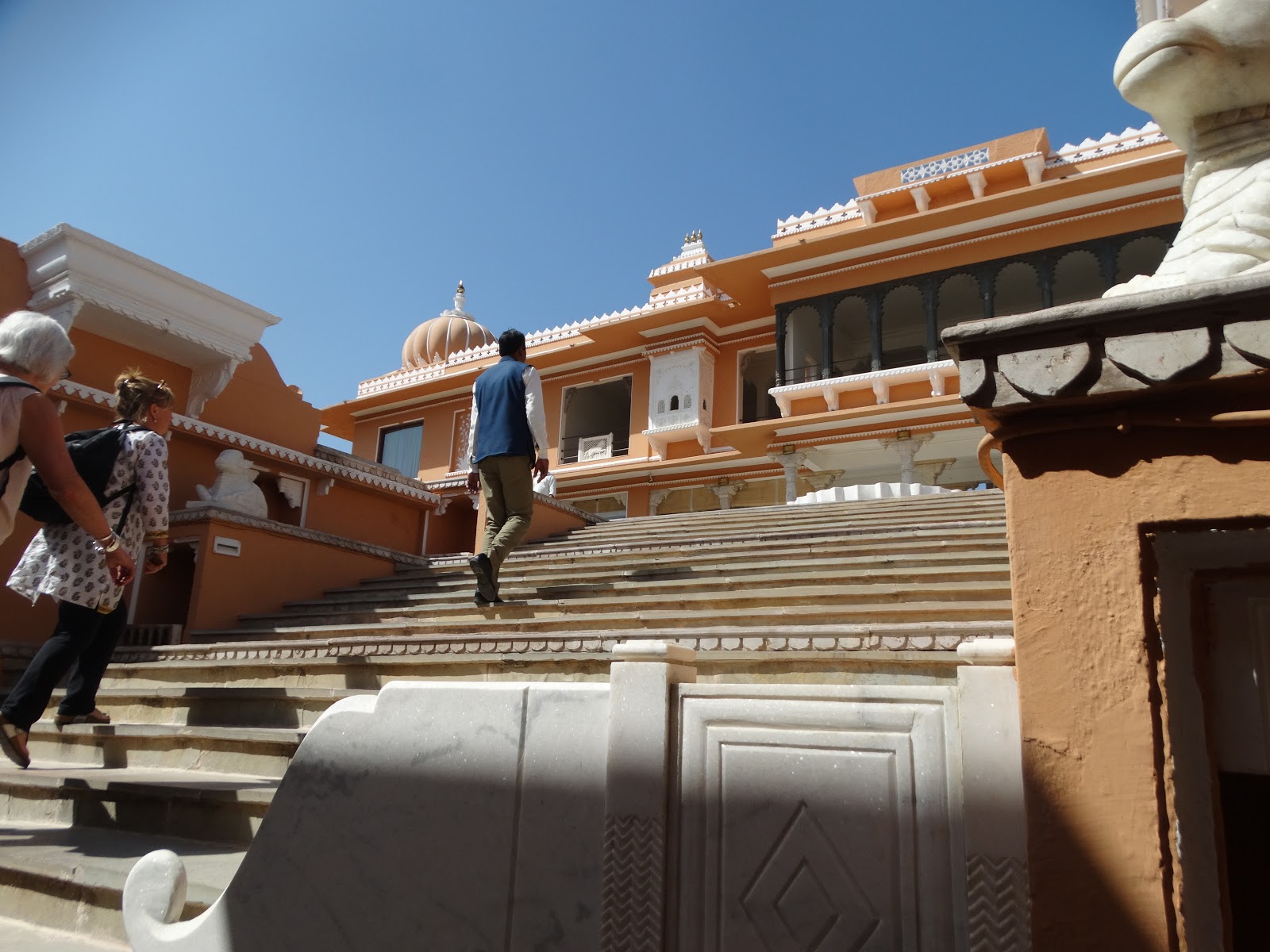
Lots of oohs and ahhs from the women in the group when we arrived at the Fateh Garh Palace Hotel outside of Udaipur, which is west of the city amid green fields, atop a hill. The views from anyplace in the Palace were outstanding. All the stairs, no railings, was not so much appreciated. Fateh Garh is a ‘modern’ replica of a Rajasthan Palace and what made it even prettier were the decorations being put up for the Indian wedding taking place that weekend. The rooms were large, the doors quirky to get into. Lots of colorful saris about, women in the bridal party had their hands henna painted, the colors were vivid and the atmosphere festive.
Inner Courtyard Normally Open to the Sky
Now Covered With Coloured Streamers 


On one night we witnessed a show of dance performances by the wedding party, led by a DJ, that was very unlike a western night club. Amazing India!

Hennaed Hands
It was a pretty place, high above with a view towards Udaipur and the lakes (Lake Pichola). No wonder Udaipur is called the Venice of India. And so much water in the middle of a desert. Udaipur is called an oasis by some but that is because it somehow rains more here than, let's say in Jaipur. This extra rain, this extra water allows for a greener look. To preserve and save Maharaja (Warrior Kings) had 2 lakes built (hand dug), with a small canal in between with which they could regulate the content of each lake. Water is precious, especially around these parts.
water the old

Right after we checked in to the hotel we were on the bus again to start our city tour. The City Palace of Udaipur, while it is a tourist place is also still occupied by the Singh family. The Maharaja, (Great King) of Udaipur, has reigned over Udaipur for 1500 years or a total of 76 generations making it the longest dynasty in India. Udaipur started with Maharana Udai Singh in 1560 and his heirs are still the head of the
Gates To the City Palace Are Open
family today.  Tourist fees help pay for the huge cost of upkeep for this giant Palace. Still, the Singh dynasty lives within the part of the Palace which we did not see.

There are many, many large mansions, houses, estates and palaces in Rajasthan, the land of the kings. But this Palace is the largest. Decorated with personal taste (peacock mosaics along the grand reception walls) of the people of previous generations and ‘modernized’ here and there, the palace had add-ons made over centuries which grew the palace to today's humongous size. It sits on a low, but steep hill side, abutting one of the 2 lakes. The lake
(Lake Pichola) is large enough to house a few islands, which also contain palaces or pleasure spots. I
An Ornate Swing
felt a little bit like an intruder traipsing through their relics. Naturally we were only
shown that part of the palace that is now the museum. Fancy rooms built for functions which are no longer in vogue or needed. Throne rooms are decorated with gilded silver and gold chairs and windows with bright window dressings, ancient elevators that do not run any longer, hidden staircases no longer used by service people, etc. It is a museum now, no longer an active part of how the Maharana live today but how life used to be.

This Large Painting of the Palace Complex Contains Many Miniature Figures

These Are Some Of the Figures In the Above Painting
One very peculiar thing about the rooms in this Palace, all are full of miniature paintings. Large areas on the walls, ceilings, anywhere there was space, full of paintings in miniature. All show events from the past, special days but also everyday scenes. They were painted as historical records. Not much was written down, but events were painted on the walls. So we, the visitors could see, did not have to read, the events that took place. It's like a series of photos, but since there were no photos in 1600 those happenings were painted. Some were wall-sized but with very small and accurate detail. Every face in the paintings is different. Each rider, each horse, elephant, ladies in their saris, etc. were painted as they used to be, just very, very, small. The brush that was used to paint those large pictures had only 2 hairs; hairs from the ear of a squirrel or sable. This brush provides a very, very fine detail, even within the clothing of the people, their expressions, their body language.  Amazing India!

Much Tiny Detail In This Painting
Those artists, those painters were special people; it took generations to develop this art form. Today, there are no more commissions from the Maharana for them.

Rather Garish Decor
Those artists, still around, now have to rely on tourists for their income. So, naturally, there are shops that specialize in miniature paintings, and also of course, there are good artists and not so good ones. I looked and priced some of them, just to be curious. Sorry, it was way over my head. A picture as large as my hand for US$ 4000, - was just too much. I understand the delicacy and time it takes to paint those scenes, still a lot of money, even though I would have liked to support those artists.

Udaipur has ‘only’ about a half a million people, a manageable size for India. Udaipur lives off tourism, even though the state of Rajasthan also lives off the mining of zinc, cadmium, marble, phosphates and talc. These old Mountain Ranges (Aravalli) are full of natural resources.

Members of the Royal Family Exercising Their Horses
It can get hot in summer (112F) or 44C and while there is a lot of greenery visible, it is a desert city. Today, in March, it was already 31C.

On the way out of the Palace, we saw 3 horsemen in military uniform and we were told they were part of the Royal Family exercising their polo ponies. It must be nice to live at this high level with palaces, polo horses, luxury cars, etc. from birth. For 76 generations money is no object.

We Had Dinner Under the Stars At the Edge Of the Balcony


Dinner at night for us was “under the stars“, on Milky Way quite visible. People from the wedding party at the next table in their finest dress, in saris, kept us company. It was a festive and romantic evening and ending to our first day in Udaipur.
the terrace of the hotel. There were no other lights on around us (only the flickering candles on the table); it was a clear night, starry skies with the

After Dinner We Watched Some of the Wedding Celebrations
But the Blue Lights Turned the Pictures Blue