Through my eyes

living my life without regrets

Sunday, November 29, 2015

Vatra Dornei, RO

Vatra Dornei, RO

RO is the international abbreviation for Romania. 

We are on the road today, with VatraDornei being the closest, largest town near the painted Monasteries in the North of the Country (Bucolic), our targets for the next few days. We are in the Carpathian Mountains. We are not on a race in Romania, so we ride about 5 to 6 hours a day and then stop and smell the roses. Vatra Dornei is just a normal town. Sure they would love to be a ski resort and maybe they are, but for me it is a stopover. We were lucky to have found a hotel that is modern, air conditioned, with secure parking, elevator, breakfast included and near town; a really nice place: HotelBelvedere.

Riding a motorcycle needs to be an adaptive sport. Just because you can ride in, let’s say, Germany or the U.S, does not mean you know the small intricacies of riding in Austria or Hungary or Romania. There is something different here. Just like there is a difference between Mexico and the U.S.

I once rode from Mexico into Guatemala and noticed a difference there, too. It happens almost instantly: just cross a border and something changes. The effect is immediate: Canadians drive and ride differently than their Southern Neighbors. It is difficult to put into words but I feel it. So my awareness needs to adapt. I need to be ready for new things. In Romania the roads are narrow and winding. The highways are not international interstates with wide aprons on the side of the road. The roads here are the old roads, established over centuries, just paved over. They still twist their way through the center of towns, up and down mountains and are used by dogs, cows and horse drawn carts.
Horse's Pace Of Life 
Anticipate the unexpected in Romania, you will even see geese or pigs standing in the road, right after a curve, looking at you and seeming to ask: “What are you doing here on my road?” Riding a bike is full of small adventures. Six hours of full attention to the road is about all I can give of myself before I feel a fatigue creeping in.
So we don’t push ourselves to make it to the ultimate goal.  We know our limits and bunk down even if we are near to where we have to go. I find it better to see the attraction we headed for the next day. Fresh like a daisy I get better impressions of whatever we came to see. How many miles I ride a day is totally irrelevant! What matters is that we ride safely and get there. Time seems to have a different value in Romania. The horse carts I mentioned are slow but seem to be on a mission. Just imagine commerce being done at their speed. Of course there are many trucks on the road but still, there is also the time-forgotten way of one step at a time, living at a horse’s speed.
The towns, similar to Hungary, have a layout I do not understand. When going into a town, I see deep ditches on the left and right side of the road. The town road is just two lanes, and then comes the deep ditch. Beyond that is a narrow strip of land and then the houses start. The houses are built in a row. Yes you can call them row houses but each house is different, yet they are very close together or even touching each other. The strip of land in front of the house is sometimes made into a garden, other times it is a parking spot. Small bridges cross the ditch; each house has their own bridge from the road to the house. It’s a strange look and I noticed it first in Hungary, but now I see it in Romania, too.
I can understand the purpose of the ditch in heavy rains, it drains the roads, it might even have drained effluents years ago, but this is 2015. Still, those are historic setups and do not seem to change. I cannot understand why a town was laid out that way, though.
Idyllic? It Was A Nice Ttown !

A Well Deserved Drink 


Vatra Dornei is not laid out that way. Somehow this town is like other European towns, a bit old and yet it has its own charm. A pedestrian street (no cars allowed) full of outside restaurants is in the center of the town, we had dinner there. A wide shallow river flows through the city, flanked by railroad tracks. People walk instead of driving cars. The general feeling is of contentment with a dash of ambition for something new. I like this town.
Sure I yelled at the woman who was parked, blocking the entrance to our hotel, leaving us vulnerable on the street amid a construction zone. She had plenty of room to park anyplace else, but no, she was lazy and had to park in the most convenient spot, disregarding the difficulty she caused for anyone else. People are people, including me. I get all steamed up when I see idiots and I let them know it.

But I smile at myself too, for being the other idiot.


Saturday, November 28, 2015

Cluj Napoca, Romania (Klausenburg)

Cluj Napoca, Romania ( Klausenburg ) 


I will write the German names next to the Romanian names, because for centuries those cities we will visit in Romania were at least 50% occupied by Germans. The “SiebenbürgerSachsen”, as they are known in Germany, were people sent by German Royalty to hold off attacks by the Mongols (Golden Hordes) and then later the Ottoman (Turkish and Islam) attacks. Those Germans established, built and organized their cities in ways that made them stand out in the region. A lot of the Germans sent to Romania were Protestants, people that the Catholic Church did not want in Germany and kind of ‘exiled’ them to the East. But the first waves of Germans came before the Reformation and to complicate it even more, they were not from Saxony but mainly from the lower Rhine Valley. History, even though understood, is still complicated.

History seems unavoidable when I visit a place. I ask myself questions like: how old is this town? What did it look like before man came to this spot? Why is the town in this spot? Somehow I am not so much interested in the latest buildings, bridges or living quarters the town is so proud to show me. I like to understand what made people come here and why and what kind of people they were. I have a hard time remembering the names because they are just names to me. Even though they were the important people of their time; today they are just names, with no longer any power behind them. I am not impressed with their wealth when they were alive, and I am sure I would not be impressed with their wealth today, either. But I must admit that, because of them, this part of the world looks like it does today. There are many circumstances that determine the appearance of a city or place in years to come. Just as there were many such circumstances and events that made a place the place it is today. History! It made and will make the world go around.

We had booked a pension via Bookings.com with an Italian name, Pension Piccola Italia.   We had a hard time finding it, even with our very good and brand new GPS. We had maps of the town, we had our GPS but the city had major construction going on and a lot of roads were torn apart and detour signs all over the place. Our GPS gave up, too many detours. The map did not have the smallest streets on them and asking people? Do you speak Romanian? Besides, we were looking for a place with an Italian name, so when we did ask, they looked at us funny and kind of shrugged us off, shaking their head. “This guy is looking for Italia?” they might have thought. “This is Romania, fool.”

Well we found the place, an old, turn of the century house, converted into B&B. Parking for the bikes was under a grape arbor in the front yard behind a secure steel gate. Breakfast was in a small annex in the back, also under grape vines. Those plants give great shade. Much needed shade, the temps on the way in were 92 F and it was hot. The big, fat walls of the building though, helped the inside of the house remain cool and comfortable. No A/C, of course. It was an OK place to bunk down and explore the city. Exploring we did on foot, though. Besides the mess the construction made of the inner city, we were not happy with the way Romanians drive; aggressive, reckless and sometimes very foolish driving. We were better off per pedes, especially since the old town was only about 10 blocks away. When I use the word old town, it is a misnomer. Cluj (that is what the locals call the city for short) is a University town; There are many young people around. The ‘old’ center is made to look old but it is seeded over with Restaurants, eateries and drinking places. I felt like I was walking the gauntlet, everybody wanted us to come in and eat or drink in their place, the whole of it not busy, but all establishments very eager for customers.

We had dinner at one of the outside cafes but the atmosphere felt wrong. Naturally we had nothing better to do but watch the passersby and the general bustle of the place. To me it seemed contrived. I cannot remember the food we ate, all I remember is that it seemed overpriced for what we received. I do not know really what I expected, but I did not expect to see a town that made an area ‘old’ to bring in tourists but it was a failed attempt. Maybe we were too early in the day (7.00 PM) and the real “action” starts later, remember this is a University town or…… maybe the University was closed for the summer months. Anyhow, to me it was a dead duck place.

So all I can say about Cluj is that the houses need some fixing up, that most need a coat of paint and maybe there needs to be a program to teach drivers to be more respectful of others.

We had a nicer time at lunch today, we stopped alongside the road and the place had Romanian authenticity, great food and ambiance. A nice place with flowers in the front and a large hall with wooden tables and a nice menu greeted us. Even some (7) local bikers stopped in and occupied a table not far from us. They just nodded an acknowledgement when they saw us and did not make us a tourist target, like those dinner folks.

Authorities in Hunedoara, a city in central-western Romania, are threatening to tear down the so-called 'gypsy palaces' dotting the region because all were built illegally, and many of them are safety hazardsA curious event was the sight of large wooden houses with ‘silver’ roofs, trims and gables. I remember reading about some of them being ‘Gypsy’ king houses,  but did not know they looked like that. A very peculiar look, very different looking. Very ornate and foreign, something my brain could not conceive as ever being a house for me.

 Well, we are just starting to move into Romania, I need to keep an open mind. Romania is very different. 


Wednesday, November 25, 2015

Hungary

Hungary

Happy Times

We have ridden around Hungary before and since our target is Turkey, why linger?  We sure wanted to avoid the congested Budapest area so we picked local roads. Well, almost, because when faced with long, out of the way routes, we bit the bullet and bought the minimum toll ticket which allowed us to use the highways for a week . We were glad to use the highways to go around Budapest.
Looking at the map and calculating a route so that we don’t have to travel miles and miles, we headed from Sopron East towards the town of Kecskemet, a town that would make it easy to enter Romania the next day

The booking we made from Bookings.com said a double room, attached bathroom and breakfast included. All that for 23 Euro; parking within the premises or across the street. Great, off we go to find this place. Boy, am I glad we had our GPS. It turned out to be a room in a private house, nice and clean but not a hostel, as advertised. Not that it was bad, it just was very small. Yes, they had parking; they moved their car out of their carport and let us park there for the night. The bikes were relatively safe. Finding a place for dinner was another thing though. We ended up eating some strange Asian food in a nearby Supermarket that had a few tables stuffed in the corner. Now, I know that sounds snobbish and maybe it is, but the food was sub-standard. Greasy and all mixed together looked not appetizing. Served on a paper plate with a plastic fork is not ‘dining’. We just used this private home as a sleeping place and left in the morning as early as we could (7.00 AM). Breakfast was a slice of toast with Velveeta cheese wedges, bad coffee but it was food. I tried to pay the woman but my pantomime must not have been understood, she just shook her head and moved away. I stood there, holding the Euros and did not know what to do. All she said was ‘Bookings’, which meant nothing to me. Language can help, but I don’t know a lot of people who learn Hungarian. She spoke no English, not even thank you. So, what do we do? Well I figured she wants her money sooner or later so let her come to me.  We packed our bikes, had some tough time getting out of the yard, a bit down the hill, and then we rode off. (I totally forgot to pay the woman), did not even think about it later on.

Sad Times
Our next ‘target’ is the border crossing for Romania, some 3 to 4 hours away. Mentally I make a list in my head of where my passport is, where the bike papers are, etc. Questions pop up: do I need a Vignette for their highway system? How much money do I exchange at the border? etc.  My mind is preoccupied, busy. It is hot; the sun beats down on us in all of our full gear, with the helmet on, too. We finally come to the border and now the fun begins. I find a kiosk and they tell me I don’t need a Toll Vignette for the bikes. Bikes in Romania do not have to pay tolls for any Highway. Great!  Now comes the actual Border crossing! Ready, Carol?  Carol? 

We find out in our confusion at last night’s place, Carol left her green document folder someplace. There is no other answer but to ride back. Yes, stuff like that happens to the best of us. We cannot call them, we don’t speak Hungarian. They don’t speak English, or German, or any other language. So, off we go, back to where we came from. About 4 hours later we pull in to their street and ring their bell. Ah, yes, we kind of waited for you, was their pantomime. Here is the green folder. A nice smile and a wave and a big relief on Carol’s face. But now what? We took a break in an Air Conditioned gas station for 45 minutes to cool down and to breathe a sigh of relief.  Carol and I talked. No, I don’t want to stay there again, did not really love the place but now it is the afternoon and where do we go?  I did not even love the town!  So we decided to go for another few hours back towards the Romanian border and find a hotel on a highway someplace. Anything will be better than what we had. Yes, we rode a lot of km that day!

The 'Wild West' In Hungary
Simple Rooms But Looked Nice 
Yes, Sh!@t Happens!
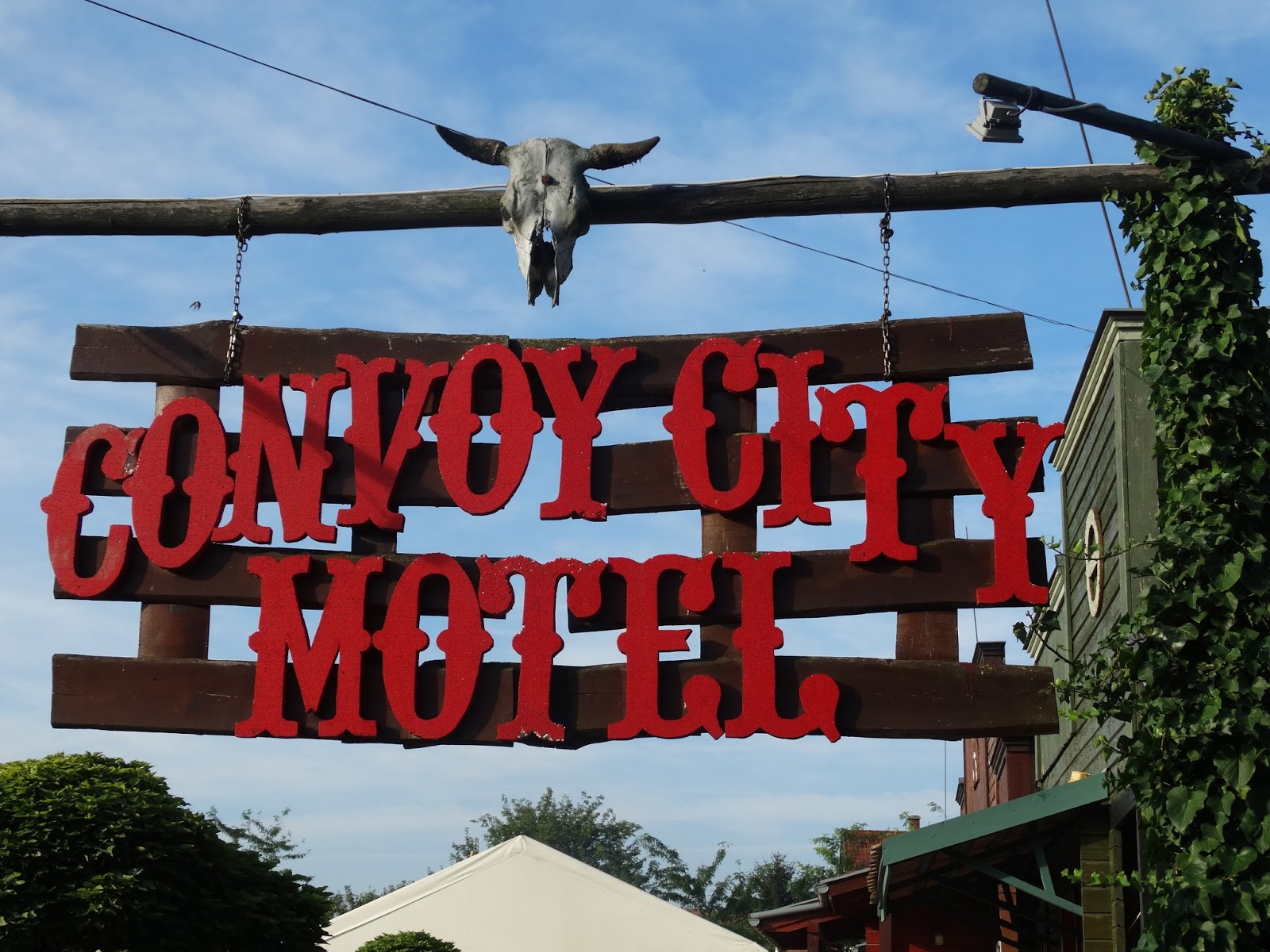
About 2 hours later I see a sign that spells out “Convoy Hotel.” Carol and I agree we will just take it, no matter what it looks like. All we want at this point is a room. The temperatures on this day were around 90 F and we have had it. So, we walk into the reception and are told that the place has a Wedding Reception this very night. Yes, they have a room but it might be noisy because of the party. Again, what do you do? Also, there is no AC in the rooms, just a fan. The location is good, right off the highway, the bikes would be secure (somewhat) but with a party going on? Will some drunken guy pee on the bikes?  Will someone puke all over them? No AC really bothered me, the day was very hot and it still is hot. On the good side it is an easy walk to a restaurant, the price is acceptable and riding longer is just not in the cards. Carol has had it, too. So, we take the room and I slept great, did not hear a thing. The bikes were safe, the night cooled off enough to not feel the heat and all is well with the world. Sometimes I worry too much. But when on a trip, things can go wrong, sometimes they can be avoided, sometimes it is just my stupidity, other times stuff just happens. Romania is next!


Tuesday, November 24, 2015

Sopron, Hungary - Eisenstadt, Austria

Sopron, Hungary  -  Eisenstadt Austria


Joseph Haydn Bust


The Esterhazy Palace Is Now In The Center of Eisenstadt
It was just a hop, about 90 minutes from Bratislava, Slovakia (Pressburg) to SopronHungary. The actual city we wanted to visit however was Eisenstadt in Austria. But again, the prices for hotels in Eisenstadt were way too high. So we went to the Hungarian side and saved a lot of money.
In The Center Of The Courtyard Of The Haydn Museum
I know you wonder why I would go to Eisenstadt, you probably never heard of it. Eisenstadt, what is there? Ah, it’s the music lover in me. Eisenstadt was the Pleasure Castle or Hunting Castle of the Esterhazy Family. And the Esterhazy clan hired Joseph Haydn, the father of classical String Quartet music. For 40 years Haydn composed and worked for the elite of the Austrian Empire. Well, actually he worked for the Esterhazy family but also had occasions to teach pupils such as Mozart or even Beethoven and many more. No wonder they called him Papa Haydn. When you think of Eisenstadt you think of Haydn and also Esterhazy, the Hungarian Royal House. Eisenstadt was one of their castles. They were a complicated family with many family members and inter-relationships.
The American Tourist Hans
Ceiling In The Chapel 
I took the tourist tour but was more interested in the fact that this man Joseph Haydn, composed here. He might have walked where I now walk. He might even have sat in town having a coffee where I sat and had my coffee. It made me smile inside to realize that the world has changed to allow me, a commoner, to sit and talk where only the highest elite once lived. I read that Eisenstadt Palace in its prime was compared with Versailles. Well I have seen both, and no, Eisenstadt is not even close. Maybe it is the town encroaching onto the Palace Grounds today that makes this building a bit ordinary or not so special, maybe it was the way the Austrian Government rebuilt or refurbished the place that made it not equal to Versailles, or it might be just me. I am kind of jaded by now, I have seen too much.  The inside walls are not real, for example. Printed cloth is used to give the impression of ‘walls’ and architectural details are printed on the ‘walls’ that give a fairly good illusion, but after you see it, and know it, you know it’s not real. So yes, I have seen the Palace in Eisenstadt but only after the Restoration and what is left of it and what is shown to the tourist.
I read that, after Paul Anton Esterhazy and especially Nikolaus Esterhazy died the rest of the family did not like the Palace at Eisenstadt at all and abandoned it; left it to go to ruins. Rain and neglect took its toll on the palace and in no time it was a pile of rubble. To rebuild it would have cost a fortune and the Austrian Government had really no use for the place. So what to do? What they did do to the Buildings served a purpose, and tourists come to Eisenstadt, spend money, help the economy, listen to concerts, drink coffee in the coffee houses and all is well. True to Austrian ways, they have Sacher Torte to eat and even an Esterhazy Schnitte, cakes you just have to have when you are in Austria. Yes, we had those cakes in the coffee shop inside the castle. We were tourists! 

And then there is the music. Wonderful music!  The German National Anthem was written by Haydn, for example. He called it the Emperor Quartet and here is a sample of it. (click on the blue name) By the way, all the pictures you see on this YouTube clip are Germany. Great Stuff!    
Those Guys Played Well And Had Fun Entertaining The Public

We heard it played with a Brass group and it was done very well. The Tuba Player was really into it and fun to watch. I felt like a kid listening to great music.

For Serious Concert Goers - It Had An Air To It.
No matter that Eisenstadt was and is in disrepair, Haydn’s music lives on.  The music will be around for centuries to come, it’s a repertoire, a staple of any Baroque performance. And if you are like me, who loves classical music, then Eisenstadt is a must visit. There is still a very fancy concert hall in the palace. It is still a hub of classical performances, music lives here. Not just the old stuff, but modern Jazz too.


Portrait Of 'Sisi', A Troubled Soul 
It helps to know a bit of Hungarian History; who Sisi was (Empress Elizabeth) and why she was so loved by the Hungarians. (She learned their language and could talk to the common folks, a difficult language to learn).

This corner of Europe, somehow, still honors the Royals and the era around the Hapsburgs. It was the center of the Holy Roman Empire for many years and it still shows today.
Then A Columned Something, Now A Coffee Shop
Can You See All The Horses That Used To Live Here ?
Bratislava had the German name of Pressburg then. Half the population of Pressburg was Austrian/German at the turn of the 19 Century. Eisenstadt was a center of culture but also a bit in the sticks then, so hunting was a big deal. A totally different time, but it left traces of the golden age that can still be seen today. Some of the old buildings are still being used. Old horse stables are storage places today for example. Old office buildings are made into coffee shops. Etc.
Roman Catholicism Was Their Religion
Saint ?  
We took a guided tour through the Palace to see where Sisi lived part time. We visited the Chapel; saw the relics of some Saint, whose name I forgot.
A Cute Pair, Don't You Think ?
We played tourists.  To ride the bikes from Sopron to Eisenstadt took all of 20 minutes in the morning. We found a good parking spot, stuffed all our riding gear, including boots, into the empty (we left stuff at the hotel) saddle bags and had a wonderful day. The weather was on our side. Blue sky, Perfect temperature. Eisenstadt is about 1 hour southeast from Vienna, near the Hungarian Border, look at a map    

Blue Sky, A Perfect Day For A Visit
I Try Not To Be Too Serious !
Worth a visit if you like Classical Music. 


Monday, November 23, 2015

Bratislava, Slovakia


Hotel Brix in Bratislava, Slovakia

Bookings.com has some good deals and Hotel Brix was one of those, well for us, anyhow. On purpose, we chose a hotel outside the old city, because the prices were outrageous within the historic center and parking almost nonexistent.  The ride from Budweis to Bratislava took 5 plus hours because the roads now are no longer the ‘highways’ we are used to riding on. Yes, the Czech people give it a highway number but really, it’s a glorified local road.
I wanted to see Bratislava for a quirky reason. A few years ago I spoke with someone who was aglow in praise of Slovakia, especially the Capital Bratislava. In her opinion this was a nicer town than Prague, or Vienna, or any other older Capital in Europe. What could I say at the time? I had not been to Bratislava, so I had to just listen and grin and nod my head to her. Now I can talk about Bratislava, I have seen the town. And my verdict is? Grinning! I like Vienna better, but it could be nicer than Prague, depends on what you like. No matter, we had a wonderful time exploring the rather large, old place. We walked our feet sore. No riding around on the bikes, those were parked securely in the underground garage of the hotel. We took the local bus in and out of town. The bus stop was directly in front of the hotel and it was super easy to use public transport. If there had not been a bus schedule, we would have gone to town by taxi. I find it much easier not to ride in big cities and not to be exposed to foreign travel rules. In addition it is much easier to walk around in regular street clothing than in riding gear. That is why Hotel Brix was perfect for us.

Carol’s rear view mirror came loose. No matter how I tried to secure it, it would not stay tight and fast. I had to rely on the Silicone I carry with my spare parts. This goo did the job, especially since it had 2 days to dry while being parked.

When I stop in a large town, I like to take my time and explore the town slowly. No, I will not see everything the town has to offer, but I get the highlights. We walked for at least 6 hours. I told you, our feet were sore. St. Martin’s Cathedral was one of those highlights. 
Church Regalia From St. Martin's Church

The Crown Room, See St. Stefan's Crown In The Center

This church served as the place for the Kingdom of Hungary’s coronations.  11 Kings and 8 Queens of the Empire were crowned within the walls of this Catholic house of prayer. The most popular Coronation was probably the crowning of the Austrian Empress, Maria Theresa


I Know This One.... Lamb Of God


Wood Carving At Each End Of The Pews

Decorated Pews
Bratislava’s location made it a much wanted town to ‘own’. The great Empires around this town found it somehow irresistible to fight to occupy it. Already in the Stone Ages a castle was built to defend the population from the usurpers.
The list is too long to write, so I copied something I found which should give you a clue. The list of conquerors is long.

The Hangman's House
History
After the fall of the Great Moravian Empire Slovakia became part of the Kingdom of Hungary from the 10th century until the end of the First World War when the Treaty of Trianon created Czechoslovakia, a country of which Slovaks are widely proud - for example, some Czechoslovakian representatives, such as Alexander Dubček and Gustáv Husák, were ethnically Slovak.
Between 1939 and 1944, Slovakia was a German-controlled state. Then, it was conquered by the Soviets to recreate a new Czechoslovakia, but one that would be pro-Soviet and Communist this time.
This lasted until the fall of Communist rule in Czechoslovakia, during the Velvet Revolution of 1989. In 1993, peaceful differences between Czechs and Slovaks when rebuilding their nation after the fall of Communism led to the dissolution of Czechoslovakia into two separate and independent nations: the Czech Republic, and of course Slovakia (Slovak Republic). To this day, Slovaks and Czechs have generally friendly relations, and the two nations cooperate together frequently on international issues.
Bratislava was the capital (1536-1784), the coronation city (1563-1830) 
Believed T Be The Crown Of St. Stefan 
and the seat of the diet (1536-1848) of the Kingdom of Hungary for many years. Since 1960, it has been the capital of the federal state of Slovakia within Czechoslovakia and since 1993, it has been the capital of independent Slovakia.
Although today Bratislava's population is mostly Slovak, from the 13th to the early 19th century, the majority ethnic group in the city were the Germans, who remained the largest ethnic group until the First World War (in 1910, 42% were German, 41% Hungarian and 15% Slovak out of a total population of 78,000). Hungarians formed another important group in the city in the 19th century, but after the First World War, many Germans and Hungarians left for Austria and Hungary respectively, and the remaining Germans were expelled at the end of World War II.
Stark, Empty Halls Inside The Castle


None the less, this German marched up to the Castle to explore and see for myself. 


I was not there to conquer anything but my tired, worn out body. Up on top, at the Castle, I learned that German tourists are allowed to come back and spend money. Never mind that they were thrown out a few decades ago. But then, technically, I am no longer German. And truth be told, Carol made me walk up those cobblestone streets, those twisty roads that give a grand view over the ancient city. The original Castle dated from the 9th Century but it was rebuilt after being destroyed by fire in 1881.

A Steep Incline To Get To The Castle Gate


The Castle today has an Austrian Empire feeling. Glitz and pomp and ornate decorations. By the end of the 19th Century, the Castle was used primarily for royal entertainment, rather than as a defense against attacks. The inside is sparse: the interior courtyards are bare, the halls feel a bit empty. Its a touristy place but has a historical value. The view from the top of the Castle is stunning. 

             Barren Courtyards Within The Castle


Carol Liked Her Oxtail Soup                         


We sat and ate Oxtail soup at the Veranda Restaurant. The weather was mild and we fit in perfectly, we were tourists.


                      St. Elizabeth  (Blue Church)


Carol read something about a blue Church. So off we go to find this 'blue' Church. It was another long walk but we found it. It was closed but the outside facade was covered with blue mosaics and the roof with blue glazed tiles.


  Blue Details                                          
Did they mean 'heavenly' blue?
In front of this Church of St. Elizabeth, we talked to a couple from S. Africa who were traveling Europe on bicycles. When I think riding a motorcycle is tough, imagine doing those distances on a bicycle. Amazing! They were having a fine time though; they were not the youngest of folks either. I learned that there are many 'Bicycle Roads Only' criss-crossing all of Europe so traffic is not an issue. One hardly needs to use car roads and every so many km are rest spots, hostels or hotels. What a great way to see a country!
More Blue


Blue, Blue, Blue and Gold


After that we were so pooped, we took a taxi back to the bus stop which happened to be in front of the Presidential Palace. And from there we took the bus back to Hotel Brix.


Presidential Palace 


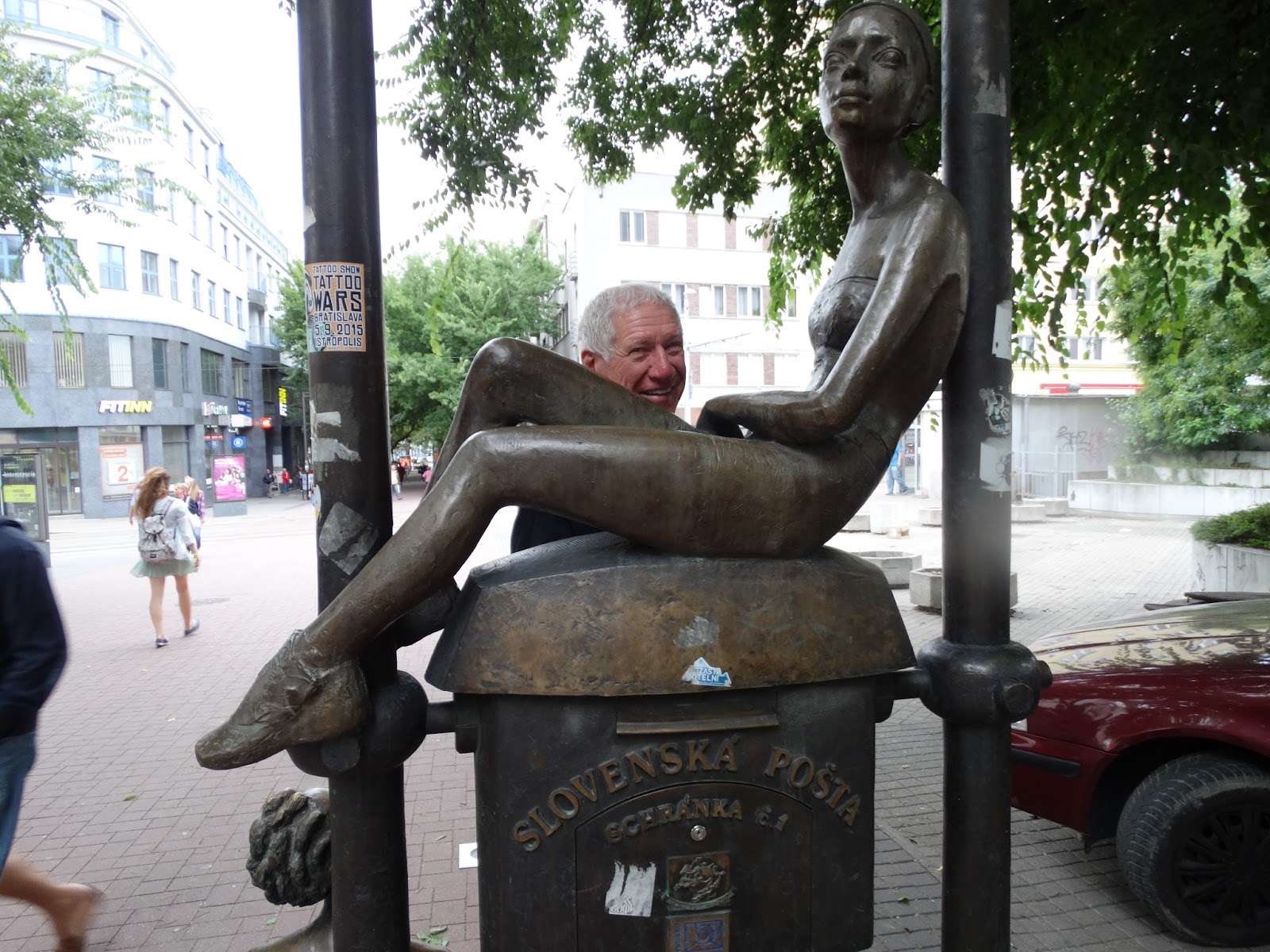
Best Mail Box Ever


Supper tasted great, we had walked up an appetite. We slept like babies. 


I Told Him! Now He Knows!


Elaborate Graffiti 

Graffiti On A Grand Scale


The Stones Were Slick In The Rain 


Rough Road If I Had To Ride On This 

Missing Utility Covers, Not Good For A Motorcycle


Click On The Picture. It Is The Layout Of The Castle


Bird's Eye View Of Bratislava


Narrow Streets, Cobblestoned