Through my eyes

living my life without regrets

Wednesday, March 18, 2020

Cambodia 2020 - 11. Ta Prohm Temple


11. Ta Prohm Temple

The year is 1182 AD and Jayavarman VII has ascended the throne. In 1186 he started a ‘HUGE’ building spree across Cambodia. No, I mean HUGE, like you would not believe.

West Entrance to Ta Prohm
Ta Prohm was one of the first buildings he started. This building was dedicated to Wisdom 

(Prajnaparamita) and this King chose his mother to be in the center and focus of this Royal Monastery. Yes, monks lived around this place along with their service staff. The main image (which is no longer there) in the center of this temple showed Jayavarman’s mom. She must have felt honored to be called ‘wise’ by her son.
West Entrance Unsafe So Had to Walk Around This Building

We know all this because a stele was found spelling it out. The name Ta Prohm, which means Ancestor Brahma, used to be originally Rajavihara (Monastery of the King). 

We also learned from this stele, that a partner building was built named Preah Khan, built to honor the King's father but we will visit that later.

 
Information About the Khmer Musicians
On the way to the main entrance, we bought a CD from a group of disabled musicians.  All of them were maimed by stepping on land-mines. In the video below, they are playing traditional Khmer music on traditional instruments.
Khmer Musicians

Buying a CD


Oh, what a delightful visit this Ta Prohm was.


The ‘Ecole Francaise d’ Extreme-Orient’ Society, in the 20th Century, decided that this Monastery is ‘best allowed to merge with the jungle’.
Strangler Fig Tree, Ficus Gibbosa

Much Rubble Everywhere
Meaning, leave it alone, don’t cut the trees down. The French were in charge of Cambodia at that time and ‘decided’.

Experts today have scoured this place, and established that the original layout, still very well visible, had 5 rectangular walls surrounding the center.
Silk-Cotton Tree Roots (Ceiba Pentandra)
There used to be moats inside and outside of the 4th wall but those moats have dried up, were taken over by the jungle.  The jungle is all around Ta Prohm.

You might have seen some of the pictures we show here. Ta Prohm is one of the most popular places to take pictures.

More Strangler Fig Roots
Pictures of the roots of giant trees (Ficus Gibbosa) a Strangler Fig tree and the roots of the Silk-Cotton Tree, (Ceiba Pentandra) are famous. Both tree specimens are very aggressive trees and it is obvious now that the French Society may have made a mistake years ago. To let nature take over means to lose all the details very quickly.

Today, India has stepped in. In co-operation with the Cambodian Government, they are trying to preserve what is left, but also trying to not disturb too much of the root systems visible now, that actually are hastening its destruction. It’s a complicated situation.
Recognize This Scene From Tomb Raider?

But my, the effect of the roots crawling along the walls from the roof, is amazing.

Movies were made here because of the kind of eerie effect produced. Tomb Raider (Lara Croft played by Angelina Jolie) was one of those films that took advantage of the all over effect of these ruins.

Some Amazing Carvings Remain - Not Stolen or Demolished
The whole complex is 650,000 square meters. Yes, again, it was built on a grand scale. The long side of this rectangle is 1000 meters, east to west. The shorter side is 650 meters. Yes, Jayavarman VII thought in huge terms!

Along the outer perimeter wall (5th wall) are 2 small, satellite temples.
One was built for the King’s brother, the other for his Guru (teacher).
I love those names, the Guru was called:  Jayamangalartha.
Mostly Intact Carvings Above the Door

Notice, Jaya is part of the Kings name… so it might mean Kings… something. Consensus is it means ‘guru’.

It is good when a stele is found, it helps establish things.

Ta Prohm is a ‘flat’ temple; it does not have the towers in it like there are at Angkor Wat for example and which represent mountains. The whole temple of Ta Prohm is oriented towards the East, meaning the main buildings were on the East side of the rectangular shaped complex, which is the case with most of the buildings then being built.
It Must Have Been Spectacular in the Late 1100s

We walked from west to east. Our tuk-tuk dropped us off on the west side and picked us up on the east side. I was puzzled how those tuk-tuk drivers know whom they have to pick up, but they seem to know. Our guy was there, no problem.

We asked our driver to pass by the Elephant Terrace and the Terrace of the Leper King but we did not go in. We might do that at a later date.

Being that we, again, walked what seemed like forever, we asked the driver to take us back to the hotel. The temperatures had reached 34C again and it was also hot and humid.
Both the Silk-Cotton Roots and the Building Structure Supported by Metal Rods

Shortly after we took off from Ta Prohm the tuk-tuk needed gas. So the driver bought a liter gas (you can buy it by the liter along the road, its stored in old Coca Cola bottles or such) and poured it into his moped.

This Is the Main Entrance But We Exited Here
A bit down the road his bike stalled. Here we sat, at the side of the road, in blazing sunshine. Nice!
It took the driver a few minutes to use his mouth to blow into the tank. He had to do it a few times, I guess it must have been a vapor lock, but after a
few tries…. Put-put-put… the moped started up with a cough and then ran a bit unevenly and then straightened out… we got to the hotel just fine.  
The Long Walk to the Exit

Phew, walking through rubble, bending under small doors, watching our footing and then afterwards trudging through sandy roads for a km wore me out. Glad to be in A/C at the Hotel.

Best Hours we found are the very early hours….

Gopura  = Exit Gate

We do learn quickly.


Monday, March 16, 2020

Cambodia 2020 - 10. Angkor Wat: Part 2


10. Angkor Wat: Part 2

This place is huge.
Getting a Blessing

It is difficult to walk through; the floors are uneven, old and broken. There is a bump, a high step-over, in every doorway. Those ‘bumps’ keep out the bad spirits, who slide along the ground.
8-Armed Vishnu

Walking is not on an even floor. Some parts were destroyed by nature, some by man and tourists seem to be everywhere. There is rubble about, fallen down walls fill some ‘rooms’ or spaces. But you need to walk literally one step at the time, watching where you place your foot.

All entrances to the upper floors were blocked off; I imagine it to be too dangerous to walk up there. There
Stairs Everywhere - No Railings
are no guard rails or stair railings anyplace. If Cambodia would be a 1st world country, you would not be allowed to walk into the ruins. Here though, you are free to roam ‘almost’ anywhere. Each step of the way gives you a different view. Each room you enter, each niche or vestibule has a different feeling to it.

Inside the Main Temple

Yet, the old splendor can still be felt.

It is only my lack of understanding of history that prevents me from enjoying it more. I know very little of the Khmer.
At one time, during the 11th to 13th Century, the Khmer Dynasty was the richest Empire in the world. Nothing anyplace came even close to it.
Can You 'Imagine' How It Must Have Looked in the 12th Century?

Angkor Wat was just the temple. Angkor Thom was the actual Capital city of the then Empire. But more about some of those details later in the blog.

But can you imagine if this Angkor Wat is ‘just’ the temple, what the whole of the total city complex must have been like?
Wow! Amazing

Incomprehensible!  Truly, I have never seen such an amassing of wealth. Even the Forbidden City in China is just a shadow of this place.

Carol and I climbed through the ruins. I scaled some stairs on hands and knees. I made Carol climb steps that were so deteriorated that one needed to be a mountain climber. But good for Carol, even though she protested, she did great. Yes, I held her hand.
I Cannot Believe I Climbed This - Even With Help

We scoured what we could, walked where we were allowed but it was tough going. Ah, to be 30 again!

So we walked half way through this temple. We never saw the North side of the complex. We were too exhausted at the end. We remembered that we had to walk all the way back to our tuk-tuk, too.

Standing just outside the entrance again, with a bit of an elevated view, I tried to imagine the time when this Wat was at its best. When it was in full operation, what it would be like on the busiest days, with the old Khmer people all around. I imagined when the royals, the military, the priests, the common folks all were doing their thing. What a sight that must have been!
Multi-Headed Naga (Serpent), Instrumental in the Formation of the World

It is a still a sight to behold today, but just ‘Imagine’.

I know I am a dreamer.

Carol and I walked slowly back to the tuk-tuk. We walked along the forest that is growing inside the outer south walls, which was the shady side. We did not walk the busy, ancient center causeway access on the way back. This causeway is difficult to walk on.
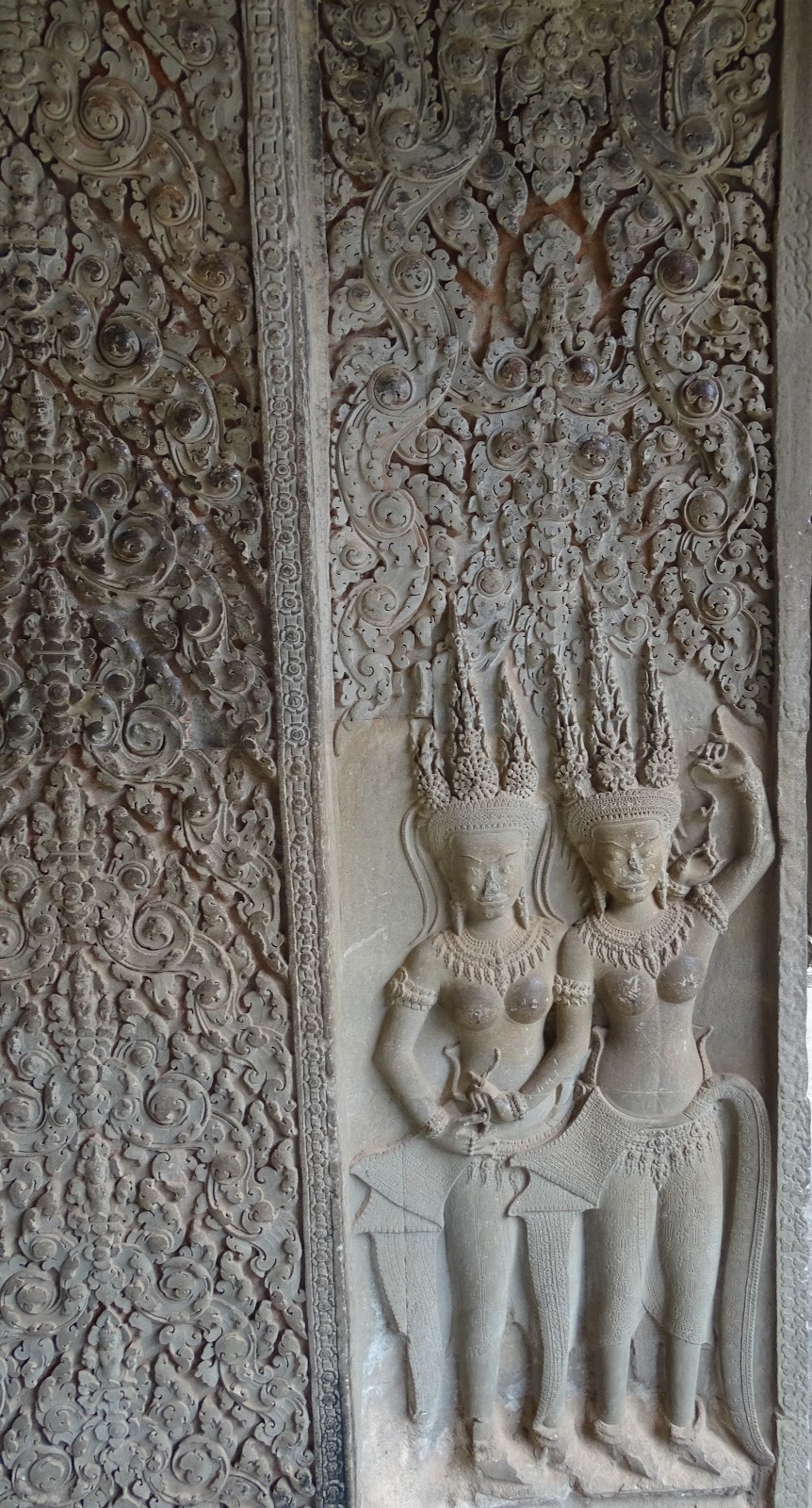
Apsaras - Divine Dancers

Some enterprising ‘vendors’ sold drinks and even some small snacks along our way. I tried the drinks offered. I don’t know what it was, but it was refreshing and natural, the vendor said.  It was!  Carol passed on it; she just had bottled water.

Once we were out of the historic Wat area there were vendors everywhere selling whatever you wanted and offering items I cannot imagine I would ever want. Carol however bought an excellent book describing in detail, with pictures many of the temples in the Angkor area. She paid $5 for ‘Ancient Angkor’ which has a sticker price of $27.95.

We found our tuk-tuk driver in this jumble of vendors, the organization around Angkor Wat is good. While it looks primitive, it all works out pretty well.
Excellent Book For All the Sites We Visited

While the whole of the ‘Historic Area’ of Angkor is a National treasure to Cambodia, bringing in millions of tourists, it is today, mostly stone ruins.

One needs to envision the living quarters for the working class people, and the ‘life’ that was going on around those palatial stone buildings. You need to mentally add the oxen, the fields, the farms the roads, the common man, etc.

The stones somehow survived but the wooden houses, the living quarters made centuries ago only out of natural products, were all reclaimed by nature. What we see today is what has survived from ancient times.

An Awe Inspiring Experience
The Khmer Empire started around 800 AD and lasted until about 1500 AD.  That was a long time ago; the jungle has had plenty of time to reclaim a lot of it. This is a jungle area, a tropical area.

This reclamation from jungle forces is still going on today.
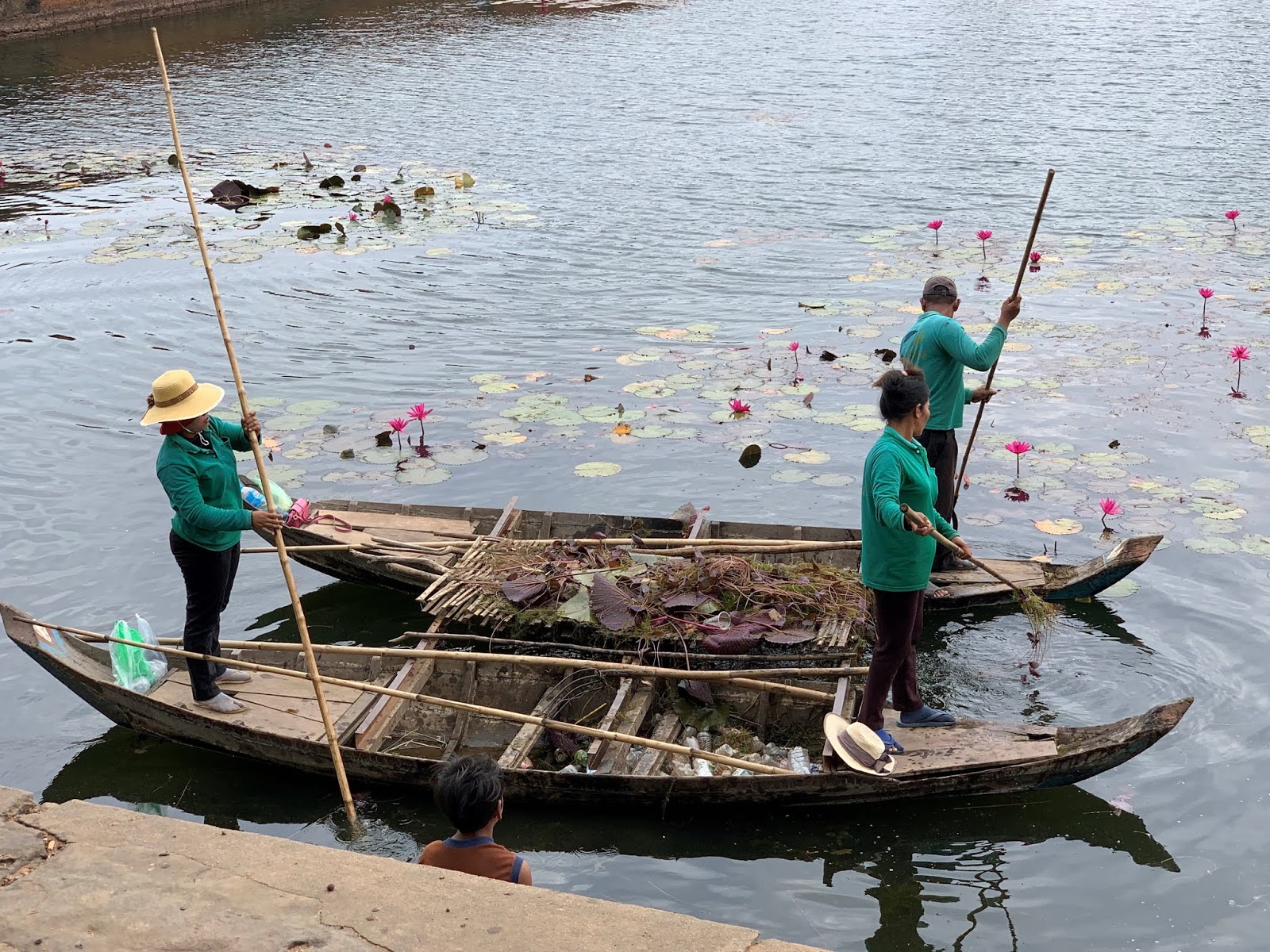
Enterprising People Gathering Lotus Flowers From the Moat to Sell

We used the tuk-tuk to take us past some of the temples that we want to see later in the week along our way home. We asked our tuk-tuk driver to give us a quick ‘drive by’ since a lot of the old attractions are near the Wat of Angkor.

Well relatively near, but again, that is for later.
Lotus Flowers

It was good to have a tuk-tuk, because were tuckered out.