Through my eyes

living my life without regrets

Thursday, May 11, 2017

More Pictures at the Tiger Preserve

Vivanta Hotel Just Outside the Tiger Preserve

Huge Wasp Nest In the Hotel Park

Unusual Door Locks

This Tattooed Camel Will Take You to Your Room


Close Up Of the Colourful Tree-Pie Bird
Red Wattled Leap Wing Bird  (Thank you Dinesh)

Tree-Pie Birds and Spotted Deer

Rocky Road

Very Excited To Be In This Amazing Park

Banyan Tree

Dense Undergrowth


One Of the Largest Banyan Trees In India

Female Peacocks in the wild 

Very Bumpy Road


Wonder What Caused This Banyan Tree To Have Such A Weird Shape


Monday, May 08, 2017

Tiger Preserve,  


Aravalli Mountains in the Tiger Preserve
Ranthambhore Tiger Preserve, Rajasthan, Northern India, a 392 square km National Park in the Aravalli mountains which has lately been increased to 1334 square km. Full of wild animals including LeopardsNilgai, Wild Boar, Sambarstriped Hyena, Sloth Bearsouthern plains gray Langur, Mongoose, Rhesus Macaque and Chital. And, of course, the hero of our visit, the Bengal Tiger, all living in their natural habitat. The sanctuary is also home to a wide variety of treesplantsbirds and reptiles, as well as one of the largest Banyan trees in India. A mythical place, very different from the National Parks I have seen.
Huge Banyan Tree With a Doorway Through It


Our group took 3 jeeps to drive through the Preserve, walking was against the rules. It would have been too dangerous; the tigers are very smart and unpredictable. So we all sat safely in each car in groups of 6. Only 24 cars are allowed in per day. There is a morning
Getting the Paperwork Done To Enter the Park
session, lasting about 3 hours and an afternoon session, also lasting about 3 hours. The park is sectioned off, cars are only allowed into certain sections, on certain days. Those rules are very much reinforced by rangers and yes, bureaucrats. The Bureaucrats of the Indian type, which take their sweet time and shuffle papers for what seems like forever. Naturally we were at the entrance to the park early but it seemed to take a long time and lots of paper work to gain access. Dinesh handled it all and I am glad he was there. He has his ways, has his buddy system and knows the ins and outs well.
Monkey On the Road
This was not an American or Canadian National Park. This Tiger Preserve is India at her finest, good and bad and like always in India, somehow it all works OK. In 2005 the count of tigers in this preserve was 26. Today, even though there has been some poaching, the total count for the 2014 census was 62 tigers. India is committed to preserve her Bengal tigers. Bengal Tiger because millennia ago Siberian Tigers moved South passing the Bay of Bengal, settling in India. They became their own species.
Sambar Deer
Arrowhead Coming Out of the Tall Grass

The natural age for a tiger is about 16 years. Some turn 20 but it's rare. Males weigh on average 500 lbs, females about 280 lbs. In 1939 a male tiger was shot weighing just below 900 lbs. They can run at over 80 km per hour for short distances. Tigers are territorial, with some overlaps. Males have a very large territory that contains several female territories. Man is the only real competition for a tiger’s territory. Even though India spends millions of rupees to save the tigers, the total population is on a downward curve for all of India. Female tigers have a ‘core’ area where they hang out, and the rangers in the park seem to know where those areas are. But this is not a real science; tigers change their core areas often and at will. So we were very lucky to have seen tigers when we visited. Carol spotted a grey cougar but it quickly disappeared into the bush. There was no time to photograph it. It is rare to spot a cougar so she was very lucky.
 

The Remains of Arrowhead's Diner

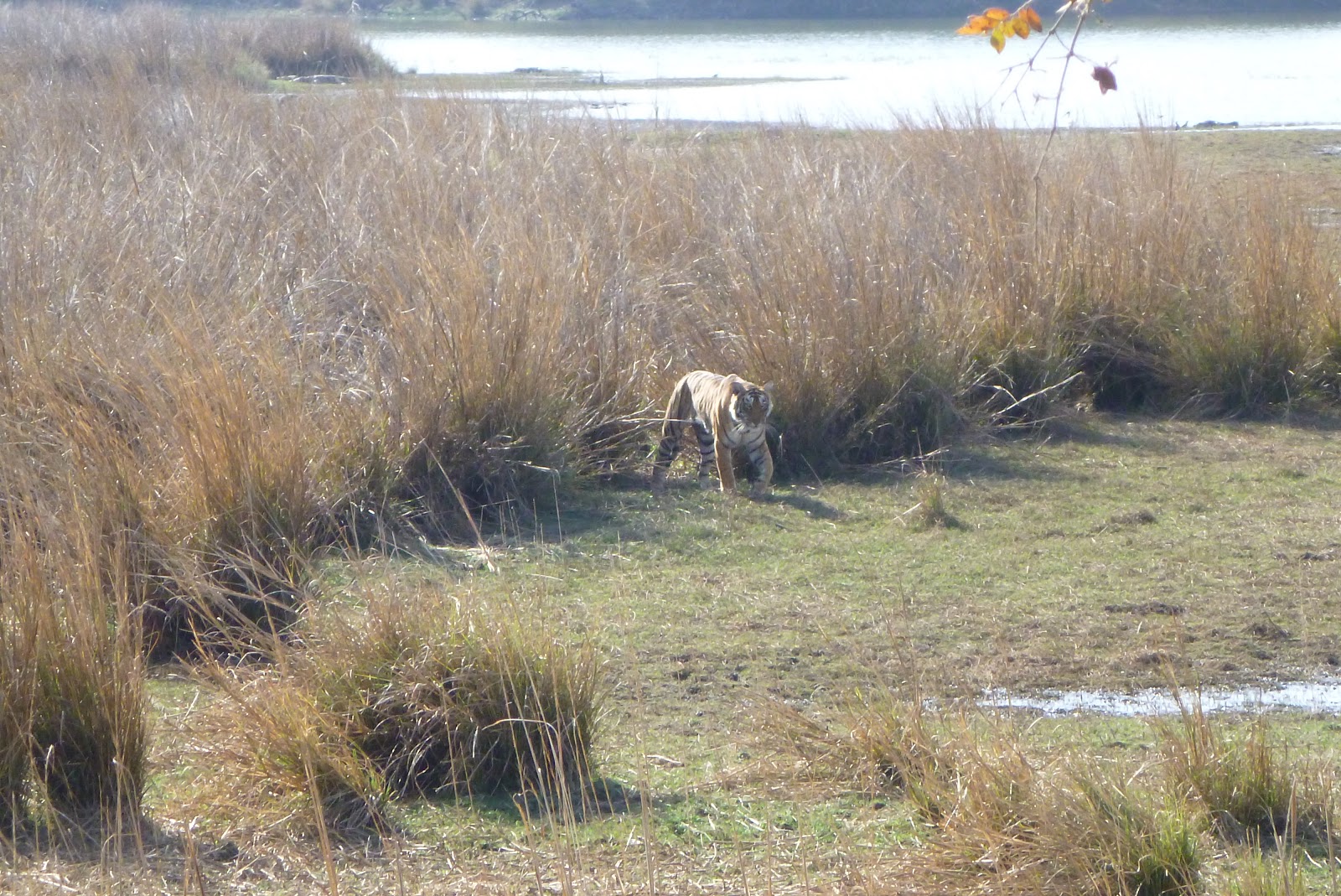
 The first tigress we saw was near a lake, hidden in the tall grass, her hangout place. You could spend days looking at the
The Markings Between Her Eyes Resemble An Arrowhead
grassy area without ever seeing her, but be assured, she sees you. We found, not that far away a carcass, a freshly killed antelope but it was not totally eaten. The guide suggested the carcass was too big for the tiger to drag to its den so it was left there, perhaps for a future meal.


A Magnificent Animal
The tigress in the grass, we later learned, was named Arrowhead (because of the markings on her head). She decided to pay ‘us’ a visit and came out of her grassy home. Her appearance caused a jeep stampede. All those little jeeps, maybe 10 or so, buzzed around her so people inside could take photographs or videos. It was a bouncy affair in those jeeps; the drivers drove over rocks, small trees, stumps etc. to get a good look at Arrowhead because a tiger sighting, this close, is a rare event. We were extremely lucky to have had the experience. Dinesh told me he counts the years now as “BT” or “AT”! BT is before seeing a tiger and AT is after seeing a tiger. Once you have seen a tiger in the wild you will never forget it. Dinesh is right; it was a sight I will never forget.


So Beautiful

Mr. Singh, A Most Remarkable Man
After our morning session we had to head back to the hotel for breakfast. Later, after lunch, the speaker was a Mr. Singh, who spoke freely of his experience meeting a tiger in the preserve. This tiger had been killing small animals in several villages so the villagers insisted Mr. Singh capture it or they would kill it. He knew it was very dangerous to corner a tiger and offer no escape. The tiger had no other option but to attack in order to escape. So Mr. Singh lost half his face and one eye. Years of rehabilitation and many surgeries later, Mr. Singh looks presentable again and still works for the forest service as a ranger.
Can You See Her?

For the afternoon we were lucky to have gotten admission again, thank you Dinesh, and again we were lucky to gain access to 3 jeeps for our group. Naturally we tried the grassy area again, hoping to see Arrowhead once more, but of course she saw us and did not show. We checked on the antelope carcass but there was no change. Nobody ate the rest of the antelope but we could tell the heat had started to blow up the carcass. So, Dinesh spoke with one of the wardens and we were allowed to change sectors and drive
The Lady of the Lake
into a different part of the park. Some other jeeps had also gotten permits and the waiting game started. This tigress was called “Lady of the Lake” and she supposedly had 3 cubs. We had to keep our distance. Carol managed to see her and took some photos but the Lady was hidden in grass, close to a tree. Difficult to see but yes, she was there. No sign of the cubs however. All tigers have different stripes, so the rangers give them names based on the look of the stripes or some other particularity. This tigress chose her core area near a smallish lake, so…Lady of the Lake. Tigers love water.
Tree-pie Birds Fighting Over the Seeds Dinesh Put In His Hat

We spent a good hour waiting to see more of Lady but then some of our group got antsy so we called it quits. Instead we visited what might be the largest Banyan tree in India. Tree is the wrong word, trees would be better. Banyan spread by using air roots and this tree had spread wide and majestically.


We were also lucky enough to see wild boars, a white owl, lots of spotted deer and peacocks, mongoose and monkeys. We stopped in one area and the Tree-pie birds were eating seeds out of our hands and from Dinesh’s hat.
Tree-pie Birds Love Those Seeds

Throughout the park are very old buildings, castles, temples, walls etc. now abandoned so that the preserve is truly left to the wildlife, to the tigers. It is a wild, natural preserve. Will it be large enough to save the tiger? There are people totally dedicated to saving the tiger. Dinesh seems to be one of those men. Mr. Singh, the speaker is one of those men. And then there is Mr. M.D. Parashar, an artist. He draws tigers. His art is in the U.S. White House. We met him late at night thanks to Dinesh. Those 2 men are friends.  

Mr. Parashar Made This Portrait of Arrowhead
With Soot and a Small Piece of Twisted Newspaper


Mr. Parashar it seems is obsessed by tigers, everything he paints is tigers. He had a soot drawing in black and white of the tiger we saw first, Arrowhead. Yes, soot, the black stuff you get when you burn a candle. In this case Mr. Parashar has his own ‘secret’ very fine soot he uses to paint with. This man has an eye for details, down to the hairs on the tigers he draws, detailed to the whiskers, to the eyes, to the stripes. I was floored. And I bought the Arrowhead painting as an early Birthday gift to myself. I now, too live in the “AT” time.

Mr. Parashar With His Art and Us

I was told the park is still owned by a Maharajah, that India only has been given the right to use it as a tiger preserve. Not sure if that is true though, I cannot find anything on this on the internet.

The study of tigers, the protection of the species is a large and intricate science and there is a large brotherhood of tiger conservationists among people in India. Dinesh is part of that group.

Sariska Tiger Foundation

D-4, Malviya Marg, C-Scheme, Jaipur, India

www.Sariskatigerfoundation.org - they do take donations.


At a Marble Factory, Run By the Jain


Huge Inlaid Marble Piece


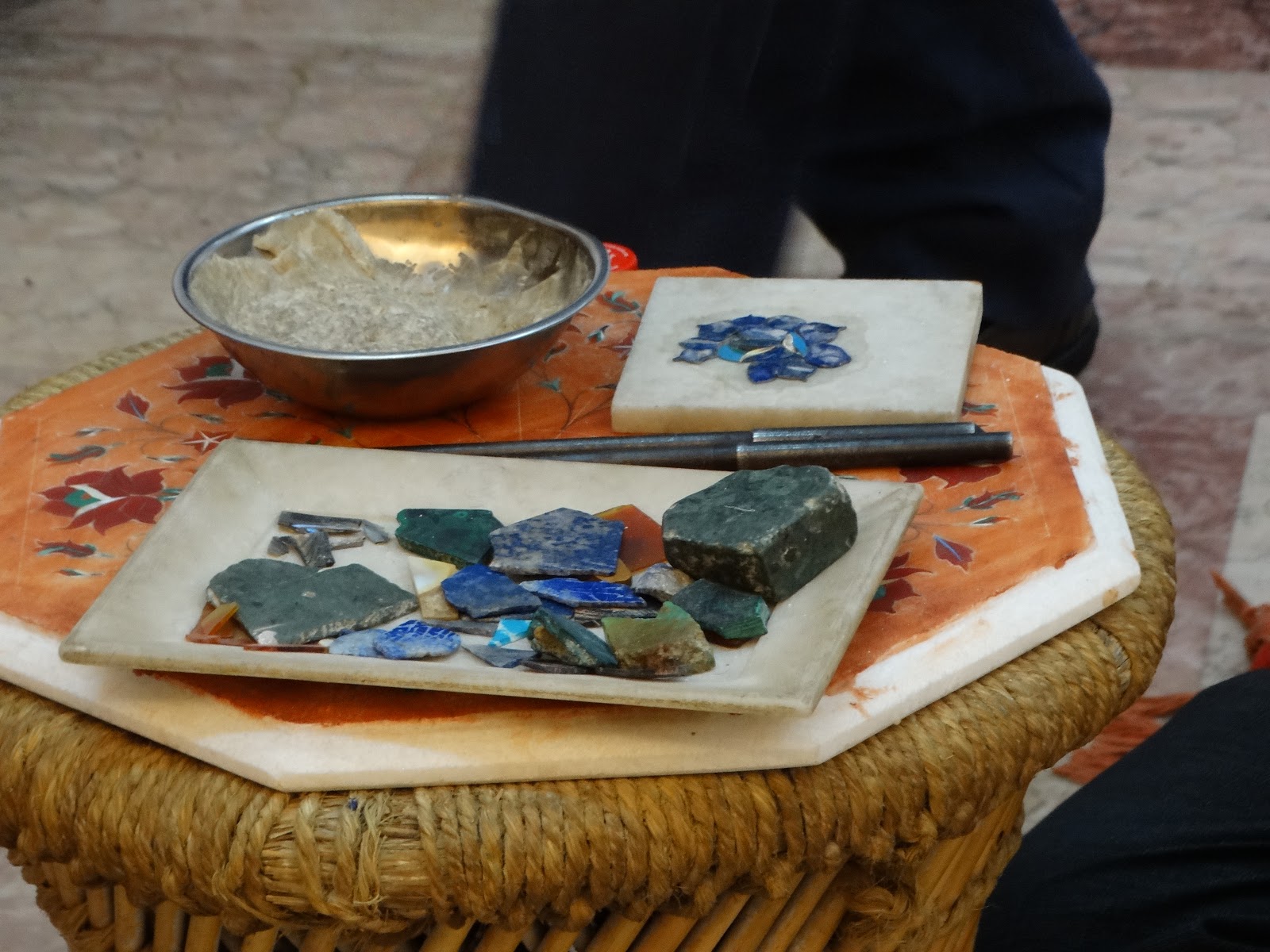
While in Agra, we visited a marble factory, a place where they still practice the ancient art of marble inlay work. Today those inlaid marble items are tables, lamps, jewelry boxes, etc. Anything that can be made out of marble is available.


Small Marble Boxes

But it still takes hard work to carve the marble, cut the semi-precious stones, the mother of pearl and it still takes lots of patience and perseverance. Here are a few Pictures Carol took while I bought a small table.


One Worker is Cutting Designs in the Marble
Other Has Attached Small Stones to the Stick
to Grind Them Into the Right Shape


Designs Have Been Cut Into the Marble


These Are the Stones That Will Be Cut To Fit


Here Is A Finished Table Top


Amazing Work - Tiny Pieces Cut By Hand

Sunday, May 07, 2017

On the Way to the Tiger Preserve

A Foggy? Smoggy? Morning


Sunday and the Living Is Easy.


Before we drove out of Agra we stopped one more time along the road to take a good bye picture of the Taj Mahal. We were in for a long bus ride. 10 hours to get to the tiger preserve, including stops every couple of hours for meals, bathroom breaks and one sightseeing spot..


Fatehpur Sikri

One of the Main Pavilions


Struts In the Form of Serpentine Scrolls Coming Out of the Mouth Monsters (click to see more detail
This Is Where the Elephant Was Tethered

 The sightseeing stop was the ‘Ghost’ Capital by the name of Fatehpur Sikri, a (UNESCO) town (1571-1585) that the famous Mogul Akbar wanted to establish, but the lack of water was so severe that the town and the palace were just abandoned. One spot within the palace was a large loop, secured in the ground, where an elephant used to be tied up. If someone was given the death sentence he was stomped to death by this elephant. Near to it, a Parcheesi board was set up, where the emperor played Parcheesi; using live people he ordered to move about on the board. It was not clear to me if he played Parcheesi while the execution was going on or
 not.

Nearby are the oldest hills (mountains) in India, the Aravalli range. Those ancient mountains are a wonderful source for garnets and emeralds.

All we did was ride the bus; get to the hotel and sleep, with just a few stops in between. India is a large country; the distances between major hubs are great distances.  We saw more greenery along the way, slowly turning into desert-like surroundings, well maybe not pure desert but much more arid and in need of rain.
Meditation?

So I take this bus ride time to chat about:

Jain:  a branch of Hinduism where the people do not believe in any personal possessions. Their purpose on Earth is to “do no harm”. Jainism has been around since 550 BCE. Some Jains do not even wear clothes, yes they walk around nude. Yes, we met Jains but not this extreme kind. All Jains are pure vegetarians and none wear any kind of animal skin like leather, furs, etc. The Jains I met all ran businesses.

Sikhs:  (Sikh men wear turbans, they never cut their hair.)
Philosophy and Beliefs: There is only One God. He is the same God for all people of all religions.
The soul goes through cycles of births and deaths before it reaches the human form. The goal of our life is to lead an exemplary existence so that one may merge with God. Sikhs should remember God at all times and practice living a virtuous and truthful life while maintaining a balance between their spiritual obligations and temporal obligations.

The true path to achieving salvation and merging with God does not require renunciation of the world or celibacy, but living the life of a householder, earning an honest living and avoiding worldly temptations and sins.

Sikhism condemns blind rituals such as fasting, visiting places of pilgrimage, superstitions, worship of the dead, idol worship etc.

Colourful Sari
 Sikhism preaches that people of different races, religions, or sex are all equal in the eyes of God. It teaches the full equality of men and women. Women can participate in any religious function or perform any Sikh ceremony or lead the congregation in prayer.

All Sikh people are named Singh, but when you meet a Singh it does not means he/she is a Sikh.

Even though Sikhs and Jains denounce Hinduism, Hindus seem to consider all other religions as an offshoot of Hinduism. India is a melting pot of all religions. Religious freedom seems paramount, and the laws of the land are adaptable to the religion you declare on your citizenship papers. So yes, you may walk around nude and you may marry and have 4 wives, etc. it all depends on what religion you practice, I guess.

“pur” and “bad”.  If the town ends with -pur (Jaipur) it's a Hindu town; If it ends in -bad (Allahabad) it's a Moslem town.
Another Colourful Sari

Maharajah:  Maha = big. Rajah = King. So, it means big King or Emperor. This set up of a main Chieftain was around before Islam invaded India.

Rajasthan means King’s Land, or land of the Kings. In fact we are on the way to the state of Rajasthan, and it was explained to me this way:

As we know Maharajahs had many children and only one could inherit the throne. What to do with all the other sons? Daughters were married off and moved in with their husband’s family. But what do you do with all the extra sons? Infighting, deporting, eliminating your rival brother was part of life then, only the smartest, strongest would survive. It's the law of survival, its competition.

Such Big Eyes You Have
So, what do you do with all those Rajahs? No they were not the Maha (big), they were just the Rajah. All of those sons, trained as warriors, educated as priests, from a caste of either Priest or Warrior class had to live somewhere. So, many moved into the less occupied areas, the deserts or semi deserts like Rajasthan and tried to live there. There was much infighting among those Rajput as they were called. Deep down they were loyal to their family, to their tribe, but of course their Maharaja Brother saw them as a threat, as competition, as usurpers. Rajasthan has many of those sons, so many that it was called the land of the kings = Rajasthan.

It becomes really complicated when Islam arrives, now two laws, two ways of looking at succession need to somehow fit the daily life. No wonder India had a Warrior’s Caste, those petty Kingdoms and later the Moguls fought each other tooth and nail all the time.

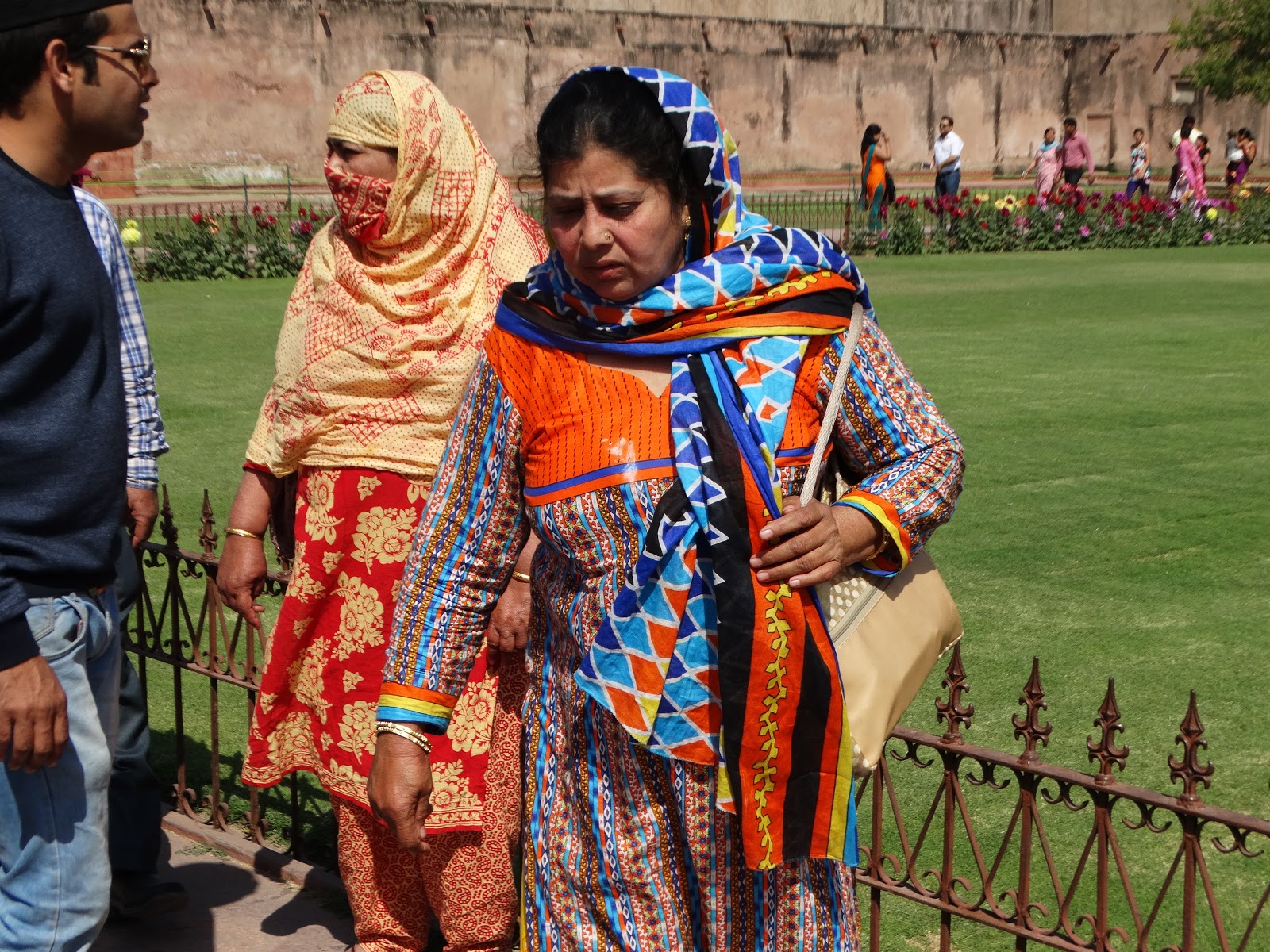
Amazing India!  Rajasthan women wear the most colorful saris.


More Pictures of the Red Fort

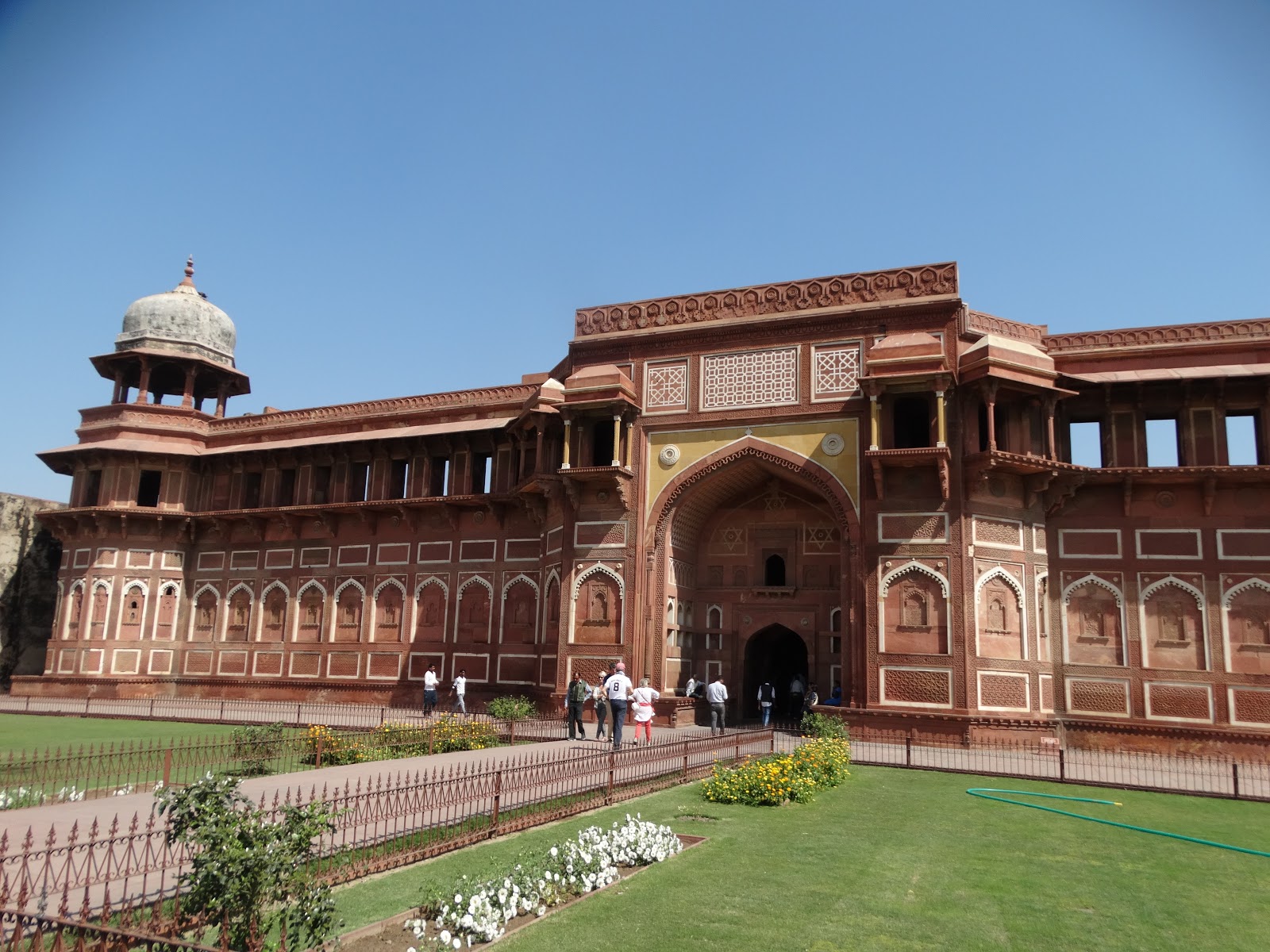
The Red Fort Looks Impenetrable

Even Close Up It Looks Like a Fortress


A 2nd Gate Inside the Previous Gate


Tile Work Around the Door


Inside the Red Fort

More Tile Work

Large, Open, Breezy and Cool Pavilion, Part of the Palace Complex

Decorated Pillars in the Pavilion

Inlaid Mother of Pearl Makes the Wall Glisten

Very Breezy on This Balcony


Another View of the Taj From a Nearby Balcony in the Palace


Highly Decorated Arches Everywhere

Beautiful Carvings

Tile Work On the Ceilings


Intricately Carved Door Corners

Building is Part of the Fort Not the Palace

More Intricate Carvings

They Must Have Been Highly Skilled Artisans


They Become More and More Elaborate

Incredibly Intricate Work

This Was the Shah's Bathtub - See the Steps Behind the Grill Work

Colourful Saris
A Family Portrait

Decorated Walls and Ceiling in an Alcove in the Palace

Alcove Decoration
Ceilings in the Palace


Inlaid Marble in the Palace


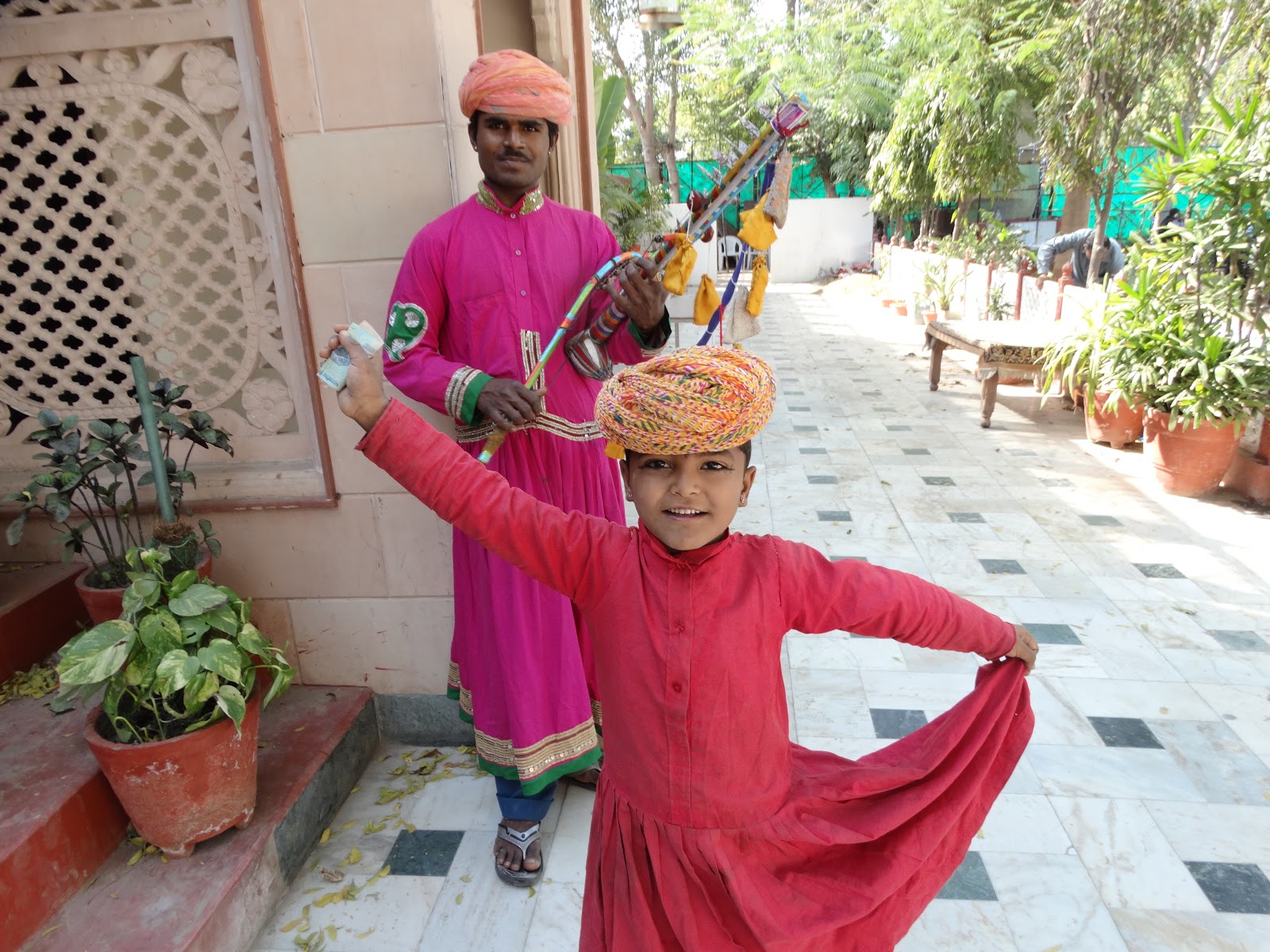
Dancing For Your Pleasure and Your Money