I saw a lot of advertisements on large billboards inside the
airport building. Silk dresses, gold and jewelry and Bollywood ladies all
smiled down on us. Kochi is the first airport I know that is entirely driven by
solar power. Electricity is inexpensive here. The sun always shines and it is
always hot and humid. The region is named the Kerala region, a State of India.
It's very tropical.
Kochi is on India's west coast, relatively close to the Horn of Africaand Arabian traders were here ages ago. Sailors from King Solomon’s time had already settled near Kochi. In 587 BC, after the 1st
Israeli temple was destroyed, Jews established themselves in India in great numbers.
Some
Jewish Area of Kochi
researchers’ claim they had settled as early as 600 BC, and Jewish
trading, had been done in Kochi for many years. Already a rather large Jewish
village was in Kochi around 52 AD, according to some written records. When
Israel was under Roman rule, this enclave was not affected at all. When, in 70
AD the Romans destroyed Israel and put every Jew in exile or slavery, destroyed
the 2nd temple, conquered Masada, etc., the Jewish people in India,
especially in Kochi were not affected, but some Jews from Israel fled to India
after the Roman destruction, joining the Jews who lived there already. The Jews
lived their life, had their own systems, beliefs and were free from
Hand Painted Floor Tiles In the Synagogue
suppression. After Jews were expelled from Spain in 1498, many more Sephardic Jews settled in this part of India. Cochin was sometimes called the New
Jerusalem. Their trade was in the spice business. This old Jewish section is
still around today, albeit very few Jews still live here now. After WW II, many
Jews in India resettled in Israel or moved to Australia or other modern places.
Their synagogue however, small as it may be, is still around. The present synagogue
was built in 1567. There are only 5 members today; the youngest is a 42 year
old female who is not married. The Kochi synagogue is the oldest,
Some of the Many Chandeliers In the Synagogue
active synagogue
in the British Empire. It is amazing to see such old history in Cochin.
The more commercial part of old Cochin, the basic layout of
the old town however, is a mix of Dutch housing, Portuguese housing and has a rural,
sometimes British feel. All the streets are tree lined, many parks abound and
the feeling is of a rich, wealthy small city.
We visited this “old” section of Kochi which still has special
rules, a left over from the colonial days. Not just the last British rules, but
treaties signed by the Portuguese and even the Dutch.
Dhobi Washing Clothes
Also Washing Clothes
They Prefer Hand Washing to the Machines
Laundry Drying In the Sun
One such treaty was the
area where still today, the laundry people (a former cast known as Dhobi) wash clothes
everyday. These low end trade workers had a treaty made with the British that
assured them 14 acres of land to do their work. They needed this much acreage
because they relied on a small creek to supply them with water and they spread
the clothes on the ground to dry. The town of Kochi some years ago made a deal
with them, in exchange for 10 acres, the town built them a quite modern
facility, washing machines, wells, ironing tables, etc. whatever they needed
and wanted. It was a fair exchange, everybody was happy at the end.
Today, like generations before, those people still wash for
families and households. While not rich, the Dhobi have a steady job and make a
good living in India's economy; US$ equivalent of $ 400.00 per week. Yes they
work hard but it's an honorable job and everybody is happy. We saw no one using
the washing machines; they prefer the old, tried and true hand washing and
natural sun drying methods.
St. Francis' Church
Kerala is the most educated state in India with 100% literacy,
but it also has high unemployment. Kerala, the state, is spread over 22 islands
with Kochi being the financial center. Tourism is the main industry.
These Paddles Were Moved By Slaves Standing Outside
The Movement Cooled the Congregation
The main tourist attraction would be the old Fort area of
Kochi. This section looks a bit like a medieval area of Portugal, or Holland,
or a British village. Like always, the center of town is the church, in this
case St. Francis’ church. It houses a tomb for Vasco da Gama, who died here.
His epitaph in the memory of the folks here is not good. He was a pillager, plunderer
and rapist who died of gonorrhea or syphilis. We also saw the house where da
Gama died. His remains were sent back to Portugal many years ago. Reading about
him I have to agree, he was not a good man.
The lovely old trees in and around Kochi, large, majestic
and healthy looking were planted about 300 years ago by the British. Thank you
for that, their shade is wonderful, I am glad you did that, Britain.
Shops Along the Street
The feel of the old fort section is of a cozy place, today
many small shops occupy the old houses and yes it’s a bit touristy.
The Mattancherry Palace: Built by Portugal in 1555, this
small Palace was a gift to the ruling Maharaja, to appease him for the terrible
destruction and raids of former Portuguese, especially Vasco da Gama and ilk. In
1663, when the Dutch took over from the Portuguese they updated and enlarged
and improved upon this Palace. It was thereafter always known as the Dutch
Palace. The place is known in India for the exquisite murals painted on many
walls. Hindu religious scenes, some even from the Portuguese time decorate the place.
The ceilings, the wood work, the tiles, all have an artistic touch. Brass
studded ceilings, along with many delicately
The Inside Of the Mattancherry Palace Was More Impressive
painted depictions of Vishnu,
Krishna, Shiva and others in the bedroom of the Maharaja give this Palace a
feel of Europe and India mixed. Treasures of the Maharaja are on display, 300
kg golden elephant seats, opulent furniture, gold and jewels. No photos
allowed.
This building, as it is, while under the protection of
historical places in India, is not up to international preservation standards.
Work is in progress to do so, however.
Our 89 Year Old Hostess and Her
Lunch time:an
unusual experience. We had lunch in a private home. Lunch as served by an 89
year old woman and her 3 daughters and/or daughters in law. The older lady was
very spry, spoke English well, and had owned this house since 1971. The house,
built years ago and then left in 1947 by the British is today in absolutely
marvelous condition. The 4 ladies keep it spotless and in perfect repair, down
to the lawn and garden. The furnishings were airy, simple yet classy. The meal
we were served was delicious. A cooking class was given by one of ladies to
show us how to make Fish Soup. Those women found a good way to supplement their income and also meet many nice foreigners. Good for them.
An Incredibly Good Fish Soup
The Family
Not Much Left After This Great Meal
The afternoon was hot, we took a little break.
Some mix-up occurred at dinner when I ordered the wrong food.
My hearing is not getting any better. Carol got stuck with oily humus, with
pomegranate seeds and black olives. Sounds OK to you?Carol does not like black olives, oops. She
also does not appreciate oily food, oops again. Poor Carol!
Our Two Kathakali Actors Before Make-Up
Starting to Apply Face-Paint
Late afternoon we went to an unusual performance, a
Kathakali. I have to reach back into deep history to make this performance a
bit understandable. Millennia back. But let it just be said that It is a performance,
a dance, a story-telling accompanied by music, based most times on religious
beliefs or old classical folk tales or stories of India; Mostly from southern
India. All dancers are male, even the females in the story are danced by males.
Dance is not the right word.
Starting to Apply Face-Paint
Demonstrating Some of the Hand and Eye Movements
There are 22 prescribed hand movements, hand
movements are given to supplement the spoken story. A separate speaker does the
speaking, or singing, the “dancer” only dances. There are ritualized steps (based
on ancient martial arts) and many facial features, especially eye movements,
which show the emotional state of the story being told.
In Full Costume
To top it all off the
make up, the masks, the costumes, the colors are all over the top. Each color
used in the garish makeup has a special meaning, defining the character being
acted out. There are many art forms combined in any performance. It takes
several hours to just apply the facial make up. While we were there our 2
actors gave an insight into the difficulty of applying make-up. They sat on
stage and let us witness the procedure of applying their make-up mask for over
an hour before they went behind the stage to finish their faces.
The Story Ends With the Murder of the "Woman"
To coordinate
their steps with the music, let
their eyes tell the emotional state of the
story, their hand movements show the progression of the tale told, keep their
appearance “lady-like” or act the demon, or King, or God, etc. all at the same
time, seems impossible, but those actors do it. It takes years of practice, it
is a refined art. The stage is empty, hardly any props. Connoisseurs see a lot
more than we see, but it was an amazing display of India. It was a unique
experience. Amazing India!
The history of Kathakali, if you are interested, can be read
on the internet. It portrays life as wonderful. To know more about it is a good
way to expand one’s horizon.
Gold Head Adornment for the Elephants
On the way back from the performance we saw some commotion
on the side of the road. Fiona had the bus stopped and we all got off.The local guide helped us get to the display close
up, right in the middle of it, in fact.
There were 3 huge elephants, decked out in royal garb, in
glistening, golden splendor, standing in the road and young men in traditional leg-dressings
were blowing trumpets, horns, and loud brass instruments and banging drums in
front of them. They were standing, not marching. Burning torches were lit and
swayed in front of the animals, which just stood there, taking it all in,
munching on sugarcane. The ‘music’ (racket) was tremendous. Supposedly it was a
festive celebration of a religious kind, honoring Shiva. I never found out for
sure, but it sure was loud and seemed ancient and historic.
Drummers Getting Frenzied
We were told the elephants were rented for the night. The
rent per elephant was 100,000 rupees (US$ 1540.00) for the night and you had to
feed the elephant with special foods, like sugarcane, etc.So, let's say those elephants were $5000, not
a cheap affair, add to that the young men's salaries, it was a very expensive
display. But for what reason were they hired? I never found out!You just have to experience India in her many
forms, simply stunning.
We had the morning to continue exploring Mysore so we started
off with a visit to the Chamindeshwai Temple. Set high on top of a hill at 3400
feet, this temple is over 100 years old and is now undergoing rehabilitation.
It's an active place.
Moped Blessing
We saw a priest bless a new moped. The bike was
garlanded and stood on its center stand. The owner smashed a coconut on the ground,
in front of the bike. The priest then walked around the bike a few times,
rubbed a paste on its headlight, handle-bars and seat and gave the owner 2
small lemons to put under the front and back tires to crush while driving over them. End of service.
I watched with keen interest, I now know how to do this. If
you want your Bike blessed in a similar way, my charge is $ 200 per blessing. –
A bargain, I saw what the Indian biker paid the priest –
Owner About To Smash Coconut On the Ground
Note Lemons Under the Wheels
Signs were posted around the temple proclaiming a “No
Plastic Zone“. This effort of creating zones hopefully will pay off and will
reduce the trash that accumulates everywhere in India. Good idea, if it is
enforced. Bins were set up to collect plastics.
Hinduism is truly a way of life, people were praying inside
the Temple and there were many ‘stations’ where the priests collected donations
for a yellow or white bindi or some water to splash, some flower pedals to
spread, etc. each activity costing money. It was a busy Temple. Outside, even
within the Temple grounds, beggars were asking for help.
Temple Priests Selling Offerings To Lord Shiva
Monkeys looked on or
hopped around. Naturally one had to enter without shoes on. Photos were
forbidden. Idols (statues) of the deity Shiva inside the Temple just sat and
watched the goings one. The Deity statues were lit up and richly decorated. I believe
that Shiva was well admired here.
Large Granite Nandi, Transport For Lord Shiva
On the way down from the temple we stopped at a Nandi; this
is the 5th largest Nandi in India. A Nandi represents the transport
Shiva uses when traveling. This Nandi was carved out of one large granite rock,
which had always been just standing there. People just ‘helped‘ to create an
image that they could understand better when they carved the rock. This rock,
this Nandi, is periodically washed, oiled and then covered with a mixture of
ash and turmeric. This procedure protects it but has turned the Nandi black.
St. Philomena
Now we were off to the airport in Bangalore, a 4 hour bus
ride to get there. Mysore has a perfectly good airport, brand new even, but…we
have to drive to Bangalore to catch a flight to Cochin (Kochi). The new airport
in Mysore was built in 2011 so why isn’t it open by now? Every tourist has to
come and go via Bangalore, 4 hours away.
St. Philomena Catholic Church
On the way to Bangalore we stopped at St. Philomena Church,
a Catholic Church. She is a Saint and a relic of her was obtained in France and
is now in a crypt downstairs in this church. By order of the Maharaja this
large cathedral was built to replace a much smaller church that stood in its
place. The cathedral is a copy of the Gothic style dome of Cologne, Germany. It
was finished in 1952.
Extracting a Green Liquid From Raw Sugar Cane
We also stopped along the way at a sugar press (factory?). I
have a difficult time writing the word factory. Let's say a place where
sugarcane is crushed and then boiled down to get raw sugar. It was not on the
tour schedule but was a good stop. It had a machine to crush the sugar cane, belt driven, powered by
electricity that was the only machine in the whole place. The rest was all done
by hand and could have been thousands of years old. The juice of the sugar cane
was boiled in a pot until it crystallized, voila sugar. The whole yard, all the
rooms were full of sugar cane. People slept there at night,
Boiled Then Stirred Until Thickened Then Put in Molds (Behind
the Stirrer). Tastes A Bit Like Maple Sugar
right on the cane.
It was a mess but…. They made sugar, Jaggery as they call it.
The process is as primitive as it gets but the end result
were large sugar cubes that were sold in the market place. This is a hard way
to make a living. I saw 4 people “living” inside the ‘factory’ but those were
just the workers I assume. The whole installation was shockingly low tech.
Now What Do I Do With This?
We had a lunch stop along our route someplace.
It was a busy
place, very typical South Indian cuisine. Food was served to me on a banana
leaf, utensils were my right hand. The food was excellent. And I could get as
much food as I could possibly eat.Not
everybody in our group ate like this but they missed something special. It was
outstanding. And an experience besides, because eating with my right hand, just
using my fingers to scoop up food, is not what I do often. It is a normal thing
in this southern region of India to eat like this. We watched Lakuma eat her
lunch on her banana leaf, wow she is good at it. The used banana leaves are fed
to animals or used for compost.
Difficult to Tear Bread With One Hand
On this bus ride we leaned the following:
Horses were not native to India; they only arrived with
Alexander the Great around 300 BCE. Hmmm!
Face painting for priests. Turmeric and lime mixed gives a
red color.White ash comes from burning
cow dung, from temple cows of course. Two red horizontal lines on a priest’s forehead
means he worships Shiva, red and white vertical lines means he worships Vishnu.
If a person smears these ashes all over his body it will reduce a fever.
Lakuma, With All Her Practice, Ate the Whole Meal With One Hand.
Her Left Hand Is Kept Hidden During the Meal
A priest has a 12 year education to become a priest.
There are words we use in English that are pure Indian
words: bungalow, catamaran, etc. I was told many but do not remember more.
Jaggery recipe and other food goodies:
Boil water; add jaggery, ginger and lime then let sit
overnight. Good to prevent dehydration. Many South Indians drink this every
day.
When hot food is dished out on the banana leaf it absorbs
some chlorophyll into the food which is a disease preventative.
Add buttermilk and yogurt in a pot, boil, and let sit…apply
on skin when cooled. Good against sunburn.
We learned a lot from you, Lakuma, thank you.
Lakuma said good-bye to us at the airport; she is flying
back to her husband.
When I was young I worked for a while in a bakery shop,
after school hours, mostly cleaning pots and pans. It takes a lot of scrubbing
to get those baked-on crumbs off. The people I worked for liked me, they would
have loved for me to be an apprentice, but starting work at 2 AM was not for
me. Here I am, on ‘vacation’ getting up at 3 AM…..groan.
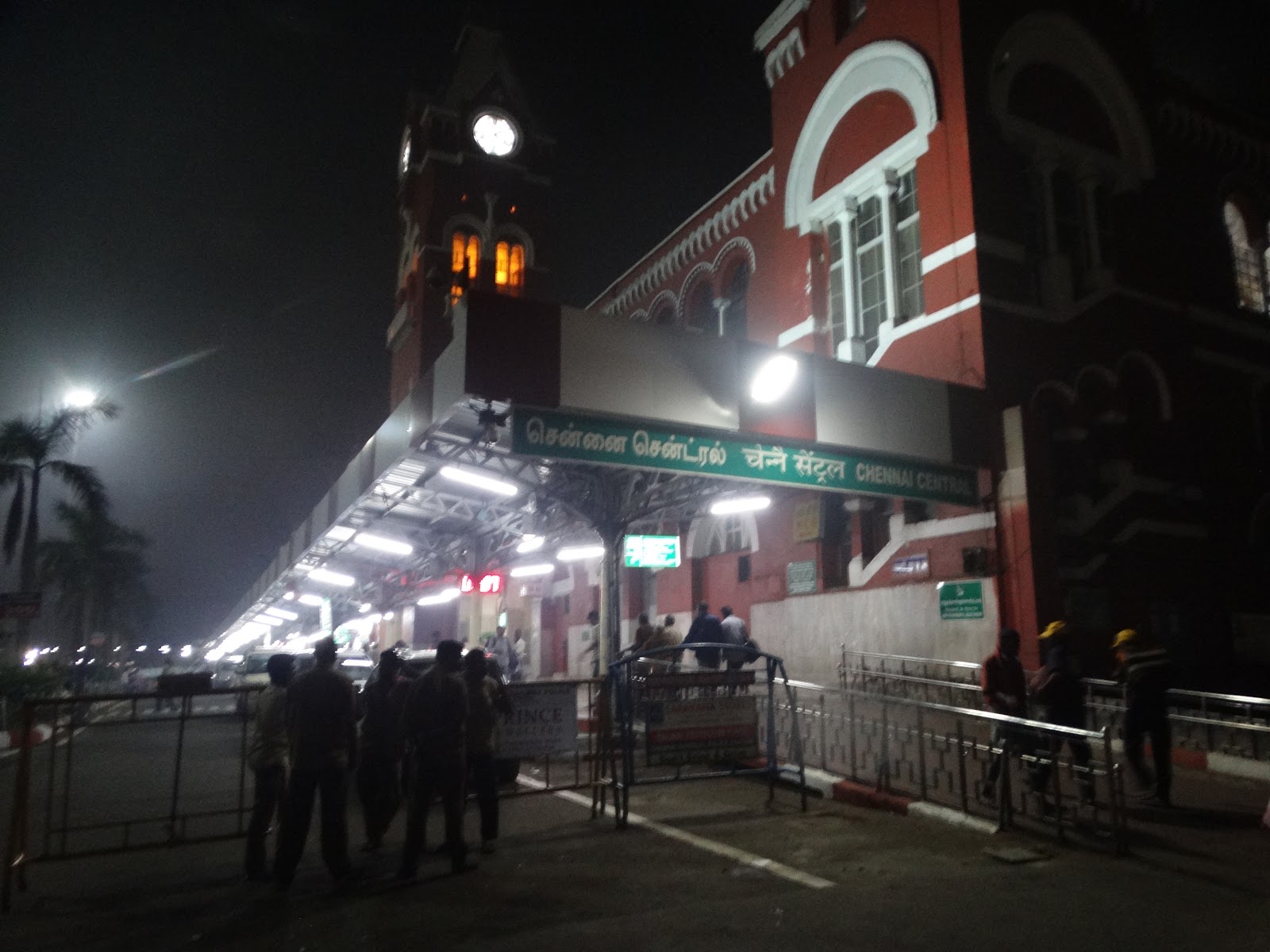
Still Dark As We Arrive At the Station
The train leaves at 6 and with packing the bus, driving to
the train station, finding the right train, hauling suitcases around, we
thought it would take a while. Lakuma was not there, she arrived a bit late, so
Fiona and Gary had to negotiate all. They did fine, we were early and nobody
had to haul luggage, all taken care of. The train ride from Chennai Central to
Mysore takes 7 to 8 hours on this express. So we relaxed, the hotel had
prepared a breakfast box for each of us.
Have you been in a large train station lately? Chennai’s is
huge, old but well-kept and yes, huge. I felt I entered a special world, not
related to life outside. Even the people waiting for
Inside the Cavernous Train Station
something, sitting,
sleeping on or near the platforms look different. Hand carts stand around, some
loaded, some not. Packages wrapped in burlap, porters looking for work. A train
station, especially this large, in a big city, is a town in itself. We had
first class seats which meant lots of space, A/C and seat service. We were
served coffee and yes, another breakfast and also, later on, a nice lunch.
Indian style of course, but we are in India. The train left on time, exactly at
6 AM. We were on the Shatabdhi Express Train, electric and fast. Outside
temperature at 4.45 AM was a sultry 27 C (84F).
Long Modern Train
Buzzing along at high speed we saw the country whiz by. Some
towns or villages were clean, some not so. I have taken many train rides in the
world and always found that the tracks are used as dumping places for the trash
that people need to get rid of. So I prepared myself for the worst in India,
but it was not bad. I was even impressed on how clean some towns looked.
Someone Left In a Hurry?
Oblivious In the Station
India has a large and old railroad system. The regular,
common trains can be overcrowded I read, I only saw the nicer side of India's
RR system. It worked well, was fast, clean and had all the amenities one could
want.
Mysore, Still Some Trash About
We arrived in Mysore in the afternoon and just dropped off
our bags, then took a bus to the Palace. Lakuma, whom I did not see in the
train, was our guide. We had to deposit our cameras at a station, no pictures
allowed inside the Mysore city palace. Yes, we could take some outside
pictures.
Entrance To the City Palace Is Free Of Trash
Mysore is advertised as the 2nd cleanest city in all of India because they have greatly restricted the use of plastic, I am told. I am not
sure what criteria were used to make that statement but you can read the qualifications by clicking on the link above. There were certainly less
plastic bags and bottles around. The mix of old, colonial and Indian housing
was pleasant to look at. The road layout, the old trees planted during the British
rule added to the orderly look, yet this is India. The claim: 2nd cleanest
town? It is all relative!
The Mysore Palace:by now, having traveled India, having seen
some grand palaces I wondered why we had to see this Palace, too? Is it really
that special? Look, we just traveled 8
hours by train to come here to see this place, how GRAND is it? We were told that
after the Taj Mahal, this is the 2nd most visited sight in India.
Another Building On the Palace Grounds
The first Palace built here was from the 14th
Century, but it was ripped down a few times to finally create the present
Palace. It was finished in 1912 and no expense was spared. In fact even after
1912 and as late as 1940, things, rooms, gardens, temples, etc. were added to
this complex. The whole installation is large and reminded me of Versailles.
Grandiose splendor, let them eat cake. There is this golden seat for the top of
an elephant, 750 kg in weight. It took 8 people to fit the seat to the
elephant. There are large silver doors inside the Palace. Other doors made out
of rosewood inlaid with ivory. Intricately carved teak
Close-Up Of the Intricate Carving On the Above Building
ceilings, hand painted
tiled floors. Not one, but 2 Dunbar halls (reception rooms), marbled in rare colored
marble, splendid and more splendid. The main, stained glass cupola was made in
Glasgow Scotland. The throne room left nothing to wish for. It seemed that taste
was secondary, as long as it was the most expensive way to decorate. Well,
taste is subjective; I really did not like Versailles either. The opulence was
over the top for my taste. In my mind I saw the men outside covering the rose
garden with cow manure, amid all the stink of it, too. India had this heritage,
I know it but sometimes it is difficult to look at, like in this case.
Main Entrance To the Main Palace
And the British, who fully supported this builder, this Maharajah,
and even installed him into power, were ultimately responsible for it all. The Maharajah would subdue his subjects so that the
British could reap even more benefits. The British gave him all the power, supported him, helped him in his squandering,
even encouraged this Maharajah, and backed him up. Yuk! It was overload for me.
It was too much.
I guess if you just came, had a look around, let yourself be
amazed at the former wealth, it's a nice enough place. The hype of Mysore being
the 2nd cleanest city is over rated. Mysore’s Palace 2nd main attraction
in India? Hmmmm!
One Side Of the Main Palace
The total complex had several (7?) temples within its walls.
Mysore itself has other palaces as well, but none as grand as this City Palace.
Fierce Palace Guardian
We progressed from the over-the-top richness of the Palace to
the city’s old spice market. Devaraj fruit and vegetable market the sign read.
It was well swept and kept orderly. The aroma of all the spices overwhelmed my
olfactory senses. There were hundreds of sellers, the prices were low but I was
in no position to buy anything.
Sweets In the Devaraj Fruit and Vegetable Market
The colors of all the offerings were a photo op
however. Lakuma felt at home here, I could just tell. I had a bit of a hard
time following Lakuma and tried not to get lost in the maze of the market. In
the end all was fine. Carol bought a bindi set; we looked at saffron, 400
Rupees/gram (US$ 6.15) but did not buy the spice. In my way of cooking I never
use saffron.
Mysore is known for its sandalwood, a very expensive wood. Buying
from a government source, if you can get it, costs US$ 200. per Kg plus tax (Jan 2017
price). A piece of wood, that expensive?
Colourful Spices
The oil from this wood costs way more, a bit more than $2000
a kilo. Did we buy some? No! The oil is mostly used in Hindu special services
and Mysore seems to be one of the centers for its production.
Silk and Incense, besides tourism, are the other industries
bringing money to the towns coffers.
We Had No Clue What Most Of the Vegetables Were
But They Were Very Colourful
Our Guide Lakuma With Another Of Her Beautiful Saris