Through my eyes

living my life without regrets

Monday, May 24, 2010

Bled

In order to go to the Slovenian town of Bled, famous for its idyllic setting, we had to get back to Austria for a little bit. The town of Bled comes highly recommended by every guide book. One cannot go to Slovenia and not go to Bled. We needed a rest anyway from the cold and from riding every day so we thought about staying 2 nights. Entering Austria was as difficult as leaving Austria. Little did we know that Austria would not let us go in or out without going over some tricky roads! The passes we had to take to get in or out of Austria were not that high, Paulitsch Sattel at 1338 meters, Schaida Sattel at 1069 meters and Kleiner Loibl Pass at 720 meters, but all had their own tricks up their sleeves. Having passed our baptism last year in Italy we managed each pass just fine, albeit it was hard work getting through all the hairpin curves, the narrow roads, the sometimes scary drop offs. We got a great workout, our arms hurt, and our necks pained us from looking up and way over through each hairpin curve. Some passes were so isolated that I thought about what I might have to do to get help, just in case. We were just the 2 of us riding the tricky roads. No time to take pictures, just hang on, do the right thing, get past this dangerous section, then get ready for the next twisty. One by one, we managed yet I can tell you these not so high passes were surprisingly difficult. We entered Slovenia again and again I had to get used to the names. How to you pronounce “Trižič “?
Once we arrived in Bled we were determined to be in the center of town. We saw a sign on a nice looking hotel, room with breakfast, double occupancy for 50 Euro a night. Great! We could not park or even stop in front of this hotel and had to find the back alley first. Once there we got off the bike and… the hotel was closed. Nice looking place but closed. I guess you can put any price on a place if you are closed. I tried the hotel next door but there the price for a room was 120 Euros per night. Even crying a little only brought it down to 96 Euros. I passed. The young man behind the reception of the open 3 star hotel heard me cry so loudly and had pity on me and told me about an apartment nearby that rented on a daily basis so we checked there. We got the room for 40 Euros without breakfast. Parking was in front of the door, we had a kitchen and while there were 52 steps up to our room (Carol counted them) and the place was old, run by an older lady that needed extra income, it was just fine. The apartment had the best location in town, too. A supermarket one street over gave us what we needed for food. We were ready to explore the place.
One of the things to do here is to walk around the lake. About a 2 hour walk. We passed. We have seen lakes before. Another thing to do is a boat trip, one guy rowing you and others to a small Island near the center of the lake for 12 Euro per person. The Island had a few trees and was so small it only had a small Chapel in the center and nothing else. We passed on that one, too. I am not that fond of Churches, Cathedrals and/or Chapels. That leaves the main Church of St. Martin and the castle, high on the cliff to explore.
The first day we walked up to St. Martin and it was nice enough, yet, like I said, I am not keen in visiting one church after another. I went just to get some walking in after all the riding we did. Through a well laid out park along the edge of the lake we meandered, always uphill, to this church. Yet it was open, Carol took some pictures and now it was time to return to our loft and rest for the night.
The next morning, the weather was wonderful and mild; we looked at each other and the castle from below. We decided to take a taxi up and walk down. It was a good choice. Even after arriving at the castle by car, we still had a steep hike for the last few hundred yards. The old bones start to creak and the lungs wheeze after walking like that. The castle contained a small museum and showed an exhibit of the local history. This well done display gave us an insight back to the beginning of Bled but I would like to add something here.
Slovenia has always been a country of turmoil. It is said that the Greek Argonauts under Jason travelled through the land and founded cities such as Ljubjana (Laibach). Some ancient finds give proof of this, depending how one looks at things. In Bled, it is shown that men occupied Slovenia during the Ice age. Slovenia has a history that is very diverse and difficult to study and to remember. While the Romans definitely founded towns such as Ljubjiana (Emona in Latin), Ptuj (Poetovia), Celje (Celia), the history of Slovenia started with local tribes such as the Celts and the Illyrians. Attila the Hun ran across the land in the 5th Century, burning everything in his path. A lot of written documents were lost during Attila’s carnage. The Roman settlers retreated to the coastline during Attila’s attack and founded the cities of Trieste (now in Italy) and the towns of Piran (Piranum) and Koper (Capris). The coast remained a Roman/Italian strong hold for centuries and the port cities served Italian city states, such as Venice, as safe harbors. The inland of Slovenia remained purely agricultural and is even today, a very hilly, very lush, very productive agricultural area.
After Attila the Hun left this region (Attila could never find a way to cross the Alps to attack Vienna) the devastated area he left behind in the 6th Century, was occupied by Slavic tribes coming from the East. These tribes brought along their superstitious beliefs and agriculture and founded an area known then as Karantania. Not long after this formation of a Slavic ‘State’ the new Christians from the North, the Germanic Frankish tribes forced Christianity onto the new Slavic settlers. In the 14th Century the house of Habsburg (Austria) took over for the Franks. The ‘Heilige Römische Reich Deutscher Nations’ (Holy Roman Reich of German Nations) took over. Vienna, as headquarter of this Reich, ruled for the longest time. The Balkan countries were along the route of the Holy Crusades (the many takeover attempts of the Catholic Church to take back Palestine from the new religion, Islam). A tide of warfare ebbed back and forth through this region between the Christians from the North and the Muslims, especially the Turks, from the South. These back and forth battles made for a difficult life. The coastline towns searched for alliances and found protection from the City States in Italy, like Venice for example. The inland was unprotected and, like a ping pong ball, frequently changed hands. Napoleon in the 18th Century occupied Slovenia, too. After the Peace Treaty in 1812 in Vienna, the area reverted back to the Holy Roman Reich of German Nations. Vienna was in charge again. The Elite, spell Royalty, promoted the German culture. The peasantry however, spell farmers and workers, were the people of Slavic descent.
This back and forth went on and on. The history of Slovenia is difficult. The museum in Bled could only give the smallest picture of its history yet did a fairly good job. After World War 1 Austria lost Slovenia, After World War 2 Russia or the Eastern Block took over and Slovenia was part of Yugoslavia. Yet here we are today, Slovenia is now, since 1991, independent and doing a great job being part of the EU.
Not that I learned all this at the museum in Bled but it is essential to understand when visiting this great county.
The town of Bled is indeed a good illustration of what Slovenia is today. Clean, sophisticated, industrious and very educated, the town is worth a visit.
If only…… we had to walk down from the castle and it is a long walk. Not only is the way long but dangerously precarious, following a path established by mountain goats, it seems. We were glad to be back near the edge of the lake and in the sophisticated surroundings of modern society. The area in and around Bled is good for young people. Hiking, canoeing, parasailing, bungee jumping, white water rafting, etc. are the main activities. It is nice to watch the young do it, but why jump out of a perfectly good airplane to skydive? I am getting old!

Sunday, May 23, 2010

Muta


I was curious as to what Slovenia felt and looked like. While in Austria we rode along the most Eastern part, along the border with Hungary. The new map from the ADAC had us pass through the most South Eastern city of Bad Radkersburg in Austria but we were close to the large Slovenian town of Maribor (Marburg). We could have stopped for a day or two at Bad Radkersburg, an old walled city with wonderful quiet streets and a relaxed atmosphere. Yet we wanted to end up in Slovenia so Maribor was a consideration for our fist stop in the Balkans.
It is always an experience to enter a new country; immediately the language changes. All the street signs are in different colors. The curbs are even painted differently. All signage is new to the eye and it takes awhile to get used to the new. The roads seem new, different and unusual. This is not the case when one drives from PA to NY but there is a much bigger difference over here in Europe. We crossed the open border without showing our passports. The old installations for passport control are still in place but all gates are open and we rode past those old aggravations.
Our first town after crossing the border was the town of Šentilij. I noticed the hat-check over the letter S, a special character that changed the pronunciation. Now my German, English, Spanish and a little French do not help at all. I do not know any of the Slavic languages spoken in the Balkans. Lucky for me, a lot of people speak English so that is what we will use from now on.
Riding thru Maribor made it clear this is not the town to spend the night. Maribor is way too big, way too busy. An hour west is the town of Dravograd and a pleasant ride along the Drava River brought us to the Information Bureau, still open, even on a Sunday. The best hotel they could find for us was Euro 96 per night, which included breakfast. I asked for a different, less expensive place and they guided us back to Muta or about 9 Km back on the same road we just travelled. Ok, off we went again. We had a price from the Travel info place of Euro 29 per person but when we got there is was the price for groups, not individuals. The proprietor was nice however; we compromised on 32 Euro per night, incl. breakfast. Wow! What a place it turned out to be. Wonderful! (www.gostilna-prilipi.si) our room was large and very comfortable with a view of the mountains surrounding us. The food served to us was outstanding in that it was all natural. It was Slovenian food; picked fresh that day and used in the kitchen to make delicious meals. The next morning, our breakfast was as astounding as the dinner we had the night before.
Next door to the gostilna (family run place) was a small church from 1052 which was dedicated by Pope Leo the 9th. One needed an appointment to get inside this jewel of a church but we were lucky, a painter who was working on the church let us in, free of charge. Should you ever come past this place, give it a try. Located right next to the road it is hard to miss. Muta itself is not much of a town but then, neither was Dravograd, the town we did not say in.
One more note about Maribor or Marburg. Before World War 1, this area was under the influence of the Austrian Empire, the Habsburgs, as they were called. German was the main language used at the time. A lot of towns had German names that were later changed to Slovenian names. Slovenia has a long history but I will explain what I know later.

Slowly thru Austria

The month of May is an early season in the Alpine area we are travelling through. Yes, all is green and it looks fantastic but the temperature is still cold. The small towns we visit on our bikes are just waking up from a sleepy winter. Tractors are plowing the fields; hay is being cut and laid out to dry. Cows graze and look at us with their bovine features. Life is good in Austria.
The ADAC map takes us to the really local places. The roads are not outstandingly stunning. This ADAC map is not only a layout of the high passes. We did the Grossglockner Pass last year and some of the Italian curves and dangerous sections I wrote about in 2009. This year with the new map, we are rolling along gently. Not that the roads are easy, but these are not the extreme sections one can find in Austria. If you like to meet the locals, this is the tour for you.
We rode that day until we had enough and found a bed for the night in a local Austrian Gasthaus in Fischbach (www.strudlwirt.at). The owner was cutting the lawn but stopped to show us our room. Dinner was cooked for us downstairs in the tavern, the bikes had to be pushed into the back yard under an overhang and we were good for the night.
I had asked around town for a private Zimmer, a place in a private home but while the signs are on the wall, the owners were not yet set up to receive guests. It is too early in the season, I guess. Life progresses in a certain rhythm. Between 1 and 3 PM all stores are still closed. Sunday is a day for church. Neighbors say hello and chat a little when they meet someone they know. Prices are not that low, however. A room for one night with breakfast is $ 60 or 70 Euro. Gasoline is 1.44 Euro per liter for regular; at least that is what we paid. I did notice that the octane rating starts at 91 Octane. Not the low stuff one gets in the U.S. I have seen gasoline of 99 Octane at pumps. Lots of people drive diesel cars and one needs to watch out when filling up the bike, since the diesel hose hangs right next to the gasoline hose. Don’t be asleep and put diesel into your bike. I did this in reverse, years ago, I put gasoline into a diesel car and I can tell you, it was an expensive experience. I had to pay for the repair of the rental car and it took days to get the car fixed.
There are differences in language, in Austria. In a restaurant, I had to ask what a Jause was. We do not have this word in German. The server in the hotel could not explain it, so I ordered it anyhow. Well, it is a cold meat platter. The plate I received had blood sausage, smoked ham, salami, and one or 2 slices of cheese thrown in, a pickle, a radish and some farmers bread. It made a good evening meal. We typically do not try to eat that much while on the road. Most rooms over here come with breakfast and we eat a good breakfast. Typically we have one or 2 hard rolls with cold cuts and cheese. An orange juice, one cup of good coffee and we are set for the day. Lunch we try to skip but since it is so cold at the moment we stop for soup mid-day if we can find it. Sometimes the soup is part of the menu daily special and then Carol gets the soup and I have the rest, which could be anything, from fish to sausage. In a small tourist town named Mariazell, we arrived at about 3 pm, way after the lunch hour and too early for dinner. We asked a guy in the street if he knew of a place that was open and he just looked at us and said, come. We followed him and we stepped into his restaurant and he cooked something for us, just so we would not be hungry. His place was not officially open. In fact, the cleaning stuff was still all over the place, chairs still on the tables, vacuum still plugged into the wall. We really interrupted the staff’s routine. The fish this man cooked for us was very good and, yes, we received a soup, too. I noticed people go out of their way if asked in the right way.
Our trip through the true, old time, authentic Austrian Country side was a pleasure. Nothing earth shattering yet it was extremely pleasant to find good hospitality, wonderful roads and pleasant people. We crossed Austria this way in two days and finally entered the Balkan, starting with Slovenia.

Friday, May 21, 2010

Leaving Heidelberg for Austria

A light mist is hanging in the air. Do I wear my rain suit? It is cold at 8 degrees C and the sky is overcast. The plan is not to use the Autobahn at all but get to the Austrian border near Salzburg using only the byways. I am good at reading maps, good at finding my way to the next town. I seem to have an instinct but I am not too proud to ask for directions when I feel I am lost. Speaking German helps, of course, but with so many dialects in Germany, I do not understand all that is said to me. I do not hear well, I wear ear plugs while riding. Over that I wear a full face helmet. Asking a Bavarian for directions, in a small town in Bavaria where everybody speaks in the Bavarian dialect is the same as not speaking German at all. Only when they point at a direction can I make out the correct way. The wind is picking up, it gets colder when riding.
Carol and I moved from small town to small town, always following the direction I had planned. The town names were long and we needed to start at Neckarsgemuend, then Mosbach, then Heilbronn, then Obersulm, Mainhardt, Gaildorf, Aalen, Elchingen, Neresheim, Ballmertzhofen, Schabingen and finally Dillingen where we needed to rest for the night. It is essential to write down the towns and their sequence on a piece of paper and follow this list. If you do not plan the route with the correct names you will get lost in Germany. There are no directional help signs like East or West over here. The roads are not necessarily numbered. It is best to know your next town and then move from one town to the next. Even that can be difficult since the signs often disappear or the names change to some smaller, lesser known destination. I have a GPS, old and with only a World Map as a base. My European GPS conked out on me, I had to rely on an old GPS but at least I can determine if I am going East or North, etc. The cloud cover is thick, no sign of the sun to find directions.
We stopped in Dillingen at a hotel that a gas station attendant recommended. The hotel Trumm (www.hotel-garni-trumm.de) worked out great for us. The breakfast was outstanding and the bikes were safe for the night. We were offered a garage for our bikes but opted to just throw the bike cover over each bike and park at the side of the hotel. Dillingen is a small town; crime did not seem to be an issue.
The next morning we were off again but the weather again was very cold. This time we put on our heated jackets. The warmth is wonderful. And to break our resolution, we took the Autobahn around Munich because to take the local roads thru Munich would have added an extra day to our trip. After finding the exit for Route 304 on the East Side of Munich, we exited again to take in the local flavor. Towns like Vaterstetten, Wasserburg, Traunreut and Freilassing flew by and we finally crossed the Austrian border in Salzburg. Again, do not take the Autobahn to cross into Austria, you will need an Austrian Vignette and why pay for something you will hardly use on a motorcycle?
Our intention was to stay in Salzburg but the city was big, busy and full of traffic, even on a Sunday. We rode thru Salzburg, the city Wolfgang Amadeus Mozart was born in, and searched for road 158. The signage in Austria was not easy to follow. Either the signs were too small, or the colors (white and blue) blend in so much it is almost impossible to find your way. I felt wrong after some time and sure enough, I asked, had to turn around and finally found the exit out of Salzburg and we were on the right road, road 158, the road we needed to get started.
ADAC has motorcycle specific maps. Each map is marked with Motorcycle specific roads. The best twisties, the best rural, the best scenic routes are all laid out. We obtained such a map for the Steiermark, Kaernten, Friaul and Slowenien. These are the areas where we intended to ride. Our starting point was the town of Admont, near Liezen, Austria.
We found another hotel for the night in the town of Fuschl am See, East of Salzburg and the next day we started off following the map we received from ADAC. From Fuschl am See we took 158 East to Lietzen and it is still cold. No rain to speak of, just cold and windy. The wind or the gusts seemed to be trying to blow us off the bikes. Traffic was light but we needed to get used to the signage in Austria. In the country side the white and blue signs are ok, yet still difficult to see sometimes. Again it is best to write down the sequences of towns one needs to travel through. Terz, Frein, Muerzberg, Wegsteig, Sebergsattel, Seewiesen, Au etc. were on my little notepad.
I followed from one town to the next and the ride was pleasant. The roads ADAC picked here were not dramatic yet were gentle and a pleasure to ride. Yes, some twisties, some up and downs but nothing that will strain you. We rode all day, enjoying the country and delighting in the Alpine views all around us. The area for me was typically Germanic. Everything around us was neat, orderly and predictable.
Carol and I were glad we had our electric vests. I was wearing an undershirt, a long sleeved silk shirt, a shirt, a BMW wind stopper jacket, the electric jacket plugged in at full heat, the Gore Tex liner for my riding jacket and the riding jacket and I was just right. But I needed every layer that I had on. Carol was wearing merino wool long johns, the BMW wind stopper jacket, a fleece sweater; the electric jacket liner plugged in and dialed up to “toasty” and her Aerostich jacket. We both looked and felt like, the Michelin Man but were warm and comfortable. I tried riding without the rain pants but it was too cold. I needed the rain paints for wind protection even though it was not raining.
We were now off on our adventure in Austria, following the map ADAC gave us.

Preparation


Before we began this trip we needed to find a flight to Frankfurt, Germany. I searched every available search engine on the internet for flights from Toronto (YYZ) to Frankfurt (FRA). I found Transat Air the least expensive at $ 958.-/person but then I waited too long to book it and the price turned into $ 1080 - then into $ 1198.-/person. This is way too expensive for a round trip ticket. I found that Air India flies out of Newark, NJ (EWK) for a price of $ 640.-/person and we booked that. Naturally we had to drive to NJ but since my children live there we combined it with a visit.
When travelling, every aspect needs to be planned and costs need to be compared. Once we arrived in Frankfurt we had to get to Heidelberg. I learned from my last trips that a Lufthansa shuttle bus departs every hour between Frankfurt Airport and a Heidelberg Hotel and I booked 2 seats on that shuttle via the internet. The cost for a one way ticket to Heidelberg came to Euro 22.-/person. From the Hotel stop in Heidelberg we took a taxi to Stefan Knopf (www.knopftours.com) where our bikes are stored. Cost for the Taxi is Euro 12.-. While all this seems complicated it is in fact very easy and beats taking the trains, buses, or costly pick-ups by a limo-service. The next best thing would have been to ask Stefan to pick us up at the airport but Stefan is very busy now that the motorcycle season has started and I did not want to burden him with our arrival. Our travelling, flight, bus, taxi went without incident and was completed as planned. We had some worries that we could be stranded because of the volcano eruption over Iceland, but none of that happened to us. We arrived in Heidelberg without complications.
We told Stefan via an email that we would be arriving on May 13th and he had our bikes ready for us. The needed paper work was done by Stefan as well. Our bikes needed Insurance for the 2 months that we will be riding in Europe and ADAC, a German Insurance company similar to AAA in the U.S., issues short term Insurance for foreigners and for motorcycles as well. Stefan handles all the paper work and the charge for a 2 months Insurance was Euro $ 250 per bike. In addition, we paid Stefan Euro 300 per bike annually to store the bikes. Add to that a yearly Insurance for road side assistance, also written by ADAC for Euro 115 plus 2 nights at Stefan’s Bed and Breakfast of Euro 60 per night and the trip starts off with a major expense. I will need a new front tire soon but this expense will come later. Riding a motorcycle in Europe is not an inexpensive hobby.
While we stayed at Stefan’s B&B we met Ken and Rita O’Malley who are going to visit Northern Italy this year. Ken stores his BMW at Stefan’s, too. Over dinner the first night we exchanged some info and I like the way Ken travels. Ken books a Hostel via Hostelworld and stays in one location for a few days. From that location he takes day trips on his bike and Ken plans very well and knows what he wants to see while in Northern Italy. Yes, he is flexible but he knows his route, knows what makes his trips worthwhile. For meals, Ken and Rita buy food at the local food markets and they cook in a micro wave or in the hostel kitchen. It is like living at home in a foreign country. Rita is a good cook and she can whip something up from whatever she finds in a supermarket. She showed me how they manage the food purchases on our 2nd day at Stefan’s. I learned a lot just watching and listening to her.
In return I told them how to enter Switzerland without buying the expensive Vignette, the Toll Sticker one must buy in order to travel thru Switzerland. Do not enter Switzerland on a highway. Take the local, secondary roads when entering Switzerland. Do not travel on the Swiss Highway system. If you do not use the highway, then you do not need the vignette. Naturally, the Euro is not accepted in Switzerland and you should have local currency, the Swiss Franc. Information of the most basic sometimes adds to a well planned trip.
Staying at Stefan’s B&B one runs into other bikers. While I know Ken and Rita and have been at their house in Louisiana and I know they know their stuff. Yet, each time I meet them anew I learn something from them. I also met a new guy from Michigan. This guy, Fred, just retired from GM after 37 years of toil. Fred it new to the EU and he bought a Honda, well equipped on E-Bay, just for the trip thru the Alps. Yes Fred was a newbie for Europe but he too, told me new things. He had an I Pod and stored all his info on this device. He received internet and weather reports on this gizmo and Fred even bought 100 Mega bytes of Phone calls for emergency calls to the States, just in case. I use “Medjet Assist Plus” for emergency situations. I pay Medjet but hope I will never use them. I do not have a telephone while travelling in Europe. I find the use of a phone and the European numbering system too complicated. When I need to make a phone call I use Skype on my portable mini-computer. I use a HP laptop computer, small and compact, made for travelling. I need a Wi-Fi connection however, and there are not too many hot spots in the Balkans, the place we have targeted for our trip this year. Travelling is always an experience and each time I travel I learn new things, new ways to travel. Nobody has the right way and each time we travel we adapt to the new country, the new language, and the new surroundings.
I prepare, I compare notes with other travelers, I am always looking and trying new ways to see the world. Some things are expensive but others, when planned right, are not. No matter the expense, motorcycle riding is my hobby and I use all my abilities to plan well, eat and sleep well. I want to ride well, without drama and arrive and be safe. I prepare the best I can.

Saturday, May 08, 2010

F 650 GS Test Ride.


Last night I went to the BMW dealership ‘Open Road ‘in Newmarket, ON to listen to the world traveler Rene Cormier (www.renedian.com), who put aside 5 years of his life to circumnavigate our earth on 2 wheels. He rode an older BMW 650 GSPD to do the job. He loved his bike; the bike never let him down. Rene had some wild stories to tell, it was a good night out. It rained so badly on the way back that, with wipers running at full speed, it was hard to see the 3-lane highway. Luckily, traffic was light; I stared at the white lines to guide me. This rain continued all night long. For this morning, I had plans to take a test ride at the same dealership, Open Road. After hearing Rene, after reading about the new F-650 with the bigger motor for some time now, I was not sure if I wanted to ride in this downpour. When I woke up this morning, the rain had abated and I said “What the heck, I’ve been wet before” and I went for my test ride.
I heard stories about the 650 Model. People love this bike. My daughter Michelle rode an F-650 for some time but I never did find out why she got rid of it. I have to remember to ask her. The new 650 actually has an 800cc motor. Yes, we all know it is stupid to call it a 650 if it has an 800cc motor but then I do not make the BMW policies. With a chain drive, the bike is a departure of what I have been riding so far. I am really looking for a lighter bike. I want a bike that is trouble free, dependable and is comfortable when going long distances. Yamaha has a new model this year the 2010 Ténéré, with a shaft drive and a 1000cc motor. I am also evaluating this Yamaha bike, but for now, it is not for sale in North America. I might be able to see it in Europe when I go next week.
I had made reservations for the first ride out this morning, at 9 AM and that meant getting up at 6 AM. Do I take my bike to ride to the dealership and then take a test bike? Alternatively, do I put all the stuff in the car, and then get dressed in the parking lot to test the F-650-GS? Checking the sky, checking the weather report on line, I choose the car. Well, ok, you might say I chickened out but boy was I lucky. I arrived at Open Road, had a cup of tea and did the usual paper work. All this was no hassle it was easy stuff. Yes, of course, I had to sign a waiver but that is now obligatory when you want to test ride a bike. Open Road had an F-650-GS ready for me and with a group of other people, we went out to see how the new bikes feel, ride, and behave. Please remember I am coming off a 1200 GS Adventure and there sure is a difference in handling. This 650 is quick and agile. I cannot get over how powerful the 800cc engine is. The range of the gears is wide. In first gear you can ride very slowly and without jerking, the motor chugs along whether you go slowly or give it some extra gas. Up-shifting is no effort, the gears fall right into place! Being in 2nd gear is almost enough to ride in heavy traffic. The power band is wide on this new 650. It feels better than on the 1200 Adventure, I ride now. Riding a bit out of town where the speed limit is 80 KM/hour (50MPH) I used third gear. Yes, I did go to fourth gear but I wanted to see if there was enough reserve in the motor. There is plenty of power on the 650, no matter what gear you are using. It was a pleasure riding this bike. Avoiding potholes was just a flick of the handle bar; the bike feels so light it is easy to do. Setting up for curves was a cinch; the ride feels solid and tight. The steering is precise. Leaning, even on wet pavement, from the rain last night, felt secure. Passing cars showed me a good, powerful, fast bike. I felt I was riding a mini version of my present 1200 GS. The 650 is smaller, yes, but at the same time, as good a ride as I could want. We rode on the 404 for some time and getting on to this highway I tried to crank it up. In fourth gear, while getting on, I hit 6000 RPM and then shifted to fifth gear. No jerks, the transition was smooth. Again I forgot the speed for a moment and concentrated on the RPM’s only and just before redline I up shifted to 6th gear. The motor just purred. It settled in to a comfortable sounding tone and when I checked my speed, I was riding along at 120+ KM/hour (80MPH), a bit high for Canadian and even U.S. standards. I eased off and smiled, the 650 is a good bike. I would change the seat if I bought a bike like that because I could feel my backside was a little sore after just one hour of riding. My feet were flat on the ground when stopped, the layout of the switches on the handlebar were logical, the display easy to read, the bike is good. It sure will be a contender when I start to down scale. Best of all, I rode the whole trip without any rain. It rained while going to the dealer ship but stopped once I arrived. It started to pour down on me again, once I was again in my car on the way back. It was a morning, I believe, made just for me, made for a good test ride on the 650 GS. The experience was excellent. Even the weatherman gave me a break, kept the rain at bay, and kept me dry. Now all I have to do is sell my other two bikes so I can entertain buying a new 650 seriously. The bike is ready for me, am I ready for it?
Once back in my car, driving back to Toronto, the sky, again, opened up in full force. I felt sorry for the riders I left behind. It rained so heavily that again, I used the full speed on my windshield wipers. It rained as if you had dumped out buckets! I was dry and comfortable in my car, with my heater on in Temps of 40 degrees F. Yet I had a good ride on a motorcycle this morning as well!

Sunday, May 02, 2010

A ride in the Woods

The forecast for the day was 23 degrees Celsius, sunny with occasional showers. Of course, it rained most of the day and mud and puddles highlighted our riding. Some members of the BMW Motorcycle Club of Ontario arranged to meet at Clinton Smout’s training school, CMTS (www.cmts.org) in Barrie, ON for a day of trying our riding skills on dirt roads at Horseshoe Valley. We met at 8.30 AM and after the usual paper work and putting on gear, which made all of us look like we were Star Wars soldiers on duty, we began our ride on the practice field in front of the office. Because we all ride on pavement, riding in sand, gravel and ruts with large stones or boulders is a new experience. A little practice before entering the trails was a good thing. It gave us all a chance to warm up and gave all of us a chance to get used to the new, different bikes. I rode an almost new, 230 cc Yamaha. I believe all of the bikes Clinton has are Yamahas and I am not such an expert on off road bikes that I would notice that one bike is better than another. Chris, one of the instructors, rode a 450 cc but then he sure knows how to ride a dirt bike. We circled over little bumps, rode alongside a very small hill, skidded thru a bit of sand and got a feel for how the tires gripped the gravel before we split into two groups. Our practice day started around 9.30 AM. About 10 of us had Chris in the lead with another guide at the tail, so about a dozen bikes. The other group, and I was in this group, were led by Joe. Our tail rider was John and he was a quiet chap but rode well. The basic positioning of the body on the seat was our first lesson. To shift your body forward gives the front wheel better traction. To move your body towards the end of the seating bench, loads more weight unto the rear wheel. These basic positions, most of them now instinctive with me, are always good to rehash. We left the premises in wonderful weather and our next exercise was learning how to skid to a stop. On an oval, narrow, sand track, in third gear, and at a good speed, we had to pull in the clutch and step hard on the rear brake. No, do not use the front brake. The result of this maneuver was a good slide of the rear wheel and the objective was to keep the bike straight and move the front wheel in the direction of the slide. We prepped for the feeling of the rear wheel wiggling and sliding away from under us. It was nothing new to me but the first time it happens; it created some anxiety, because instinctively I try to avoid this behavior on a bike and to make it happen on purpose is counter to what I normally do. After some practice, though, I had a good time slipping and sliding in the sand. We moved on to a section at Horseshoe Resort where a very twisty, tightly curved, single track, dirt path was laid out. This path meandered among some trees and around bushes and was just a left right, right left, arrangement to learn how to maneuver your bike around objects. The objective was to do it slowly and ride smoothly. By pulling in the clutch, even partway some times, revving the motor to keep the RPM’s up we crawled around the neighborhood. Some turns on this path had deep grooves to making the ride a bit more difficult. The ground was mostly sandy and we were lucky with this exercise because by now, it was raining constantly. The sand did not give us much of a problem but now we had puddles on the track. We rode back and forth a few times along this path to get us really used to it. By now, the rain came down in earnest. Joe told us that if he sees lighting we would stop and go back to base station to wait out the thunderstorm. Sure enough, that is exactly what we did. We rode off to base in our soaked, wet clothing to wait for a break in the weather. It gave all of us a chance to drink some water, to use the facilities behind the trailer and to get some rain gear. Not all this lasted long, thank god, the thunder and lightning moved off and again we went out for some more fun. Next, we practiced riding the bikes over logs. In an open practice field laid a small, about six-inch diameter, log and then a larger, about 15-inch diameter tree trunk. Joe showed us that yes, you can ride over logs like this, especially with the bikes we had. He rode towards each log and made sure each time he approached the log it was perpendicular to him. Just before the front tire reached the log, Joe stood on the pegs, twisted this throttle, and just rode squarely over the log. It was amazing to see what rider and bike could do. As a unit, they just hopped over the log and rode on as if little mattered. Those off road bikes are amazing. The power transfer to the rear wheel is so fast and always available that with a flip of the wrist this exercise was more of a confidence booster than a skill learned. The bike did all the work, it was easy enough to do, just remember to have the object perpendicular to you, stand on your pegs, and twist the throttle to get over the hurdle. The bike will do all the work for you. Remember this too, when you encounter objects on the road that appear to be insurmountable such as a 4x4 dropped from a truck, or similar debris. So now that we had practiced some basics, we moved on to ride into the woods under strict rules not to get lost or what to do if we, or someone else got hurt. Horseshoe Resort is very large and one can get lost in the vast forest. Staying with the group was essential. Lead by Joe and tailed by John we rode into the woods assuming that after our practice sessions, we now could ride among the trees. The speed was frisky and the road conditions were nature at her best. We encountered tree roots, wet soaking soil, rocks strewn about, tree trunks from previously cut down trees, steep grades up and down, whoop-de-doo sections, ruts of all dimensions, sand, low hanging branches, narrow passages between trees, twisty single file sections, angled hills, old and slick leaves, puddles of water and muck of undetermined depth. Sure, some folks got off the bike and inspected the surface of the forest floor a little closer. Sure, it took a bit of time to get the bike back on its wheels and get going again, but overall it was fun. This is a new way of riding for me. My bike performed flawlessly. I am very impressed with how the Yamaha performed when my performance was a little short of stellar. With a mind of its own, my bike found the route. It climbed over the fallen trees, jumped over rocks and inclines and bad sections of the trail. All I had to do is hang on and point it in the right direction; the bike did all the work. I give myself credit in that I took our training sessions in the morning seriously. It truly helped me not to fall, it really made the difference when I trained earlier, paid attention to the details and tried hard while testing myself just a few hours before. Riding roads like the ones we did, doing easy and not so easy trail riding, being in the extreme end of motorcycling could be addictive. I can see how this adventure could be part of me if only I were a few years younger. After a lunch at Crazy Horse, a nearby eatery who allowed us in with wet boots, wet clothing and a huge appetite some of us changed clothing or donned a rain jacket or rain suit back at base camp. My feet were soaked from all the rain. I did bring dry socks but what is the use, it still rained anyhow and the inside of my boots were soaked. I changed to a different pair of gloves; put a rain cover over a dry, new shirt and off we went for more of the same woods riding all afternoon. Our group increased because Joe took on some folks that wanted to ride along with us. We cut a swath this afternoon. I have no clue which way Joe took us but the terrain was very varied. At one point Joe asked all of us if we wanted to try climbing a steep hill. “You need considerable speed and be in third gear”: he said, “with high revs and not let up on the gas”. All of us said yes, of course and a long line formed. One by one, we assaulted the steep grade and I am happy to report all made it. Even the smaller 125 cc bike, with some coaxing arrived at the top. Ok, I give the riders some credit but all the bikes of our group did a fantastic job. All the bikes did what we asked of them and more. I made a small video clip of the last two riders. ( http://www.youtube.com/watch?v=ve9MGYomIP0 ) I hope the video downloads correctly. The ride for the afternoon took a good two or two and a half hours but it did not feel like it. My bike, at one point just died. It ran out of gasoline. Switching to reserve saved the day; I did make it to home base. The final treat for the day was a run on a motocross course. We had a large group of riders, like I said before and the course was crowded. One section, immediately after a left-hander was muddy. I had to go wide into the grass to avoid being stuck in the mud. The bumps were such that, with some extra speed, you could learn how to fly. I took it easy, no use spoiling the day with acrobatics. Joe explained to all of us that with age our bones are more brittle and snap easier. Young folks have more resilience. Well, as I said before, I did pay attention to Joe; I made it out of this experience unscathed. It was a good ride and I will do it again someday but not today. My arms are sore and my neck and shoulders are aching from exercising muscles I have not used for a while. I am glad I went and the newly developed riding skills may come in handy on the pavement, too. My confidence in my own bike is now much better, too. Many believe that BMW is the best bike around and if a Yamaha took that good care of me, then my own BMW certainly will take care of me. I sure hope this is true. All is well that ends well.

Sunday, April 11, 2010

Float your Fanny down the Ganny


The Ganaraska River, the Ganny, was my target on this day. The weather was perfect, the sun shone, the air was mild and spring had sprung. My bike ran almost by itself, I think it was happy to be out of the confines of the garage. It felt great taking the 401 East towards Port Hope. I had downloaded a map from the internet and to find the spot of Canadian fun was not difficult at all. Exit 461, then North took me directly to the start of the Canoes and Kayaks Race in Canton. I was so happy riding around that I arrived at 10.45 AM, exactly 45 minutes too late. The outhouses, 2 blue “Johnny on the Spot” plastic domes, were the only thing left to see. Well I missed that one!
At 11.00 AM, the Crazy Crafts were to be launched somewhere. Not being too familiar with the roads, I just road East and felt my way along the streets until I ended up at a bridge with lots of people watching the river and police activity and cars parked alongside the road. Even a Fire Engine was on hand. It looked so serious I parked my GS and took my camera to see what this special spot had to offer. I never made it to the Start Spot for the Crazy Crafts, either. I missed that one, too!
I read that somewhere along the river the whole contingent of Canoes, Kayaks and Crazies had to portage their craft around a fish ladder. I missed that ladder as well; I never saw fish, either!
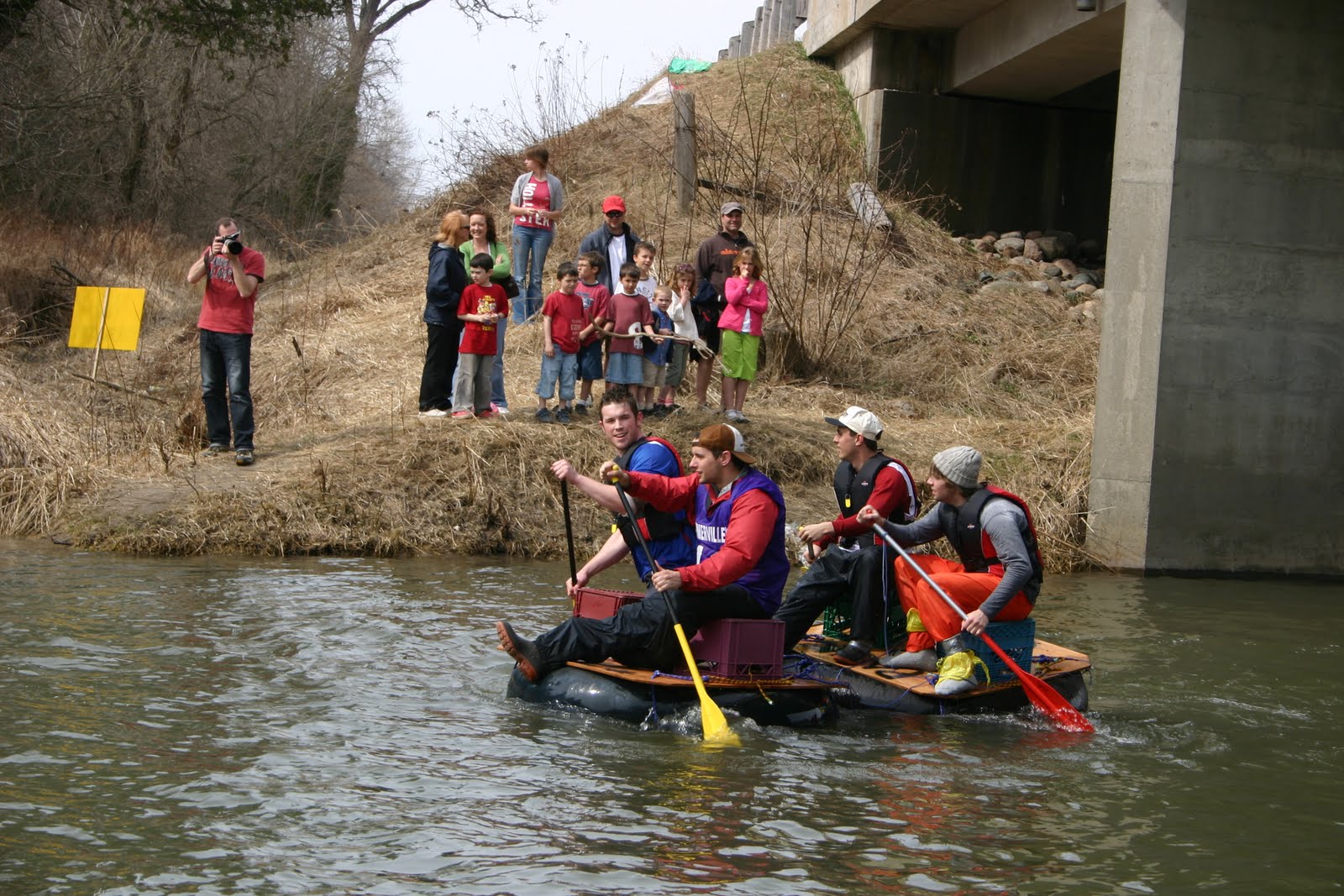
I was stuck on this nameless bridge; I think it was the highway bridge on 106 that spanned the Ganny. At first I stood on top of the bridge looking North in anticipation of some true crazy stuff. In my mind, I imagined fancy floats, similar to Carnival parades, float by. All the people around me stared up river, anticipating. Many people were about, yet I think their emotions were still partially frozen; this was after all, just the beginning of spring. Finally, a lonely canoe showed up on the horizon. This was no fancy float, just a late starter of the Canoe racers. With smiles and heavy paddling, the boat disappeared down river. Then, a quintet of canoes showed up, the occupants were wearing silly hats and had their faces painted but otherwise they looked quite normal.
I took come photos and crawled down the embankment after I asked a police officer if that would be ok to do. Having found a good spot, I was just in time to see the bulk of the Crazies approach my position. I found an Island in the river and stood in the way of the oncoming water traffic. I thought this is a cool, great spot. I took some nice pictures, but wished I’d had my telephoto lens mounted. Well, I made do with what I had.
Now, like a spigot that opened up, one float after the other showed up. Nothing looked like a parade but everybody had a great time. From the top of the bridge, people threw water-filled balloons at the crafts.

Not to be outdone, most of the folks in the flotilla had water guns or water pistols to return fire. The whole affair tuned into mayhem.
Youngsters, ever at the ready for fun, received and dished out water sprays. Balloons flew everywhere, missed some folks, bounced off others but mostly landed with a splash emptying their wet contents in somebody’s lap. The mood was happy. Boys, stripped down to their shorts, swam in the very frigid water to retrieve lost water balloons.
I had a huge smile on my face but I had to leave my spot on the Island because it was too wet. Nobody took aim at me yet being in the middle of it did not seem too wise. I retreated. Behind me the battles continued.

No participants of the Float your Fanny Races were there to win and be first. It was much more important to see and be seen. The 10 KM stretch down river was a fun activity and getting wet was part of it. In many shallow parts of the river, in rapids too, the floaters got out of their boats to lighten the craft or to push it through or past some obstacles. There are no rules in the race. Fun was the only thing that mattered. The affair was an awakening of the spirits after a deep, cold winter.
Silly costumes, elaborate boat constructions, ingenious designs were all part of this show. Come look at me, I am being silly is the best way to describe this affair.
When it seemed that everybody had passed me at the bridge spot, I went back to the bike and while there, I met another biker who told me to go downtown and see the end of the race. Sure enough, the crowds in Downtown Port Hope were huge. Parking was at a premium, even for a bike. Yet, I managed to get a spot and saw the end of the race, saw the same people I saw earlier now at the finish. Some had lost parts of their boats. Some crafts were just a wreck of their earlier appearance, others I never did see again. I watched and took pictures.
I cannot tell you who won, nor do I care to know. I can only tell you, if the weather is nice and you feel like a trip next year, go and see this spectacle on the first Saturday in April www.floatyourfanny.ca. It is something you do not see any place else. Only in Canada do people Float their Fannies in ice-cold water down a small river. Try to find the starting point for the Canoes and Kayaks, and then find the same for the Crazy Crafts. I think you will have lots of fun. On the other hand, if the Ontario club decides next year to make it an outing, let me know. I will try to make it there next year, no matter what. Either way I plan to see more of this nuttiness in 2011.

Good Bye Peru

I am writing this bit in Toronto, Canada.
It has now been some time since we left Peru. I am looking back and many people ask me “Well, what do you think of Peru?” I am puzzled as to how to answer the question. You should definitely go to Peru if you have never seen it. The trip we took was very educational, we learned a lot about the country, about the culture, the heritage, and the way of life in Peru. Having been exposed to many places in the world and seen various daily routines, I can say Peru is a good country to live in. Of course, it is not as rich as it would like to be, or even as educated as it could be, but it is a country where the inhabitants can be proud to live. No, I am not sorry I missed Machu Picchu. I found it somehow fitting that I travel and do not see or do the ‘usual’ things.
Looking back now, I find that the Jungle Tour was the most outstanding. There is just no way to ride a motorcycle thru this mud and vegetation. Roads are necessary and no matter what the riding skill level is, I do not understand how Helge Pedersen (www.globeriders.com) rode his bike thru the Darien Gap. Very unbelievable if it had not been for the pictures he brought back and published in his book ’10 Years on Two Wheels’. I take my hat off to him. Naturally, I had heard about the Inca Empire before I visited Peru but I was not aware how sophisticated the culture was until I saw the buildings and walls, the way cities were planned and the way food was collected and stored. The vast organizational setup and talents of the past, the power, and the knowledge can and must be seen to be appreciated.
So, yes, by all means, visit Peru. It is necessary to see and should be on everybody’s Bucket list. Carol and I took the trip to Peru without a bike to see ‘if’ we could ride our bikes all the way from Canada to Argentina. We thought Peru would give us an idea as to what we would experience while riding in South America. I can report that yes, riding in South America is not a problem. With the right precautions, finding shelter each night and getting enough fuel, it is not too difficult to ride and Carol and I are thinking further about taking the trip down to Tierra de Fuego. Meanwhile, we also know we are getting older and there is just so much more to see in the world, so many continents to visit, so many experiences to collect that we are running a race against time. Our friends Jean and Ross Copas just bought two KLR’s 650 and are preparing, along with friends of theirs, to do just such a trip. They are planning to ride from Canada to Tierra del Fuego. They will leave in October 2010, having planned a visit to Antarctica in January of 2011. I will see how their travel goes before I commit myself to riding this distance. Carol and I are preparing to visit Europe again starting in May of this year. Our bikes are already waiting for us in Heidelberg. I will write more blogs once we are there.

Sunday, March 14, 2010

new Nasca Lines in Japan???

How about this theory of mine regarding the mysterious Nasca lines in Peru?
The Inca or the Pre-Inca celebrated a good harvest and thanked the gods above by leaving their clan mark ( clan of the Hummingbird, for example ) in the sands. Just like the Japanese plant today for the sake of art alone. (See pictures below)

The mysterious lines in Nasca show or mark the location of water ( this is a fact ), so that the gods above could bring new water to the spots so indicated by the lines. The people in Peru tried to 'help' the gods by reminding them with arrows and lines where their water is and were the people will take the water from in the future. It was like saying: " God above, see this line ? This is were my water comes from. Could you please replenish it next year so that I have another good harvest? I am of the Hummingbird clan, I offer you my thanks by showing you my symbol 'painted' in the sands."
I think this is as good a solution to the mystery of the Nasca lines as any other.
I am so proud of myself that I solved the mystery of the Nasca lines, at least in my head it makes total sense.


with a grin on my face !
Hans


RICE FIELDS OF JAPAN � AMAZING
Looks ordinary enough....... but watch as
the rice grows!!!!!!


Stunning crop art has sprung up across rice fields in Japan ,

but this is no alien creation.

The designs have been cleverly PLANTED!


Farmers creating the huge displays use no ink or dye.

Instead, different colour rice plants

have been precisely and strategically arranged

and grown in the paddy fields.

As summer progresses and the plants shoot up,

the detailed artwork begins to emerge.


A Sengoku warrior on horseback

has been created from hundreds of thousands of rice plants.

The colours are created by using different varieties of rice plants,

whose leaves grow in certain colours.

This photo was taken in Inakadate , Japan .


Napoleon on horseback can be seen from the skies.

This was created by precision planting

and months of planning by villagers and farmers

located in Inkadate , Japan .


Fictional warrior Naoe Kanetsugu and his wife, Osen,

whose lives are featured on the television series 'Tenchijin'

appear in fields in the town of

Yonezawa in the Yamagata prefecture of Japan .


This year,

various artwork has popped up in other rice-farming areas of Japan ,

including designs of deer dancers.

Smaller works of 'crop-art' can be seen in other rice-farming areas of Japan

such as this image of Doraemon and deer dancers

The farmers create the murals

by planting little purple and yellow-leafed Kodaimai rice

along with their local green-leafed Tsugaru, a Roman variety,

to create the coloured patterns

in the time between planting and harvesting in September.

The murals in Inakadate cover 15,000 square meters of paddy fields.


From ground level,

the designs are invisible,

and viewers have to climb the mock castle tower of the village office

to get a glimpse of the work.


Closer to the image,

the careful placement of the thousands of rice plants in the paddy fields

can be seen.


Rice-paddy art was started there in 1993

as a local revitalization project,

an idea that grew from meetings of the village committees.

The different varieties of rice plants

grow alongside each other to create the masterpieces.


In the first nine years,

the village office workers and local farmers

grew a simple design of Mount Iwaki every year.


But their ideas grew more complicated and attracted more attention.


In 2005,

agreements between landowners


allowed the creation of enormous rice paddy art.
A year later,

organizers used computers

to precisely plot the planting of four differently colored rice varieties

that bring the images to life!

TRULY A WORK OF ART!!