Through my eyes

living my life without regrets

Saturday, January 23, 2016

Amsterdam, NL


Amsterdam, NL

OK, when you say Amsterdam to me the following things pop into my head: Red Light District, Anne Frank House, Rijks Museum, Grachten (Canals), Marijuana, very open minded society, Old Dutch Masters (artists), bicycles, no parking and house boats.

The Rijks Museum In The Back Ground 
What is on your mind when you think Amsterdam?

Amsterdam is a huge city, spread out, flat, with water everywhere and near impossible to see and explore in just a few days. We gave ourselves 2 days in Amsterdam, so you can imagine we know nothing of the real Amsterdam, but that was OK, too. We just wanted a quick look, wanted to see if we wanted to come back and explore it in depth. But who am I kidding, to just visit the Rijks Museum would take ages, it is jam packed with history, jam packed with art and facts.
Typical Dutch Housing 
House Boats Blend Right In 
Some House Boats Are Very Fancy
We took the public bus from the hotel into Amsterdam’s city center and then walked or took the trolley everywhere. There is not enough parking in downtown Amsterdam and if there is, it just is not worth it to get lost in the one way roads. Take the public transport. The first thing on our agenda was to take the canal sight-seeing trip via boat. Sure, it is a tourist thing to do, but it is similar to the hop-on/ hop-off bus trips one can take in other cities, it gives you an overview, a quick assessment of what you want to see and about where it is. Since Amsterdam is full of Grachten, the artificially constructed canals, taking a boat is a logical thing to do. 

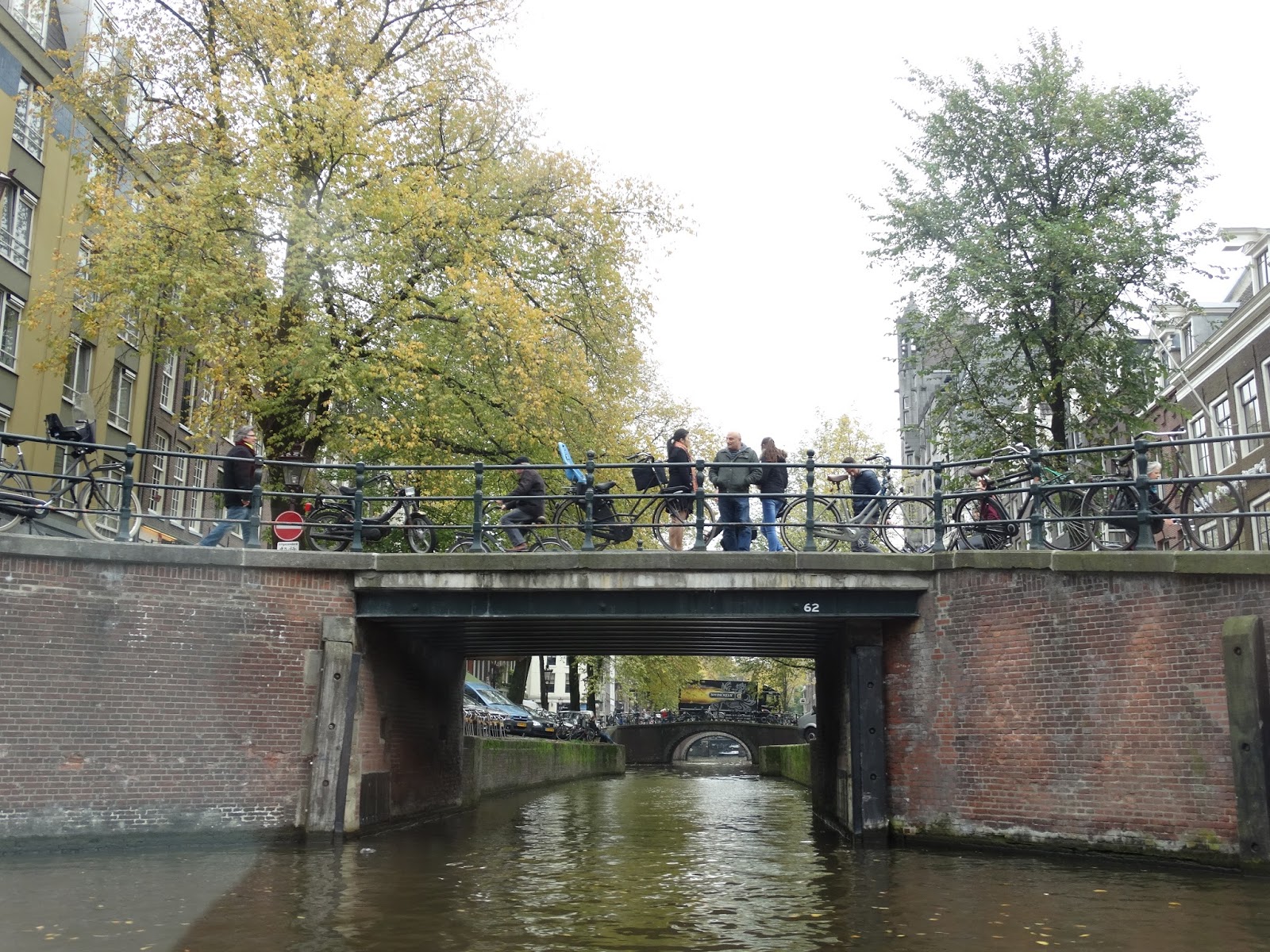
It was interesting to see the different architectural styles. The brides spanning the water are low, just high enough to let loaded barges pass. On the sides of those canals are barges or boats tied up (moored) that are used as housing. Yes, people really live in those boats. Some even had a parking spot arranged on them so the owners could park their car. Some boathouses had privacy screens, trees planted for a green effect or other quirky ways to make life comfortable for the inhabitants. It seems anything goes in Amsterdam; there is very little criticism when it comes to living your own lifestyle. Yet there are strict rules. Only so many boats are allowed throughout the city and if you like to live like a seafarer you can buy one of those boats. They are part of the local real estate market and not cheap. There is fun in Amsterdam, but living is not a free-for-all and rules do apply.

They Even Have A Museum Of Prostitution In The Red Light District

One of the rules is the regulation of the Sex Trade, very liberal, yet very strict, too. Each of the ‘workers’ undergoes a health check once a week. It is mandatory. While I saw ladies advertise themselves in a shopping window, in very revealing clothing, the actual act is performed in a private space behind closed doors. I was told there are 290 working girls in the district. 

Did Carol and I visit the red light district?  Of course we did! It is part of exploring what is offered. Did we buy anything? No! We only window shopped!

 Phobias seem to not be part of the Dutch life. Religion is up to each individual and you can have your own opinion about anything.

Carol wanted to see the Anne Frank house, I had seen it a few times but I went along and waited with Carol in line. We waited 90 minutes in line to buy an entrance ticket, standing in the rain. I did not go inside for the tour; I waited in the Cafeteria for Carol to finish her visit.  It is a depressing experience, really, and I did not want to be reminded (again) of how terrible the Jewish experiences were during Hitler’s time. Carol’s comments are:
A Very Long Line For The Anne Frank House Visit 
It was a very moving experience to walk first through the downstairs factory, then through a door hidden behind a bookcase and up a flight of narrow, steep stairs to the upstairs loft which held eight people for two years. There was only one toilet which could only be flushed at night. During the day when the factory workers were working directly beneath them, the hidden Jewish people had to be very quiet and could only speak in whispers. Food was brought to them at night by a friend who worked downstairs. 

After two years in hiding, all eight were discovered and sent to a concentration camp. Only the father survived the camp. Anne died a month before liberation after being told erroneously that her sister had died. After the war, Anne’s diary was found and made public by her father so that her story should not be lost.

Although the house was very crowded with tourists, no one spoke. We were not allowed to take pictures because that could detract from the stirring experience of imaging what it must have been like for Anne and her family. I also could not speak for some time after this visit. My life has been untouched by the horrors before, during and after WWII, but walking through this house, seeing the pictures and reading the history, reminded me again how cruel people can be towards one another. When will it end I wonder?

We mostly walked through Amsterdam. Never mind the rain, we managed OK. Daily life consumes most people and they don’t even pay attention to tourists in Amsterdam. Tourism for the Dutch is part of their daily life. Almost everybody speaks English, young and old alike. I could read and understand most of their signs but speaking Dutch takes some practice. I would need a few months to get a hang of it.
Cannabis Shop, Buy As Much As You Like. 
While walking through some streets, the sweet smell of marijuana wafted past us. Cannabis is legal in Amsterdam. The Dutch have shops throughout the city that sell different varieties of ‘weed’ and also all the paraphernalia one associates with smoking this stuff. I went into one of those stores but had no clue what was what. It seems to be for the connoisseur. I don’t fit that image.

We took the wrong bus back to our hotel on the first day and had to walk quite a bit at the end of the bus ride. That happens to the best of us. Even though I asked if this was the right bus, we were on the wrong bus. Luckily we were close enough to be able to walk back to our hotel.
View Along a Grachten 
On the 2nd day visiting the city, we concentrated mostly on the Rijks Museum. As mentioned, it is a huge place. It houses most of the paintings by the Old Dutch Masters. Any art lover can name quite a few of the pictures by just looking at them. There are some ‘modern’ painters, too, but mostly I found the Old Masters to be my focus. Van Gogh also has his own museum but we could not see everything there is to see in Amsterdam. The Rijks Museum is just too large for a quick visit. The themes for each room or section covered the Netherlands overseas, the Amsterdam period, the Haarlem Period, the Enlightenment, various Dutch Kings and other sections such as Goya, History, Prints, Japanese Officials, Meissen, Flemish Painters, etc. etc. All of it was a bit overwhelming and there were lots of people visiting the Museum. Our feet were sore that day and our minds filled to the brim. We took in so much that I can only mention a few paintings here: The famous Night Watch painting by Rembrandt, the Jewish Bride also be Rembrandt, Vermeer’s Milkmaid and The Little Street; the Museum is loaded with famous art pieces. Amazingly, we were allowed to take pictures in the Museum. Here are a few of them.
Entrance to the Rijks Museum 

Rembrandt Self Portrait 

The Jewish Bride (Rembrandt)
 

Wardens of the Amsterdam Drapers (Rembrandt)

Night Watch (Rembrandt)

Dutch Merchant Ship Model 

Battle of Waterloo (Jan Willem Pieneman)

Still Life (van Gogh)

Vincent van Gogh Self Portrait 

We had an overview, now Carol can for sure, say she has been to Holland, she has seen a lot. Yet I thought of showing her one more thing but for that we had to drive even further north. Read the next post.


Edam, NL

Edam, NL

Say Cheese! 

It is important, come on, say “Cheese”!  

So Many Cheeses, Which To Choose?
Well, it may not be important to you, but visit the town of Edam and you are in the epicenter of one of the most famous cheeses in the world. They even named a cheese after this town. I had to find a cheese factory in Edam to buy the local cheese. And I bought lots of it. We have a car, so I can pack stuff now. I love this cheese. My best meal would be a loaf of fresh French bread, some cheese (any kind) and a bottle of wine. Those are happy thoughts. Ever since I was a kid, growing up right next to the Dutch border, fresh Dutch Cheese was a treat for me. My mom used to buy it on occasion and ‘fresh cheese’ on a small roll (kind of like a French bread) even then was the best treat. 

Naturally we wanted to visit Amsterdam while being in the Netherlands but I thought staying in or near Edam would be better. The town is only about an hour North of Amsterdam, so it suited us fine to stay near to it. We chose the vacation resort in Volendam, a planned holiday resort that offered great prices in the low season. And like I said, we could take the local bus, right in front of the hotel, Hotel Marinapark, into the center of Amsterdam. Carol and I did some local exploring via car and got perfectly lost. We covered local streets in and around Volendam, drove through subdivisions, saw how people lived, moved with the traffic and enjoyed not knowing where we really were. After a while I had to set the GPS and this gizmo brought us back to our hotel without trouble. We did not have to know the roads; it was much more fun making a left, right or whatever to just follow our noses. Yes, we had to make U-turns a couple of times but it was all part of exploring the ‘real’ Holland, too. After securing my cheese and having settled in to our hotel we were set to now go and visit Amsterdam.


Delft, Holland, NL

Delft, NL
Best Personal Transport, All Over Holland 

We found an OK hotel for Delft. Right on a canal, like most places here in the old city. If not for modern vehicles, you could make believe you lived in the 17th Century. The houses look so Dutch, so typical of the old era. The houses are all tall and narrow, with a beam sticking out way on top so that heavy items could be lifted through the upper windows. The inside stairs are too narrow and way too steep to move a heavy piece of furniture. The Dutch are very practical people. All installations make real sense and Holland surely has their own style of living. Even today, Holland is a very liberal, livable country. The country is clean, organized and all the people I met are well fed and seem very happy. They are proud to be Dutch, or Netherlanders, or Hollanders. I am not sure what they prefer to be called, but it does not matter, you know what I mean.
Blue Delft Patterns Galore 


While we walked the old town a bit yesterday and visited the churches, looked at the unique houses and got a feeling for the old Holland, today we wanted to see the ‘famous’ Delft Porcelain factory. There used to be many like it in Delft but today, there are just a few, maybe even just one that still makes the famous blue colored tiles. The clay certainly is unique, it turns pure white after it is fired in a kiln and the blue tone of the paint, again, is something Delft is known for.

We also wanted to see the original spot where Vermeer painted, but I forgot about the great fire in 1654 (Delft Thunderclap) that almost totally burned Delft down. Vermeer’s studio was one of the many casualties. Most of his paintings were lost in this fire and he never recovered from the loss. His pictures today are so rare because of this fire but he did have a wonderful way of painting, especially domestic scenes. I learned that if there was a hand painted in a portrait, it would cost more; two hands even more again. At a time when there was no camera, no way to take a picture of a person, no way to leave a visual memory, portrait painting was a lucrative business. One had to be good artist to get referrals, clients and work. 

Bridges Just Tall Enough for Barges to Pass
Vermeer had a knack for bringing out the good features of the person he painted. He gave even a bit of mystery to the faces of his customers. His paintings were popular but he was a peculiar man too. He did not paint too much. His wife, after his death was left with debt. Read a book about him, he was one of the great artists the Dutch had; the book we read gave us a good insight into his personality. Oh I know it was fiction but then, every biography, even self-written is kind of a lie. To know about what I mean read Goethe’s ‘Die Leiden des Jungen Werther’. Yes, they did translate that into English. It is a good read and so true!
Canals (Grachten) Everywhere 

The Delft tile and porcelain factory has been in operation since 1653. Today, the product is called Royal Delft and the amount of art, decoration and items this smallish factory produces is amazing. The original archives go back centuries and this factory has not stood still. While the product today is equal if not better than the old items, the methods have constantly improved and production of the Royal Delft uses the latest technology where it can help. Still, the paint is applied by hand, by artists. In the final steps, the details are painstakingly checked and improved by hand. It is an artistic shop, full of good ideas, of merchandise that is shipped worldwide and as spelled out in the name, it has the blessing of the Royal Dutch Family, the House of Orange. Tourists today play a large part of the business plan, the factory set aside a section for tourists to explore and see how things are made. The visiting tour given has everything one can ask for including a café that serves great snacks and coffee with a fantastic view of the central courtyard.
Blue Delft Tiles Wherever You Look 


An Artist Adding The Patterns By Hand

Cafe (In The Background) Overlooks This Lovely Courtyard


Romantic Canals at Night 

The Dutch are smart business people. The Royal Delft is a good example of how to make money from history, from old ways, from the Dutch heritage. But then not only the factory, but all of Holland is set up and geared to serve their guests, serve their tourists. Delft is just one city of many that love visitors, loves to show off how it used to be. Delft is a great place to visit. Carol and I had a good time and we liked the way Delft preserved its old ways without losing the advantage of today’s latest technology. In front of the old Royal Delft factory is a charging station for electric cars. Talk about being with it!  Go Delft!!
Super Modern Factories
Charging Station for Electric Cars


Driving to Delft, Holland, (NL)

Driving To Delft

We have 2 weeks left before our flight home so decided to see some of Holland. At the airport in Frankfurt, I rented a car and in order to drive it for 2 weeks, without worry of any kind, I took the all-inclusive insurance the Company offered. Yes, I know, I could have saved money but I had a strange feeling that this would be the best way. As a ‘thank you’ the guy behind the counter gave me an upgrade and I drove a brand new Ford Diesel (S-Max?) with all the latest frills. I drive a 2012 Prius at home, but this Ford car was amazing. It shut off the idle while at a red light, had lights that went from high-beam to low beam and reverse automatically, separate heat controls for driver and passenger (Carol loved that), back up radar, radar for vehicles in the blind spots, wipers that went on and adjusted speed automatically, 2 USB ports, was key-less, etc. etc. The fuel consumption was very low, it drove wonderfully and it is just a shame it is not shipped to the U.S. or Canadian market. I really liked driving this car. It was powerful despite having a diesel engine. Smallish, agile but roomy enough inside, great heated seats too, with 3 levels of heat. 

After we picked up the car, did all the paper work, packed our luggage into the back of the car I just drove a little bit that day to get used to driving it. Our first stop was the town of Limburg an der Lahn, an old German town.The town has nothing to do with the Limburger Cheese, that is a totally separate town in Belgium, same name though.   

And wouldn’t you know it? I was photographed on the way to Limburg. A picture was taken by one of those automatic ticket issuing flashlight machines. The ticket will arrive in the mail any place in the world and the letter will tell you how fast you were going. Your picture, the driver’s picture will be attached, along with the time of day, the route you were on, etc. etc. The set-up is very efficient. I was going 59 KM in a 50 KM Zone and the fine was 15 Euros, to be sent to a Bank account. All is much automated. If I don’t pay, it will go to a higher authority and the fines will increase. Now, remember I received this ‘ticket’ after I was already in Canada. Did I pay it?  Smiles! What do you think?

We stayed overnight in Limburg, walked around the old town, window watched mostly and enjoyed a relaxing afternoon. The hotel was so-so, nothing to write home about.

Carol and I decided while in Limburg to visit Delft, in Holland. We both read a book awhile ago called ‘Girl with a Pearl Earring' and the book focuses on JanVermeer, the artist who painted the ‘Girl with a Pearl Earring’. 

Since looking for painters seemed to be a lead-in for our trip to the Netherlands, we now scouted out the Old Masters, artists of old in Holland. This was our goal for the next few days while we got to know some of the Dutch ways. Seeing work by Rembrandt, Vermeer, Van Gogh and many others was our goal. I love traveling when I have a focus. It makes it much more interesting and exciting to follow clues and discover what is available. We could have picked windmills, but we now had an interesting theme. I did this with music in Germany, food in France, wine in Spain, etc. Pick a subject and then have a great time exploring, for example “Who makes or where can I find the best Margarita?”  It will take you a long time to find that one. You will also need a ‘baseline’, so go to Key West, FL and drink a Margarita at Jimmy Buffet’s Margaritaville, and then compare everything else to that. Good luck……..hic……!

On the way to Delft I drove past the town of my birth and visited the public school I attended for 8 years. The school is now closed; it is just too old for the modern age. Built in 1848, it is a relic and the town put the building under ‘historic protection’. Yes, I am that old! 

Overberg Schule (#36), Inrath, My Old Public School
As luck would have it, the new owner of the property (it was auctioned off for the best price) was checking on something and we started to talk. The school building has to be maintained from the outside as a historic landmark but the inside can and will be converted into apartments. Each classroom will become a self-sufficient and independent living -space. I was invited inside to see where, I as a kid, learned my ABCs. Probably the last time anybody will see the old school. From now on, this will be an apartment building. It brought about some nostalgic feelings. When I showed Carol the classroom where I spent my time when younger, she could not believe the simplicity of it. We had the 5th and 6th Grade squeezed into one room, a total of 97 kids in one class. So when you were in the 5th Grade and then moved up to the 6th grade you were still in the same class room, you only received a bunch of new kids that moved up from grade 4. No, we did not move about the school, our one teacher was all we had. He was the art teacher, science teacher, math teacher, etc. He was the ‘everything’ teacher. And he ruled with an iron fist. How could he not, with 97 boys in one room. It sure brought back memories.

Grachten in Delft 
The drive toward Delft was uneventful, but if one does not know the area, like Carol did not know, then Holland becomes a strange place to visit. It is flat like a table top. Fields and ditches along the roads. A lot of Holland still needs to be drained daily. The major area of Holland is below sea-level and in years back that is what the windmills did, they pumped the water out of the ground and guided the water into canals. Those canals then were the highways throughout Holland. It was a very efficient way to move freight, to visit other towns, to make all of the land accessible. Today mechanical pumping stations take care of most of the water, but yes, the water still needs to be pumped out of Holland. The old canals still work but are mostly of historic value, just like the old windmills.

Oude Kirk in Delft 
Delft is packed full of canals. The old houses were built along those canals, warehouses, too. Factories and government buildings, churches, everything was concentrated on or around those canals. The ground, the dry ground was very fertile land and things grow very well with the climate being perfect for northern crops. A lot of grass grows on the flat grounds, so the cows are in heaven. There is no need for fencing, the ditches for water run-off will keep the cattle in place, they naturally shun the deep ditches and stay on their plots. All of Holland is still crisscrossed with drainage ditches, canals and run offs.

Typical of Holland?
Delft is and was a very good town for business. But also for artsy people, since the people who live in Delft could afford to hire artists to enhance their lives.

We booked a hotel downtown, in the old part of town, within walking distance of everything. Delft is not a cheap place to visit. Parking alone costs 30 Euros a day, if you can find a parking spot.

We checked in, had supper someplace but our trip in delft will really start only tomorrow. 
The Good Old Times


Thursday, January 21, 2016

Munich, Germany, D

Munich, D


Munich is a Mega City. It is a gateway and we used it as such. We stopped here only out of habit. Once you have seen the inner city, once you understand the vibes that run through the place it is a concept you will never forget. Munich is nice but it’s a business town; similar to Frankfurt or Hamburg. We took a hotel on the outskirts and used the train to get to the center. The train service is fantastic in Germany, always on time, always clean and predictable. The train station into the city was a 2 minute walk from the hotel BM Bavaria and so travelling in or around Munich was made easy. It is the best way to go should you ever visit. Use their public transportation system.

We had rain so walking was not much fun; still we visited the downtown area, saw the Glockenspiel again, had some nice German meals, and even took the hour double Decker bus visitor’s tour. But….. we have been here before; we knew a lot of stuff. It was like visiting an old friend. It was comfortable.  I scheduled this stop in Munich to get our bearings after our ride through Eastern Europe. We made a big loop, leaving Heidelberg going east, then all the way south, west and now north again to almost finish. All we have to do is get back to Heidelberg but that is no issue at all. The German road system is fantastic and predictable. We could have made it from Innsbruck in one go. But we needed to stop. 

The Open Air Market In Munich 
I contacted Stefan Knopf and he said, yes he has room for us, is looking forward to seeing us again, but he asked us to not mind him, he is packing, he is short on time, he is preoccupied because he and his family (9 people) are going on a 9 month world trip. Wow! I felt a bit like an intruder, I did not really want to interrupt in his preparations but we had no choice, we have to drop off our bikes at his place in Heidelberg. That is where we store our bikes in Europe. So a bit reluctantly, after sorting ourselves out in Munich, and yes, still with rain, we rode the few hours to Heidelberg.


When we arrived at Stefan’s he had hardly any time to wave to us, he was packing a container with his motorcycles and his truck that he was shipping to South America. He himself would take off going to South Africa first, following his container later. He is and was a busy man, well maybe even too busy. We could only stay one night at his place but due to his trip, there was no breakfast included. Stefan’s place was humming and very busy. We slept in his main house, not in his attached B&B, our bikes, as soon as we arrived were stored in his warehouse, which is a bit further away, in town. I felt rushed. We had just enough time to stow our gear, there was no time to clean our bikes, no time to prep the bikes, change the oil, add fuel additives, etc. Stefan’s was a mad house.  Not only was Stefan preparing for his trip but his oldest son Christopher was setting up for his 19th birthday party. You cannot image the amount of food, drinks, music and people that were coming to celebrate. Carol and I did not attend that party, we withdrew and slept instead. I was right, we were intruding on Stefan’s good nature, and we did not pick a good time to return to his place, it was too hectic. We rushed around and did what we could with our stuff and luggage and felt rushed to leave. We had really no choice, either; we had to re-deposit our bikes, too. The stop at Stefan’s was needed but not very pleasant, despite the Pizza dinner we were invited to on the day of our arrival. Stefan is a nice guy; it was just us traipsing on his turf when we should not have been there. 


Over the Alps in October

Over the Alps in October

From Pompeii one can ride directly to Germany but it would be a very long day; that would be for Iron Butt Riders, not for me. While Carol has her Saddle Sore1000, I am no longer interested in chasing miles.  Sure I rode huge distances (Daytona to Boston) in a day, but like I said, I don’t like riding that way any longer. Nor do I like to race. I ride my 6 to 7 hours a day, then call it quits. We made it to Ponzano, North of Rome the first day, after leaving in the afternoon from Pompeii. Then from Ponzano we made it to Campogalliano

We found a hotel that was highly rated at Bookings and had an attached restaurant which was, we saw, heavily visited by many locals. You can’t always trust the ratings. The restaurant had an ‘air’ about itself that bordered on snobbish. Sorry, but I was totally not impressed. I have seen many ‘impressive’ acting restaurants in my life and some were without substance. This was one of those. The pasta soup Carol had was way too salty and the breakfast we received the next morning even had rancid butter; the bread was as hard as Survival Tack. I could not wait to leave this place. I do not like snobs. 

We rode another day until we got to Innsbruck and stayed outside Innsbruck (Zirl) because I did not want to ride the Brenner Pass late in the afternoon, just in case there is some frost on the road and maybe even snow. It rained all the way to boot, and rain could turn to snow at night. It sure was getting colder. At Innsbruck we had 43 F, so we sure had left the warmer southern lands. Finding a hotel in Innsbruck is easy if you have unlimited funds. I chose to stay in the small town of Zirl, just west of the large city and it turned out to be almost a private home we slept in. The hotel was very clean, very organized, with a great breakfast. We are now in Austria.

I like that the currency in Europe is in Euros. No longer do we have to change all kinds of money to travel across Europe. The Euro is great, it sure makes traveling easier. We rode through Austria instead of Switzerland because it is cheaper going this way. Switzerland would ask us to buy a Vignette for the whole year even though we were just passing through. Switzerland charges per person in a room, not for the room itself. Switzerland has their own currency and we would have to exchange funds. Switzerland is just too expensive and too cumbersome to travel in.

After we woke up at Haus Bergland (our Hotel) we finally set off to ride the Brenner Pass and across the Dolomites, part of the Alps. The day is very misty. Not sure if the clouds are this low or if it is fog. The Brenner Pass is an old, very old, very big and very much traveled Pass through the Alps. Not even so high, only 1370 Meters (about 4000 feet) but yes, we had snow. We had slush in the local streets when we left Zirl and snow left and right of the highway that winds itself over the mountains, but snow it is. One can slide in snow even if it is only minimal, it is sleek stuff. Riding across bridges, while travelling the local roads I slowed down and kept the bike perfectly level. Ice forms here quicker than anyplace else. The road was wet, so it was hard if not impossible to see ‘black ice’. I chose the Brenner Pass because it was the lowest pass, because it is heavily traveled, because it is well maintained and all the cars and trucks would have left a groove in the snow for us to ride in.

Yup! Snow And It Is Cold 
All my (over)planning worked out OK for us. We arrived and made it to Munich without a crisis. Not that Munich was so warm and it rained in Munich, too but we are over the hump. From now on it is just getting back to Heidelberg to store our bikes. 


Pompeii, Italy, (I)

Pompeii, Italy, (I)

To ride from Brindisi to Pompeii means riding across Italy from East to West, it can be done in one day. We used the Autostrada, the Super Slab Highway System in Italy. It’s a toll system and it is not cheap. You can figure between US $30 to $40 per day. They charge by distance so it all depends how many miles you ride. 

We started off in dry conditions but then it started to rain, it is now October, and so the nice and sunny days seem to be gone. Still we are glad this is not snow. We are too far South in Italy to get snow this early. Riding North? That is another question and that is why we do not want to diddle along now. The ride today was rainy, we got soaked. The traffic was typically Italian, a bit pushy, cars trying to share the same lane with you, almost bumping you off the road. It is a bit freaky since we are not used to it, but in general they are good drivers, they just drive differently than in other countries. The speed limit on the Autostrada is 130 km per hour but Carol’s bike does not like this speed. We puttered along at 118 km and all was fine. If we went even just a bit over our set speed, let’s say 120, then her bike started to buzz. She rides a single cylinder bike (2002/GS650) and the motor on this bike is just not made to ‘race’. It’s a great bike but not a racer. Riding in Italy is again a learning curve; it seems each county has developed their own style of using the roads. The Autostrada is a good highway system, trucks keep to the right side of the 2 lane road and the traffic moves at a good clip. We made it to Pompeii.
Pompeii Excavation Today 
Lots Of Locals In The Streets 
I have never been to this famous old town and it’s just one of the things to see on this Earth. Never mind that we needed to get north and over the Alps. Carol and I did our best to get to Pompeii early but it was 5.30 PM by the time we arrived at our hotel in Pompeii; too late to visit the excavations, and too late to visit a museum. We parked our bikes in the back of the hotel under fig and lemon trees, behind an iron fence. The bikes were secure. To find the hotel meant riding around the block once because it was not an obvious Hotel to find. Hotel Iside was within walking distance of the Pompeii Archaeological Site, a good location.

The day of arrival we just visited the local cathedral and since it was Sunday, the church was jam packed with believers. I knew that Italy is very catholic, very religious, but it still left me a bit surprised to see so many people in the large space of the cathedral, especially since this was for the afternoon services.

The town (the modern Pompeii) had lots of people in the streets, lots of small groups standing around, young people just chatting away, older men sitting on benches watching the going on, women sharing a story, it was happy town life. Yes we were the visitors, but most of the people we saw seemed to be locals on this late Sunday afternoon.

We ate dinner someplace, trying hard not to find a tourist spot, yet I am sure most businesses here live off the crowds that come to see Pompeii. The food we received was good but the service? Getting the appetizer at the same time as the main dish? I don’t understand, but we did not come here to eat well, we came here to see what, so long ago, was a living city during Roman times.

I expect you all know that on a fateful summer morning in A.D. 79 Mount Vesuvius buried the vibrant Roman city of Pompeii—and many of its citizens—beneath tons of volcanic ash and debris.
Please READ this part of National Geographic:  t will give you a good idea of what happened…..     
Vesuvius In The Background 

Today many people have a visit to Pompeii on their bucket list. It is a worth-while place to visit.

It is difficult to describe one’s feelings when stepping into the exhibition park like we did the next day. The ashes that fell on the terrible day in AD 79 covered up most of the city but most have since been removed by archaeologists. After removal of the pumice all that was left were the ruins. The ruins of Pompeii give a clear view of what life was like then. It seems like a stopped watch. All life stopped at once. Everything was preserved at a given hour. Vines that grew, trees that bloomed, people that lived, dogs, cats, horses, all of it, was frozen in time, in space; and was preserved to a degree. The scientists can tell what variety of grapes were grown then, what kind of fruit trees were in their gardens, what people did when the catastrophe hit. The attack of the mountain was aided by gases that froze people in mid stride. Their panic, their grief, their last breath is preserved in an exhibition of forms that were created by filling hollowed out spaces under the ashes with resin to show their last moments. While the bodies of the people have decomposed, the space they occupied under the ashes gives all of us now a ‘view’ of what it was like. It is disturbing to look at, yet extremely informative.
Shocking Last Breath 

Carol and I did all the walking we could the next morning when we visited the sites. We got a good, albeit, quick oversight of Pompeii. We did however feel the urge to move on, to get on the road again. The threatening clouds in the sky meant rain down here in Italy, but farther north? What does it mean for us?  We saddled up after about 4 hours of visiting and started riding in the afternoon to go north. Autostrada all the way, time is now of the essence. Never mind the expense of the tolls.


Peaceful Today 

Stoned Roads, and Stepping Stones 

The old Colors Inside The Homes 

The Old Market Square With Vesuvius In The Background

Tourists


A Fiasco,  The Same River But Does Not Meet Here 


We got as far as Ponzano (North of Rome), where we had made a reservation via Bookings. Ponzano is a very small town that did not even have a restaurant. We walked all around the place and asked people but no, nothing, no place to eat. We found a very local store and just bought cheese, meats and bread and had a picnic in the B&B we crashed in. Our walk after we ate gave us a view over the ‘fiasco’ of the ‘Fiume Tevere’ River, (Tiber River) a very narrow space where a giant loop in the river brings it back to itself only separated by this small space.


Igoumenitsa, - Ηγουμενίτσα - GR / Brindisi, (I)

Igoumenitsa,  -  Ηγουμενίτσα  -  GR  / Brindisi, IT

Riding in Greece is a breeze if you take the highway, yes it’s a toll road, but worth it. The ride today was wonderful, despite some rather dense fog when we left Vergina. We rode past high, tree covered mountains. I never thought Greece would be covered with forest. The local roads would have become a bit more involved. I am glad we chose the highway to make better time.

Our goal for the day is the coastal town of Igoumenitsa. It is a small ferry town linking to other towns in Greece or in Italy. We want to go to Brindisi, Italy. Our plan is to visit Pompeii, then shoot north towards Germany. It beats going along the eastern side of the Adriatic Sea, with too many potential border crossings along the way. But first we need to get tickets for the ferry. I looked on line but found it too convoluted, too confusing to book the tickets via computer.

So we decided to just go to the harbor and book our tickets in person. We booked a hotel via Bookings.com and we arrived ‘early’ in Igoumenitsa. Our room was being worked on but yes, it was ready. From the hotel we could walk to the counters of the ferry companies to see who had the best rates, or the best times, etc. Or so I thought. All of the buildings and the port building itself are brand new, look modern and there are lots of options to book a ferry. When we walked over on this Thursday most of the ‘offices’ were closed. We asked who sells tickets to Italy, to Brindisi and were lead to just one ticket office. There is no real option to buy from selected companies. We were faced with the one choice and we bought the tickets. The price was 74 Euros for each of us. The ship would leave at 1 AM, next day. Yes, you read right, 1 AM (just after Midnight).  Immediately I thought why did I book a hotel room? There is absolutely nothing to do at the port. It’s a big parking lot with offices around a central space. So now it is something like 1 PM and in 12 hours we are on the ferry ship. What do we do here?

So am I glad I have a room to go to? Sleeping is a bit out of the question, the day is way too bright. We go back to the hotel and we are the only guests. We read some. We look out the window from our 3rd floor room and there is nothing to look at. I try to nap, no good. We walk to find a place to have some food, there is just one place open and we eat ‘something’. We go back to the hotel and just wait. We close the window shutters, set the alarm for Midnight and try to sleep. Impossible, I worry too much I will not hear the alarm and I toss and turn. Ah, after a while we open the window again, and read some more.
First In Line For The Ferry 
There is no way to book a hotel in Brindisi, Italy right? Well, there is! OK, I tried and found a hotel that suited me; I was pretty sure we would make Brindisi; now that we had our tickets so I went ahead and booked it. Hotel Orientale. We just laid on the bed and read but then, before I knew it, it was 11.30 PM. We had slept somehow and woke up despite all of our planning.

We were asked to be at the ferry by 12.30 AM and we were there at Midnight, almost the first people in line at the pier. We waited, and waited. At 12.40 it started to rain, pouring rain. There was no place to hide; we were standing on a very large parking lot, immediately at the water’s edge without protection of any kind. Luckily our riding gear is waterproof. It poured down on us. Other motorcyclists who showed up were not wearing rain-gear and were soaked to the bones.

We made the mistake of trying to enter the port building to get out of the down pour and almost got locked out from the ferry. We got in to the building OK but to exit, to get back to the bikes, when the rains somewhat abated we had to go through the border crossing again, and we had left our tickets with the parked bikes. A bit of talking, sign language and finally we were back standing in the rain, waiting for the ferry.
Blue Light In The Lounge
Finally, at 1.30 AM the ferry ship becomes visible. Now the hectic loading starts. First everybody gets off the ferry, and then the passengers without vehicles go on first, then the heavy trucks, then us, the motorcycle riders, then all the cars. It is a bit chaotic. Carol and I are given a spot along the walls of the ship to tie down our bikes, it takes time, it takes ingenuity, and the straps to tie the bikes down are not really made for bikes. I improvise, we should be OK.


People Piled Themselves On Anything
Now we need to climb the narrow staircase to the lounge but by the time we get there, most if not all the seats are taken because many other passengers are stretched out across 3 or 4 seats. This is an eight hour ferry trip. Where do we store ourselves? Carol asked a lady from the ship and she finds 3 seats together for us. They are small seats, like airplane seats. The whole room is crowded. There are so many people on this ferry that people crash anyplace and just lay down on the floors and try to get some rest. Blankets appear, kids hug their parents, and couples find each other and cuddle. It is definitely not organized.
They Slept, No Matter Who Watched 
Some Had Their Bedding With Them 
The ferry takes off and we are very lucky. The sea is calm and there are no waves, no storms. I can just imagine how a trip like this could be in a storm. For me it was a bit of a hellish trip. I do not like to travel when ‘humanity’ lets itself go and becomes unorganized. I know a trip like this could be a lot better but we were stuck with the tickets we bought. The next time I have to remember to not get a hotel room beforehand, to not sleep beforehand but to buy a sleeper berth on the ferry for the 8 hour duration. It would be a lot better and a bit more comfortable. Carol and I did the best we could while being caught on this ferry ride but it was not something I like.


Once we landed in Brindisi, we just had to find the hotel, get the bikes put into the garage, find a place to eat and take the rest of the day off. Well it was not that easy finding the hotel, we had to conquer cobblestone streets and back alleys. We asked directions, and turned around on a step hill and rode against a one way street, etc., but…hey, Brindisi is a nice Italian town, the hotel itself was 4 stars and we made it to Italy. We finished moving into the hotel, settling the bikes, eating a salad for lunch and by now it was 1 PM. Nap Time! We woke up at 7 PM and blinked. Some long nap!
Dinner was Pizza and all of a sudden, Brindisi, a town I thought slept like Cinderella was quite awake. Southern Italy is more active at night, it is cooler, and it is the way people have lived here for ages. Every 2nd shop sells ice cream so we had some, too.

Tomorrow we are off to Pompeii; this ferry crossing did screw me up with my sleeping patterns.