Through my eyes

living my life without regrets

Saturday, May 27, 2017

More Pictures at Mahabalipuram


Several Structures at Mahabalipuram


Another Temple at Mahabalipuram


And Another


Giant Carving of Lion

Giant Carving of Elephant


These Carvings Are Everywhere You Look


Amazing Work


Chennai


Mahabalipuram was our goal for this morning.

Stopped At a Small Temple Where a Wedding Had Just
Taken Place - Here Are the Bride and Groom
But She Is Not Wearing a Traditional Red Sari


Lakuma explained on the way some details about marriage. The women on board the bus liked this info. A woman in India needs to be 21 years old before she can marry. It's the law, and its strict. Arranged marriages depend on the outcome of the astrologer’s predictions, a 50% compatibility rate is a minimum. I know there are different ways to look at the charts. There are different methodologies used. What is needed is the exact date of your birth and the exact time you were born. The place of birth also matters. Finding a wife (the right wife) is important because she is with you through the next 7 lifetimes.

In South India the bride traditionally wears a maroon Sari, in the north a red one. The groom ties a gold pendent on a gold thread around the bride’s neck. A paste of cumin on a betel leaf is put on each other's head while the priest recites that they must look after each other and share everything. Then they go to the groom’s house where the bride must cook a meal for her in-laws. That is the first test of her suitability. Celebrations will last 10 days, and then they go on a honeymoon. On the 9th day there is a huge feast put on by the groom’s family. In India you are allowed to marry 1st cousins in some situations, i.e. your father’s sister’s children.
The Bride and Her Parents

The divorce rate for arranged marriages is very low (almost 0 %) because both families give full support and help to the marriage. If you want to remarry after a divorce (10% divorce rate in ‘love’ marriages) you need permission from your children if they are 12 years old or older. You also need legal divorce papers before you can remarry. Homosexuality happens unofficially and is not covered in the Indian constitution. It is advised to read the abridged version of the Kama Sutra to understand relationships in India..

One of the Carved Stone Temples At Mahabalipuram

OK, we have arrived at Mahabalipuram. This is a very small village on an ancient coastal port containing five monolithic rocks, each huge rock carved into a temple, each rock pure granite. It is a UNESCO site.

At first, it looks not that impressive but then, after reading about this place, I became aware it is a very old trading center. This spot was coveted even by the Chinese in BCE.  Chinese coins found provided the proof. It is not just these first few, old rocks we saw, it is the whole area that was known even to the Romans, and again Roman coins were found here. Marco Polo mentioned this place in his travel log. Especially the seven pagodas of which only one stands today, having weathered many a
The Shore Temple Also Called the Lighthouse Pagoda - the Temple Carved Out of One Block of Granite

cyclone and tidal wave assault. The last assault to this lonely pagoda was in 2004 when the famous tsunami from Indonesia landed here and moved about 2 meters high inland, destroying much for about 500 meters inland. But the same tsunami also washed away sand and exposed a lion and an elephant sculpture which had been buried.
A Whole Wall of Carvings

Details of the Wall of Carvings
This lighthouse pagoda had sisters and brothers all gone by now, taken by the ocean. Near this shore spot on the Bay of Bengal are huge rock boulders in a kind of a park setting, mostly carved into temples, wall carvings, pagodas, statues in different architectural styles. It is believed this area was a school for sculptors since some of the carvings were not finished. A test by modern sculptors, trying to recreate some carvings in soft sandstone found it takes 60 days to just do a 4 foot section in sandstone. With hard granite it must have taken hundreds of men to do these carvings. And calculating the amount of work, those hundreds needed

decades to do what is carved here. While most of what remains today is from the 7th century, it is a site that proves India traded with all kinds of nations long, long ago, not just with the EIC.  Amazing India!

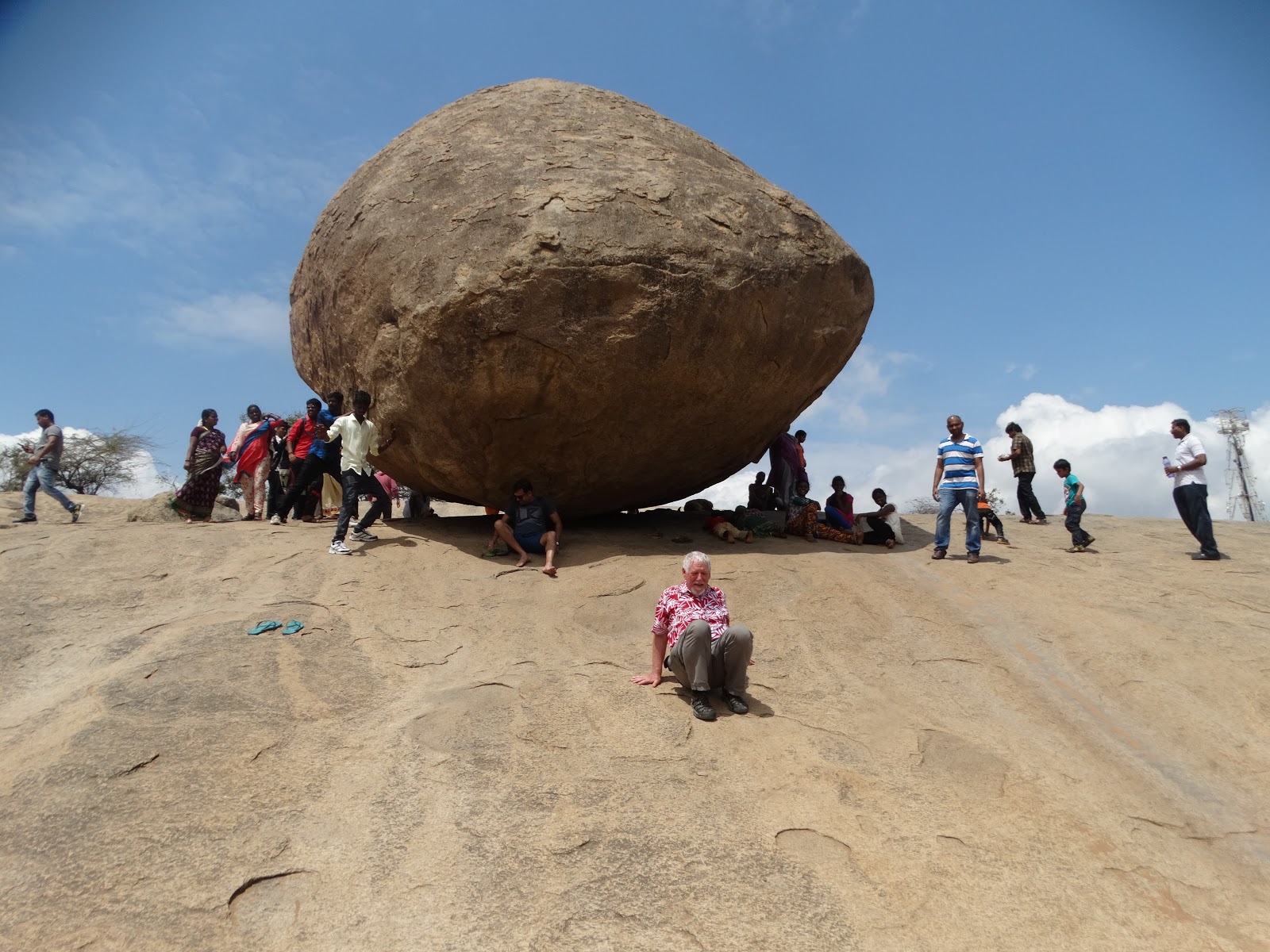
One of the rocks in the park is uncut and original, left alone. The locals call it Krishna’s butterball, it does look like that. Like a ball of butter balanced on a slanted surface. I tried to push it over, as others also tried, but nobody was a Hercules.
Kids Were Having Fun Sliding Down
the Sandy, Rocky Slope - So Why Not?
Holding Up This Gigantic Rock

For lunch we stopped in a wonderful hotel restaurant. It was modern, perfectly clean, neatly dressed people were around who were well trained, great food and smiles all around us. An Indian woman approached our table hearing us speak English. She wore western clothing, kind of like a western business suit for women. We had been told she was a Canadian from the west coast and owns and runs this hotel/restaurant. She does everything the Western way and it shows. The place is like a Swiss clock, it is run perfectly. This place is a winner.
The View From Our Lunch Room at L' Attitude Restaurant
On the way back to our hotel, in the bus, Lakuma touched on the difficulties facing modern India. As in the Western world, women today need to work in order to make ends meet. As in any other place, education costs money, and money does not grow on trees. People get old and fragile, where do you put them? People in India retire at age 58. The old setup in India with the parents being taken care of within the family is deteriorating because the modern family in India is westernizing. How do you really feel about women's rights? The discussions were about total equality, even in getting paid equally and letting women do men’s jobs and vise versa. Whatever we face in the West, India faces as well, only more so because India has such a strong family culture. The extended family in India goes back for generations, everything is interconnected.
Many Women Work Hard

I was told Hindus have essential people in their life, people that are needed for every Hindu. I wrote about it earlier. Those people are a blessing but can hold you back too, especially if you feel you need to care for all of them, as in an extended family. What to do? The courts do not have all the answers. The issue of 2 men wanting to get married has passed all lower courts but the case has been stuck at the Supreme Court of India for the last 10 years. It now demands a constitutional ruling, setting a huge precedence for the future, affecting many related issues.

A Few Women Ride Their Own Mopeds But They Have to
Change Their Style of Dress and They Do Not Like to Cover
Their Hair With a Helmet.
 
How do you legally handle all of that? The western nations are not alone in working out the rules for the new world. India has a heritage that is amazing, beautiful and very complex. India went through many changes; the people who lived along the Indus River millennia ago had a different life. Alexander the Great, Islam, Christianity, Imperialism, the EIC, the Moguls etc. all had a huge effect on India but also India affected them, too. It was and is a reversal influence, a mix of experiences, beliefs and cultures. India somehow keeps on functioning. Sure they have traffic rules, but drive in India for awhile and you will see that traffic flows well even ignoring all those rules. India will solve her issues, one day at a time. And we all can learn from how India somehow manages.

We need to go to bed early tonight; we need to get up at 3 am for the train ride to Mysore tomorrow.


Thursday, May 25, 2017

To Chennai (Madras)


We had to fly to Mumbai, then change planes and fly to Chennai. Chennai is on the East Coast of India whereas Mumbai is on the west coast. Lots of flying but all went smoothly. Fiona and Gary had it all under control, still I missed Dinesh.
Lakuma, Our New Local Guide

Arriving in Chennai in the middle of the afternoon we checked into our hotel and then immediately started our city tour. Our new guide was Lakuma who has a Doctorate Degree in Tourism with a focus on the history of South India. She wore a pretty sari and was very proud of her Indian heritage. We had some drive-byes of the buildings formerly run by the East India Co; it was somewhat of a blur. Many of the former large British buildings are now Indian Government offices. Unfortunately they look dated and I am not sure how efficient they are for today's economy or politics. Our one main stop, before it closed at 5 pm was St. Mary’s Church, the oldest Anglican Church east of Suez. Built in 1680, it is to my Western mind just an old church, nothing special,
Inside St. Mary's Church
albeit the apparatus to operate the fans to create some kind of air movement during service was ingenious. Several slaves stood outside the Church pulling on ropes attached to pulleys which moved large paddles to “fan” the pious crowd inside.

Two Kids Waiting to Make Their First Communion
At St. Mary's Church
Madras (Chennai) was just a fishing village before the Portuguese, the Dutch, and then later the English came. The big change to the area happened on Dec. 31, 1600. Queen Elizabeth 1st of England granted a royal charter to the famous East India Company (EIC) which grew to do business on a grand scale, unprecedented until that time. The EIC was given a monopoly of trade east of the Cape of Good Hope and West of the Straits of Magellan. This would be all trade in the Pacific between Africa and America. The company made good use of this charter, renewing it again in 1609 with King James 1st. The money made by EIC was astronomical. In 1639 the EIC founded Madras, known today as Chennai when they received permission from the Mogul Leader to trade and establish themselves throughout his kingdom (India). With that agreement, international politics exploded. Self-serving politics entered the trading world and with many ups and downs, wars, pirates, betrayals, expansionism, etc., etc. The company lasted until 1858, when it  was dissolved by order of Great Britain.

The power struggle between the Moguls and the British caused all kinds of wars to start here. Naturally the French, Dutch, Portuguese, etc., were involved or wanted a slice of the total business and to a degree got it, yet the EIC was by far the biggest, most powerful trading company, maybe ever. And all we visited was St. Mary’ Church? Well, Lakuma was not Dinesh. Lakuma however told us the following while riding in the bus:
A Well-Balanced Load

 Madras was the name only the English used, Chennai was the name of the town for ages in the Tamil Nadu language, the Indian language spoken here. Whenever, among Indians, the town was written down in their native script, it was always written as Chennai, never Madras. Madras was only used when speaking or writing in English. The name Madras was taken from the first fishing village that was there when the English came, Madraspatnam. A cotton cloth, produced in this area, was light weight and cool to wear in summer. Originally it was a printed over cloth, workers would wear but the big sales came when plaid woven cotton fabric was used. This plaid fabric was made using vegetable dyes that bled when washed; creating a ‘blurry’ plaid that was the epitome of style at one time. The faults in the yarn, the slubs and nubs the cloth had, the bleeding of the dye colors, all the negatives were advertised as being unique and ‘ the real thing ‘, it was only due to advertising that an inferior product became a fashion statement. Brooks Bros. was the leading fashion house that started this trend.
Flower Seller

There are 29 States within India, 22 speaking their own language, and some even have their own writing system. To be able to speak to each other, Hindi, the native language of Hindustan is used and all numbers are the internationally used numbers. Only in 2010 did the high court of Gujarat rule on making this official. The written system must be the Devanagari script. All official government writings are in English, too.

Chennai population changes over the course of the year. While it is believed that the core population is around 6 million, the seasonal swell of workers and tourists can bring it to 10 million and more.

The main road in Chennai runs from the airport to downtown, 17 km long. The house numbers run consecutively in a clockwise fashion, so the house across the street has a totally different number, not even close to your house number.
Happy Kids

Temperatures can reach 45C in summer and water is very precious. Monsoon rains are needed to refill reservoirs or soak the fields. Chennai has not had monsoon rain for the last 4 ½ years. Cyclones (hurricanes) bring some water but a steady, daily rain (monsoon) is needed desperately.

Chennai’s main industries are: automobiles, leather production, salt, rice sugar and mango production (mango is not a native fruit for Tamil Nadu).

Historically cotton and silk were main products but because of international pressure those commodities have mostly been abandoned in this region.
Kapaleeshwar Temple
Our group visited the Kapaleeshwar Temple, an ancient temple dedicated to Lord Shiva. It is said that Lord Shiva pinched off a head of Lord Brahma to arrest his pride. The crestfallen Lord Brahma came to this spot and did penance. Carol and I took some time off and did not enter the temple. We are getting “templed” out.


Close Up of Some of the Carvings On the Temple


We also drove along the famous Marina Beach (2nd longest public beach on earth – Miami is longest). It is a wide beach, busy with people but the ocean waters are not conducive to swimming, too dangerous with currents and pollution.  At each end of this long, 50 km long, beach are salt works, salt is extracted for use and export. We did not see the salt works.

Phew! It was a long day.  We called it quits for day one, the traveling, the flights and the heat wore us out.


Marina Beach


Asking Directions At the Beach


Monday, May 15, 2017

Udaipur, Day 2


City Palace From the Water
Water, (2 man-made lakes) means boat rides. Come all aboard for a leisurely put-put around Lake Pichola. The City Palace (which we explored yesterday), has steps leading into the Lake, flamboyant
areas for boats to dock, marbled grandeur that today looks forgotten and forlorn. Ah, the good old days of the princely state are gone. I can just imagine the pomp and circumstance surrounding the comings and goings of the Maharana.

Summer Palace In the Middle of the Lake
In the middle of the lake was his Summer Palace, a place to get the cool breezes off the water, to cool down in summer. Lucky us that know A/C, it must have been hot with all the heavy gold clothes that were worn years ago. We just circled around the Summer Palace and saw some of the houses the elite, rich merchants and diplomats built on the shore. It was impressive housing for their time but today some are being rebuilt and others just need more help. One large section on a peninsula is today a hotel complex, rated by Trip-Adviser as one of the best. The Leela Palace Hotel is about US$ 500/night and worth it according to our guide.

Landing on Pleasure Island
Our group disembarked on a smaller island known as the Pleasure Island. In olden days it was just for secluded parties and romantic tête-à-têtes. Today unfortunately, it is used as a concert venue, tourist stops and for large conventions or weddings which ruins the peacefulness here.

Wedding Preparations


Sweeping the Grass In Preparation For the Wedding
Note Another Broom Behind the (R) Hand Bush


Beautiful Blossoms


Our next stop was a long exploring walk through Udaipur’s shopping street. I wanted to find something to take home for the grandchildren but the area was not suitable for that. Even Carol could not find the appropriate cotton top she was looking for. Western and Indian tastes run counter to each other.

Entrance To the Ornamental Gardens
So back we went to explore a garden complex, the Saheliyon Ki Bari (Maiden Garden), an ornamental garden built in 1710 to 1734 by the King. He surprised his queen and her entourage of 48 maidens with this cool spot near one of the lakes as a gift. Here the Harem could take off their facial veils and be just among women and be free from the intrigue of the palace court. No men were allowed.

Rain Without Clouds Fountain


Also At the Entrance To the Gardens


A Favourite, Lily Pond Fountain
  Sectioned off garden areas have names which translate to:
Rain Without Clouds (fountains sprayed water into the air)
Lilly Pond Fountain (numerous water lilies)
Sounds Like in a Rain-forest, etc.
Many Flowers Blooming In These Gardens
Each section had a small Palace and a theme in statues and displays, all had water splashing about that came from the nearby lake and cooled the air. The setup was sophisticated and clever and I am sure the women loved it then more than we can image today.

Another visit to an art shop, this one picked by Dinesh gave me another chance to buy a miniature painting. I could not resist, it will be shipped to the house. Krishna and a lover; a night scene and a bit dark, but we like it.  It is painted on camel bone. Unique, not something you find every day.
Miniature Painting, Krishna With Flute and Lover
 Carol found something in cotton, a robe; hand printed and very well made and a bargain to boot, for me and for Carol. Dinesh knows his spots.

Back at the hotel the wedding preparations for the Indian Wedding were in full swing. Henna hand painting was happening for the women in the wedding party, the women were showing off their colorful saris, men needed help with their dress shirts. It was a bit of a pandemonium but in a good, happy way. Music was barely audible from the dance floor at the far corner of the Palace where our rooms were. The night was soft and mild and clear.
Dinesh and Hans, Hangin' Out In the Shade

The only sour note to all of this was the news that Dinesh could not finish the trip with us. Nobody
told me why but we were just told that Dinesh will stay behind. It was like taking an ice water shower, not pleasant, shocking even. He was a great guide; he has what it takes to make an ordinary trip extra ordinary.

We will miss you Dinesh.


More Pictures of Udaipur


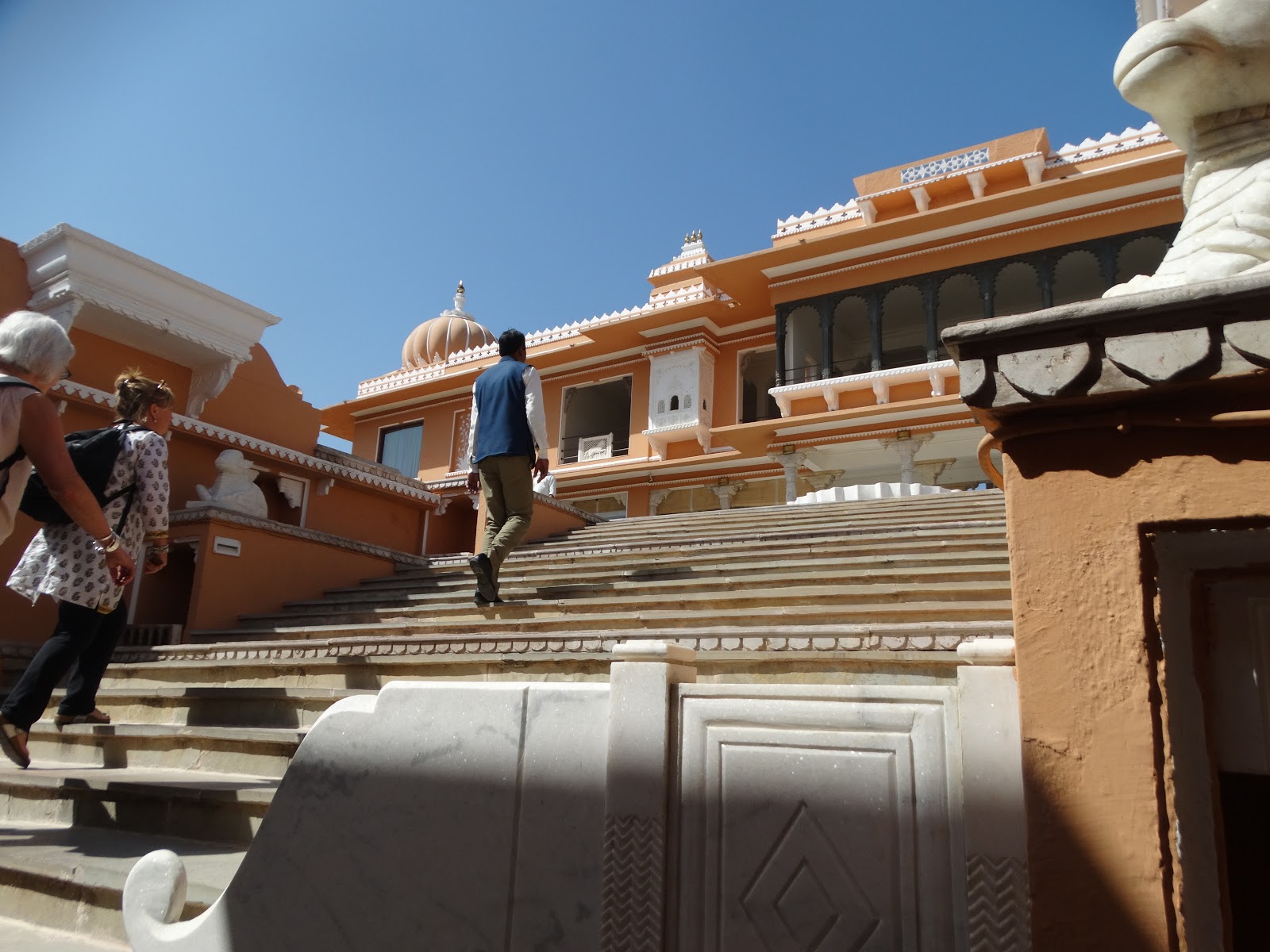
Fateh Garh Palace Hotel


Hotel Was Beautiful But Too Many Stairs


Being Welcomed With Rose Petals


A Rose Water Welcome Drink


Painting On the Wall In the Lobby

Part of the Wedding Party

Also Part of the Wedding Party


Spectacular Views
This Beautiful Woman Was Our Housekeeper


Wedding Preparations


Ganesh


Tile Work


Indoor Fountain

This is a Picture of the Huge City Palace
(With a Bit of Glare On the Glass


A Mirrored Room

Walls and Ceilings Decorated With Many Mini Paintings

Coloured Glass Windows